
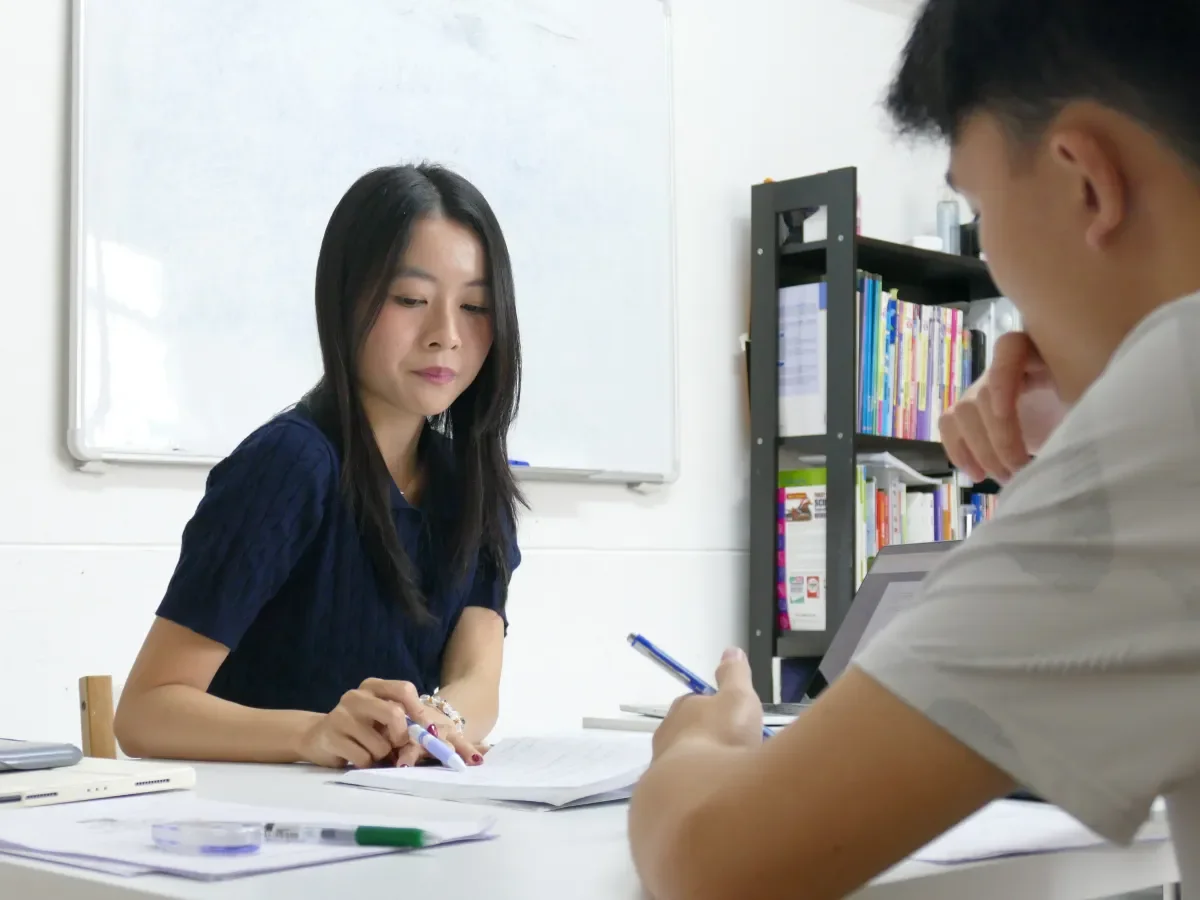
Secondary science in Singapore splits into two distinct pathways from Secondary 3 — Pure Sciences (Physics, Chemistry, Biology) and Combined Science — and choosing the right tuition approach for each pathway is essential for O-Level success. Whether your child is tackling Pure Physics equations, balancing Combined Science Chemistry and Biology demands, or preparing for the new SEC examinations from 2027, understanding what secondary science tuition should deliver helps you make informed decisions. This guide from Ancourage Academy explains the secondary science landscape, why students struggle, and what effective tuition in small groups of 3 to 6 looks like.
With years of experience teaching secondary science across all three disciplines, Gabriel has helped students at Ancourage Academy develop the analytical skills that O-Level science demands.
What Science Subjects Are Available at Secondary Level?
Secondary science in Singapore follows the MOE secondary curriculum: one general Science subject in Sec 1-2, then from Sec 3 a choice of Pure Physics, Pure Chemistry and Pure Biology (6091-6093 → K323-K325) or Combined Science in three pairings — Chem/Phy, Phy/Bio and Chem/Bio (5086-5088 → K326-K328).
If your child needs Science support, Ancourage Academy at Bishan and Woodlands offers targeted Secondary Science tuition in small groups of 3–6 — book a trial class (usually $18) for a diagnostic assessment.
In Lower Secondary (Sec 1-2), all students take a general Science course covering foundational Physics, Chemistry, and Biology concepts — the lower-secondary integrated science syllabus (see the lower secondary tuition guide for a full overview of the Sec 1-2 experience). The critical decision point arrives at the end of Secondary 2, when students choose their Upper Secondary subject combination. Under Full Subject-Based Banding (Full SBB), science subjects can be taken at G1, G2, or G3 level, giving students more flexibility than the old streaming system allowed. The table below covers the G3 options that Ancourage supports.
The available science options from Secondary 3:
| Subject | SEAB Code (O-Level / SEC 2027) | O-Level Grades | Papers | Total Duration |
|---|---|---|---|---|
| Pure Physics | 6091 / K323 | 1 separate grade | Paper 1 (MCQ) + Paper 2 (Theory) + Paper 3 (Practical) | ~4 h 35 min |
| Pure Chemistry | 6092 / K324 | 1 separate grade | Paper 1 (MCQ) + Paper 2 (Theory) + Paper 3 (Practical) | ~4 h 35 min |
| Pure Biology | 6093 / K325 | 1 separate grade | Paper 1 (MCQ) + Paper 2 (Theory) + Paper 3 (Practical) | ~4 h 35 min |
| Combined Science (Chem/Phy) | 5086 / K326 | 1 combined grade | Paper 1 (MCQ) + Paper 2 (Theory) + Paper 3 (Theory) + Paper 5 (Practical) | ~5 h |
| Combined Science (Phy/Bio) | 5087 / K327 | 1 combined grade | Paper 1 (MCQ) + Paper 2 (Theory) + Paper 4 (Theory) + Paper 5 (Practical) | ~5 h |
| Combined Science (Chem/Bio) | 5088 / K328 | 1 combined grade | Paper 1 (MCQ) + Paper 3 (Theory) + Paper 4 (Theory) + Paper 5 (Practical) | ~5 h |
Each Pure Science produces a separate O-Level grade that counts individually in the L1R5 (L1R4 under the 2028 PSE) aggregate. Combined Science produces only one grade covering two disciplines. This structural difference has significant implications for JC admission — a student taking two Pure Sciences has two science grades available for the L1R4 aggregate, while a Combined Science student has only one. Full syllabus documents are available on the SEAB website. From 2027, these O-Level codes transition to the new SEC G3 syllabus codes shown alongside them — K323 (Physics), K324 (Chemistry), and K325 (Biology) for the Pure Sciences, plus K326 (Chem/Phy), K327 (Phy/Bio) and K328 (Chem/Bio) for Combined Science; see Ancourage Academy's SEC examinations 2027 guide for the full transition.
Pure Science vs Combined Science: Which Should My Child Take?
The choice between Pure Science and Combined Science (see our Pure vs Combined Science FAQ) is not simply about difficulty — it is a structural decision that affects the JC admission aggregate (L1R4 under the 2028 PSE, which every student choosing now will be posted under; L1R5 only for the final 2026 O-Level cohort), JC H2 Science eligibility, and university course prerequisites. Many parents assume Combined Science is "easier," but a student who is strong in Chemistry but weak in Physics will find Combined Science (Chem/Phy) frustrating because a poor Physics component drags down the overall grade. For a detailed comparison of content depth, exam structure, aggregate contribution, and university pathway implications, see Ancourage Academy's Combined Science vs Pure Science guide. A practical rule: if your child is considering any STEM pathway at university, Pure Sciences keep the most doors open.
Why Do Students Struggle with Secondary Science?
Upper Secondary Science is one of the steepest jumps in Singapore education for five addressable reasons: a larger content volume, heavier mathematical demands, more abstract reasoning, a bigger recall burden, and exam technique that must match mark-scheme conventions.
Content volume and mathematical demands: Upper Secondary science demands quantitative rigour. Pure Physics alone covers kinematics, electromagnetic induction, nuclear physics, and wave phenomena — each requiring mathematical application, not just conceptual understanding. Students who are comfortable with E-Maths concepts like algebra and trigonometry perform significantly better in Physics. A student who cannot rearrange v = u + at to find t has an algebraic problem, not a physics problem.
Abstract reasoning and memory burden: Chemistry requires reasoning about invisible particles — mole calculations, chemical bonding, and organic chemistry demand abstract thinking that is fundamentally different from Lower Secondary experiments. Biology contains the most factual content of the three sciences, requiring both memorisation and application of detailed processes to unfamiliar experimental scenarios.
Exam technique gaps: The most common pattern Ancourage Academy tutors observe: students who understand concepts but cannot score marks. Science exams demand specific answering conventions — defining terms precisely, structuring explanations with cause and effect, using keywords that match mark schemes. See Ancourage Academy's secondary science strategies guide for detailed exam technique advice.
What Makes Effective Science Tuition?
Effective secondary science tuition addresses three layers simultaneously — conceptual understanding, mathematical competence, and exam technique — because weakness in any one layer undermines performance regardless of strength in the other two.
Conceptual Foundation First
Before any practice paper work, students need genuine understanding. In Physics, this means grasping why current flows in a circuit, not just memorising V=IR. In Chemistry, it means understanding why ionic compounds have high melting points through electrostatic attraction reasoning, not just reciting the fact. In Biology, it means understanding the logic of natural selection, not just listing the four conditions. Tuition that skips straight to drilling past papers produces students who can solve familiar questions but collapse on novel problems — exactly the kind the SEAB favours in examinations.
Mathematical Integration
Physics tuition without mathematical support is incomplete. Effective science tuition identifies whether a student's Physics difficulties are actually mathematics difficulties in disguise. Ancourage Academy's science tutors have found that students who struggle with Pure Physics typically have gaps in mathematical application rather than scientific concepts — addressing the maths foundations first often unlocks rapid improvement in physics problem-solving. If a student cannot rearrange v = u + at to find t, the problem is algebraic, not physical. The best science tuition coordinates with the student's secondary Maths support to close these gaps simultaneously.
Structured Exam Practice
After conceptual understanding is secure, students need deliberate practice in answering format. This means practising how to write a 3-mark explanation (statement, reason, consequence), how to draw and label diagrams correctly, how to structure "describe and explain" answers, and how to manage time across MCQ and structured sections. Each science has its own answering conventions, and students need explicit instruction in these — they do not develop naturally from content study alone.
Practical Skills Development
The practical component (Paper 3 for Pure Sciences, Paper 5 for Combined Science) tests planning, observation, recording, analysis, and evaluation skills. While tuition centres cannot replicate full lab sessions, effective tuition teaches students how to read practical question formats, plan experiments with controlled variables, draw results tables, plot graphs correctly, and evaluate sources of error — see how to prepare for the science practical (lab) exam for a full breakdown of these skills, which are highly teachable and consistently rewarded in examinations.
Sec 3-4 Pure and Combined Science Tuition: How Ancourage Academy Teaches Secondary Science
Ancourage Academy teaches Pure Physics, Pure Chemistry, Pure Biology, Combined Science (Chem/Phy), and Combined Science (Chem/Bio) in small groups of 3-6 students — small enough for every student to receive individualised attention on their specific weaknesses.
Ancourage Academy's approach to secondary science tuition is built on the ESB methodology:
- Ebbinghaus (spaced repetition): Science involves enormous factual content. Ancourage Academy schedules systematic revision of previously covered topics to prevent the "learn and forget" cycle. A Chemistry student revising organic chemistry is periodically tested on earlier topics like mole calculations and chemical bonding to ensure long-term retention
- Socratic (guided discovery): Rather than lecturing, Ancourage Academy tutors use targeted questions to guide students toward understanding. "What happens to resistance when you add another resistor in parallel?" is more effective than stating the answer — because the student who reasons it out remembers it
- Bruner (progressive complexity): The programme builds from simple to complex within each topic. A Physics student learning electromagnetic induction starts with basic magnetic field concepts, progresses to Faraday's law, then tackles Lenz's law applications — each step building on confirmed understanding of the previous one
What Sets Ancourage Academy's Science Tuition Apart?
Beyond the ESB methodology, Ancourage Academy teaches Physics and Chemistry as separate subject-specific classes, coordinates maths and science teaching when a Physics struggle is really a maths gap, adapts to each student's G-level, aligns revision to the school's own exam schedule, and reports progress to parents regularly.
- Subject-specific classes: Physics and Chemistry are taught separately, not lumped together. Combined Science students attend dedicated Combined Science sessions aligned to the specific syllabus (5086 / K326, 5087 / K327, or 5088 / K328)
- Maths-science coordination: Ancourage Academy tutors identify when a Physics struggle is actually a maths gap, and coordinate with the student's maths tuition (whether at Ancourage or elsewhere) to close the gap
- G-level awareness: Under Full SBB, a student may take Science at G3 but another subject at G2. Ancourage Academy's small classes accommodate individual G-level needs
- School-aligned preparation: Ancourage Academy tracks each student's school exam schedule, including weighted assessments and prelim patterns, to ensure revision timing is precise
- Progress tracking: Parents receive regular updates on their child's understanding and exam readiness in each science topic
"Most students who struggle with Physics are actually struggling with mathematics in disguise. Once you address the algebraic foundations, the physics concepts click into place remarkably quickly."
— Gabriel, Economics and Mathematics Educator
Ancourage Academy offers classes at both the Bishan and Woodlands centres. View our full Secondary Science programme led by science tutors (Sec 1-4) or start with a trial class (usually $18) to experience the teaching approach and receive a diagnostic assessment of your child's current science level. You can also WhatsApp us if you have any questions.
How to Choose Between Science Tuition Options
Choosing the right science tuition involves three decisions: timing, diagnosis, and format — and getting each one right determines whether tuition produces results.
When to start: The optimal window is Sec 2 Term 4 or Sec 3 Term 1, when students first encounter the full Pure or Combined Science syllabus. Starting in Sec 4 is still effective but compressed — gaps must be identified and addressed within 9-10 months. Students who wait until after Sec 3 year-end exams often discover that accumulated conceptual gaps make Sec 4 revision significantly harder than it needs to be. Ancourage Academy's Sec 4 Physics, Sec 4 Chemistry, and Sec 4 Biology programmes are designed for this intensive O-Level preparation phase.
Maths-based or science-based struggle? Before committing to science tuition, assess whether the difficulty is genuinely scientific or mathematical. If a student struggles specifically with Physics calculations, circuit analysis, or Chemistry mole calculations, the root cause may be algebraic weakness rather than science misunderstanding. A diagnostic assessment that tests both science concepts and the underlying maths skills reveals where intervention will have the most impact. Ancourage Academy's trial class assesses both dimensions.
What to evaluate in a trial class: Look for three things: whether the tutor diagnoses specific gaps rather than teaching generically, whether explanations build understanding before introducing procedures, and whether the class size allows the tutor to check each student's working individually. A tutor who lectures to 20 students cannot identify individual misconceptions. In Ancourage Academy's groups of 3-6, every student's reasoning is visible and correctable in real time. Browse our Science learning hub for more O-Level / SEC Science guides.
Common Questions About Secondary Science Tuition
When should my child start science tuition?
Ideally at the start of Secondary 3, when students encounter the full Pure or Combined Science syllabus and early gaps compound rapidly. Students who begin in Sec 4 can still improve with focused preparation. Ancourage Academy recommends booking a trial class (usually $18) early to assess your child's starting point.
Does my child need tuition for both Pure Physics and Pure Chemistry?
Not necessarily. A diagnostic assessment identifies which science needs support — some students need Physics tuition due to mathematical weaknesses, while others need Chemistry help with mole calculations and organic chemistry. Ancourage Academy's pricing allows you to choose subjects based on actual need.
Is Combined Science tuition different from Pure Science tuition?
Yes. Combined Science covers reduced depth across two disciplines with a different exam format. Effective tuition must address both disciplines efficiently and prioritise high-weightage topics. Ancourage Academy runs dedicated Combined Science (Chem/Phy) and Combined Science (Chem/Bio) sessions.
Can my child switch from Combined Science to Pure Science?
Very difficult once Upper Secondary begins — the decision is typically made at the end of Sec 2 and is hard to reverse. Discuss with school science teachers and consider a diagnostic assessment.
How does science tuition help with the practical exam component?
Ancourage Academy teaches practical exam skills (our science practical FAQ covers the format): planning experiments, drawing results tables, plotting graphs, calculating gradients, identifying errors, and writing data-supported conclusions. These skills are tested in Paper 3 (Pure Sciences) and Paper 5 (O-Level / G3 Combined Science — G2 Science has no practical paper) and respond well to structured practice.
My child understands concepts but scores poorly — what is wrong?
Almost always an exam technique problem. Science exams require precise keywords, cause-and-effect structuring, and answering conventions that differ between Physics, Chemistry, and Biology. A student who "understands" but uses imprecise language loses marks consistently. Ancourage Academy's tuition explicitly teaches these answering conventions alongside content.
Related: Combined Science vs Pure Science · Secondary science answering methods · Lower Secondary Subjects Overview · Comparing E-Maths and A-Maths · G2 vs G3 Subject Levels · Pricing · O-Level Science Preparation for Bishan Secondary Schools guide · O-Level Science for Woodlands