
Primary Mathematics Tuition
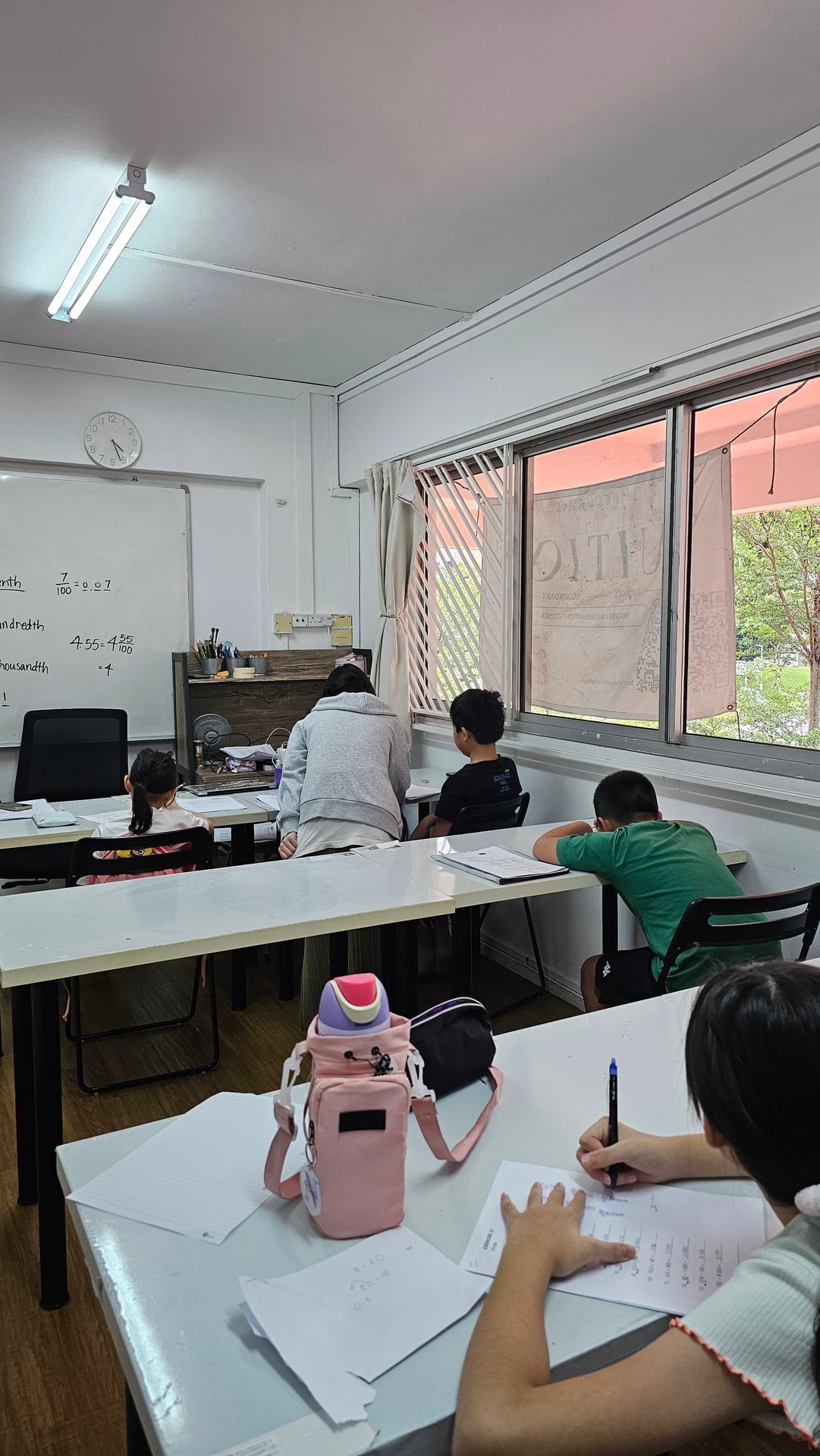
Ancourage Academy's Primary Mathematics tuition covers P1 to P6, fully aligned with Singapore's MOE Mathematics syllabus. Our small classes of 3-6 students at tuition centres near Bishan MRT and Woodlands South MRT build number sense, problem-solving heuristics, and model drawing skills progressively across all six primary levels. Lower primary (P1-P2) establishes strong foundations in whole numbers, addition, subtraction, multiplication, and basic measurement. Middle primary (P3-P4) develops fluency in fractions, area and perimeter, angles, and extends bar model problem-solving into multi-step questions. Upper primary (P5-P6) tackles ratio, percentage, average, algebra, geometry, and data analysis — with intensive PSLE preparation including heuristics strategies like guess-and-check, working backwards, before-after models, and units and parts methods. Our ESB methodology — combining Ebbinghaus spaced retrieval for long-term formula and method retention, Socratic questioning to develop mathematical reasoning, and Bruner's concrete-pictorial-abstract approach — ensures deep understanding, not rote memorisation. All materials are included with no registration fees, and parents receive regular progress updates plus 24/7 WhatsApp homework support.
Reviewed by Min Hui, Founder & Academic Director ·
At a Glance
Key details about our Primary Mathematics tuition programme, including class size, locations, and exam focus.
| Subject | Mathematics |
|---|---|
| Levels | P1 - P6 |
| Class Size | 3-6 Students |
| Locations | Bishan & Woodlands |
| Exam Focus | PSLE |
| Trial | Free (usually $18) |
What Your Child Learns at Each Level
Our Mathematics programme takes students from P1 to P6, building from number sense all the way to PSLE readiness
Number Sense
- •Numbers to 100
- •Addition & subtraction
- •Shapes & patterns
- •Multiplication basics
Multiplication
- •Numbers to 1,000
- •Multiplication & division
- •Halves & quarters
- •Length, mass, volume
Fractions
- •Fraction equivalence
- •Bar model method
- •Angles & geometry
- •Data handling
Decimals
- •Decimals & operations
- •Area & perimeter
- •Factors & multiples
- •Multi-step problems
Percentage & Volume
- •Percentage applications
- •Rate problems
- •Volume & geometry
- •Advanced heuristics
PSLE Year
- •Ratio, average & algebra
- •All heuristics
- •Exam strategies
- •Timed practice
How We Teach Mathematics
Our ESB methodology adapts specifically to mathematics learning — building lasting understanding through evidence-based teaching strategies.
Ebbinghaus Memory Theory
For Mathematics, spaced retrieval means revisiting multiplication tables, fraction concepts, and heuristic methods at expanding intervals — weekly topic quizzes and monthly mixed reviews ensure formulas and problem-solving strategies stay accessible under exam pressure.
Socratic Questioning
In Maths class, we ask 'Why did you choose that method?' and 'What happens if the question changes this number?' — probing questions that reveal whether students truly understand the concept or are just following memorised steps.
Bruner's Scaffolding
Maths concepts progress from concrete manipulatives (counting blocks, fraction strips) to pictorial models (bar diagrams) to abstract equations — each stage building on the last so students develop genuine number sense, not just procedural recall.
“The key to PSLE success isn't last-minute cramming — it's building strong foundations in Primary 4 and 5. Students who master fundamentals early have the confidence to tackle challenging problem sums without panic.”

What Mathematics Challenges Do Students Face?
These are the most frequent difficulties we help Primary students overcome
- Struggles with multiplication tables beyond 6x and 7x, leading to slow calculations in upper primary
- Cannot set up bar model drawings correctly for multi-step word problems
- Confuses fractions, decimals, and percentage — cannot convert between them fluently
- Runs out of time on PSLE Paper 2 because of disorganised working
- Memorises heuristic procedures without understanding when to apply each one
- Careless mistakes in basic operations that cost marks on otherwise correct solutions
How Do We Prepare for PSLE Mathematics?
Understanding the PSLE Mathematics format — 2 components with targeted strategies for each
Paper 1
MCQ & short answer, no calculator
50 marks · 1h 10min
Paper 2
Structured & long answer, calculator allowed
50 marks · 1h 20min
Our Exam Strategies
- Systematic elimination for MCQ — use estimation and boundary checking
- Show complete working for Paper 2 to earn method marks even if the final answer is wrong
- Heuristic identification — train students to recognise which heuristic fits each question type
- Time management — allocate 1 minute per mark and leave 5 minutes for checking
Source: SEAB PSLE Examination Information
References: MOE Primary Maths Syllabus · SEAB PSLE Format
Why Choose Ancourage for Mathematics?
Proven results with a personalised approach to mathematics learning
Small Class Sizes
3-6 students per class for focused attention
MOE-Aligned
Curriculum follows MOE syllabus closely
PSLE Experts
Teachers experienced in PSLE preparation
Heuristics Training
All 12 PSLE heuristics taught systematically
What’s Included
Everything every student receives — no hidden costs
No Registration or Material Fees
All worksheets, notes, and learning materials included
24/7 WhatsApp Support
Direct access to teachers for homework help between lessons
Progress Reports & PTC
Regular updates plus annual Parent-Teacher Consultation
Tailored Learning Materials
Resources targeted to each student’s core needs
Flexible Scheduling
Weekly reminders, plus replacement lessons and schedule adjustments on 24 hours' notice, subject to availability
Competition Support
Help with academic competition registration and preparation
Primary Mathematics classes are also available online — live via Microsoft Teams, island-wide, with the same teachers and small groups of 3-6. Learn about online classes
Deepen Your Learning
Comprehensive topic guides covering everything in this subject area.
PSLE
Everything parents and students need to know about the Primary School Leaving Examination — from subject-specific strategies to scoring, stress management, and school selection.
Browse guide →Mathematics
Your complete guide to Mathematics education in Singapore — from Primary school foundations through Secondary E-Maths and A-Maths to JC H2 Mathematics and beyond.
Browse guide →Study Tips & Exam Prep
Practical study tips and exam preparation strategies that work — from effective revision techniques and time management to past year paper strategies and exam day tips for Singapore students.
Browse guide →
Frequently Asked Questions
Yes — Ancourage Academy runs small-group primary maths tuition (P1-P6) led by experienced maths tutors at our Bishan and Woodlands centres. Each class is a dedicated tutor guiding a group of 3-6 children through number sense, model drawing, and PSLE problem sums. Your first trial class is usually $18.
Our trial class is usually $18. Regular fees vary by level — P1-P2, P3-P4, and P5-P6 each have different rates reflecting lesson complexity and PSLE preparation demands. Contact us for the latest pricing. We keep our rates competitive for small-group maths tuition of 3-6 students at our Bishan and Woodlands centres.
We recommend starting early to build strong foundations. P1-P2 is ideal for number sense and multiplication tables. If your child is struggling with word problems or model drawing by P3-P4, tuition can help fill gaps before upper primary demands increase.
Our P5-P6 programme covers all PSLE Mathematics topics: whole numbers, fractions, decimals, ratio, percentage, average, algebra, geometry, area and volume, and data analysis. We place particular emphasis on the MOE problem-solving heuristics — including model drawing, working backwards, and guess-and-check — that are essential for Paper 2 long-answer questions.
With only 3-6 students per class, our teachers identify each child's specific gaps — whether it's multiplication table recall, model drawing, or multi-step problem-solving — and provide targeted practice. This is more effective than large-class tuition where students may be too shy to ask questions.
Yes, our curriculum is fully aligned with the MOE Mathematics syllabus, covering all three content strands — Number and Algebra, Measurement and Geometry, and Statistics — at the correct level. We supplement school content with additional heuristics drills, past-year paper practice, and exam techniques that build confidence beyond the standard textbook approach.
P5 introduces percentage, rate, and advanced heuristics — these are conceptually demanding topics that many students find challenging for the first time. P6 builds on this by adding ratio, average, and algebra, then shifts to intensive PSLE revision that combines all topics into exam-style practice with timed papers and strategy refinement.
Ready to Excel in Mathematics?
Book a trial class and see how our approach helps students master mathematics.
Available at our Bishan and Woodlands centres, near Bishan MRT and Woodlands South MRT.
Serving students from nearby schools including Catholic High Primary, Kuo Chuan Presbyterian Primary, Ai Tong School, Marymount Convent School, CHIJ St Nicholas Girls' School, Admiralty Primary, Woodgrove Primary, Si Ling Primary, Innova Primary, and Fuchun Primary.
Also from Ancourage: Art classes for kids, teens & adults →