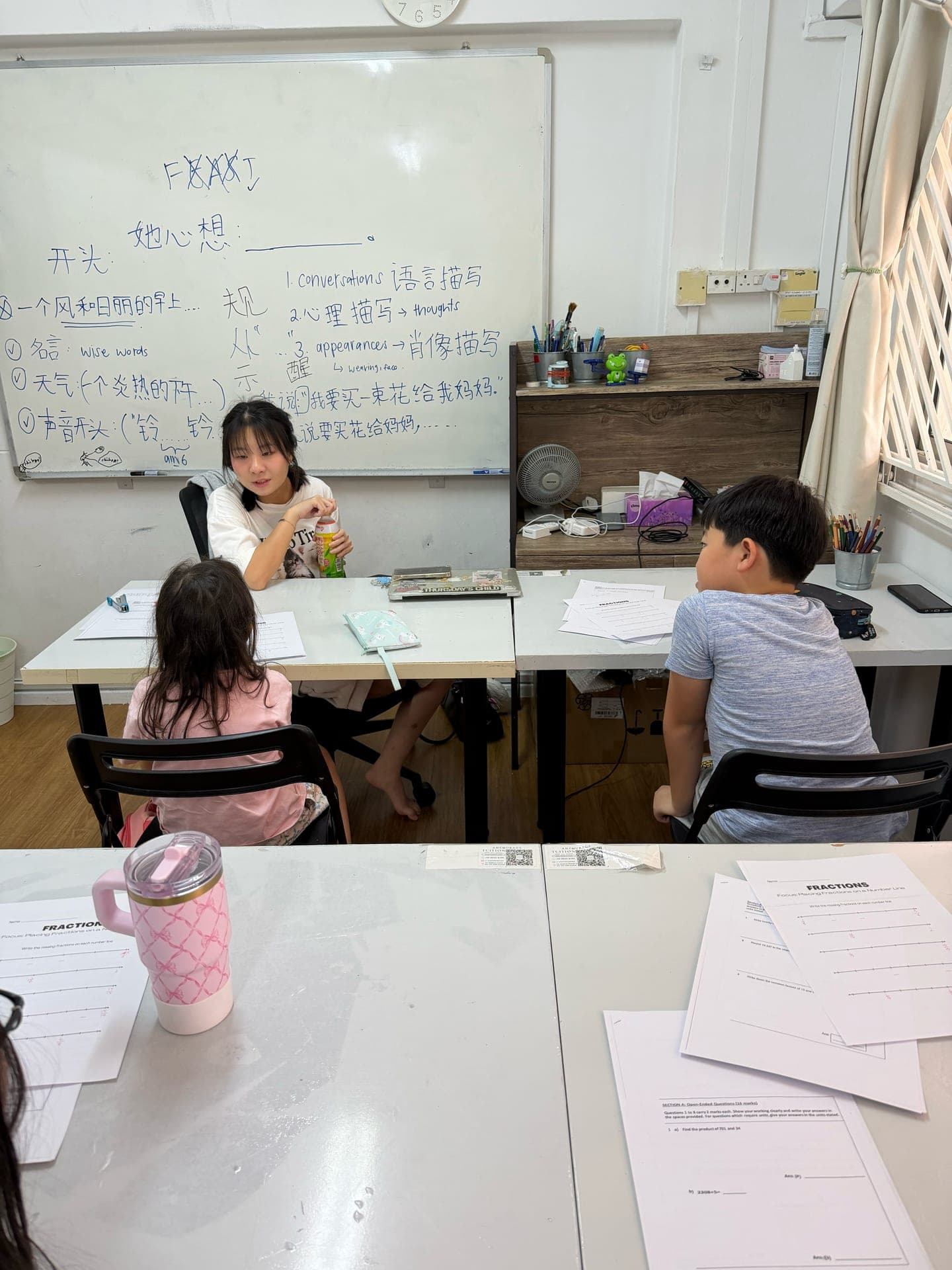
Primary Chinese Tuition
Ancourage Academy's Primary Chinese (Mandarin) tuition covers P1 to P6, fully aligned with Singapore's MOE Chinese Language syllabus. Our small classes of 3-6 students at tuition centres near Bishan MRT and Woodlands South MRT develop reading, writing, listening, and oral skills with bilingual teacher support. Lower primary (P1-P2) focuses on Hanyu Pinyin mastery, character recognition, and sentence construction. Upper primary (P3-P6) builds PSLE readiness through composition writing (作文), reading comprehension (阅读理解), oral examination (口试), and listening comprehension (听力). We also prepare students for Higher Chinese (高级华文/HCL) examinations. Our ESB methodology — combining Ebbinghaus spaced retrieval for character and vocabulary retention, Socratic questioning to develop language reasoning, and Bruner's spiral curriculum — ensures strong Mother Tongue language foundations. All materials are included with no registration fees, and parents receive regular progress updates plus 24/7 WhatsApp homework support.
Reviewed by Charmaine, Early Childhood & Primary Education Specialist ·
At a Glance
Key details about our Primary Chinese tuition programme, including class size, locations, and exam focus.
| Subject | Chinese |
|---|---|
| Levels | P1 - P6 |
| Class Size | 3-6 Students |
| Locations | Bishan & Woodlands |
| Exam Focus | PSLE |
| Trial | Free (usually $18) |
What Your Child Learns at Each Level
Our Chinese programme takes students from P1 to Higher Chinese, building from pinyin & characters all the way to PSLE readiness
Pinyin & Characters
- •Hanyu Pinyin mastery
- •Character recognition
- •Basic sentence writing
- •Oral confidence
Reading Fluency
- •Vocabulary expansion
- •Short passage reading
- •Sentence construction
- •Listening skills
Idioms & Reading
- •Paragraph writing
- •Idiom introduction
- •Inference skills
- •Oral storytelling
Essay Structure
- •Narrative essays
- •Complex sentences
- •Advanced idioms
- •Reading analysis
Advanced Expression
- •Expository writing
- •Long-form comprehension
- •Oral discussion skills
- •Higher Chinese readiness
PSLE Year
- •Composition polish
- •Comprehension accuracy
- •E-oral practice
- •Exam strategies
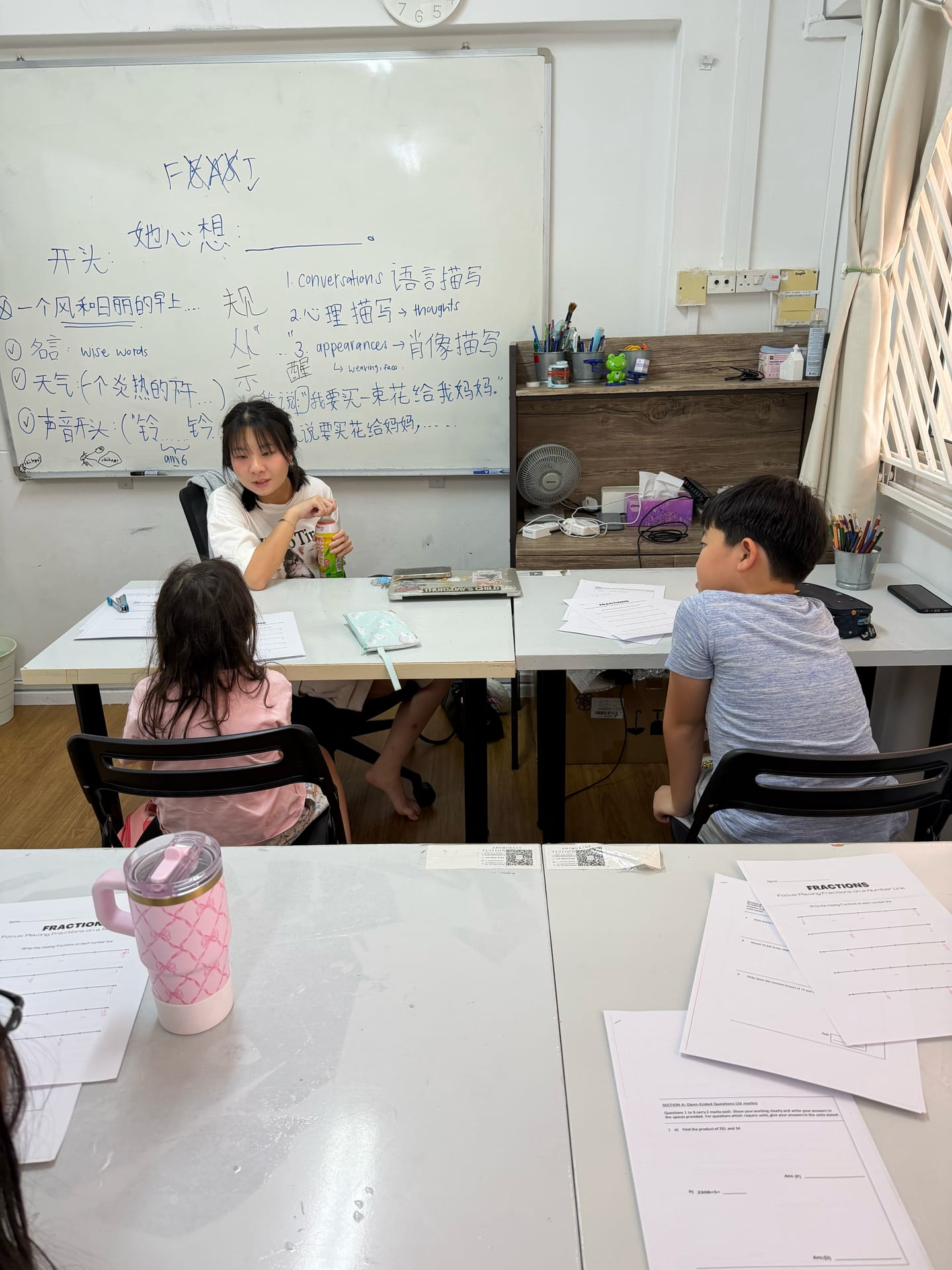
How We Teach Chinese
Our ESB methodology adapts specifically to chinese learning — building lasting understanding through evidence-based teaching strategies.
Ebbinghaus Memory Theory
For Chinese, spaced retrieval means revisiting character writing, vocabulary, and grammar patterns at expanding intervals — so students retain what they learn and can recall characters and sentence structures accurately during exams.
Socratic Questioning
In Chinese class, we ask students to explain their word choices and discuss alternative expressions — building genuine language thinking rather than rote memorisation of model essays and fixed phrases.
Bruner's Scaffolding
Chinese language skills progress from Pinyin and character recognition to sentence construction to full essay writing — each stage building confidence so students develop real proficiency, especially important for English-dominant households.
“Many children find Chinese difficult because they rarely use it outside of school. We change that by building confidence through structured reading, guided composition, and conversational practice — so Mandarin becomes a living language, not just another exam subject.”

Early Childhood & Primary Education Specialist, Ancourage Academy
SUSS · Early Childhood Specialist
What Chinese Challenges Do Students Face?
These are the most frequent difficulties we help Primary students overcome
- Cannot recall character writing — recognises characters when reading but cannot write them from memory
- Composition structure is weak — essays lack clear introduction, development, and conclusion
- Struggles with idiom usage — knows the meaning but uses idioms incorrectly in context
- Oral fluency gap — can converse casually but cannot express ideas formally during oral exams
- English-dominant at home — limited Chinese exposure outside of school makes retention harder
- Higher Chinese demands overwhelm students who are already borderline in standard Chinese
How Do We Prepare for PSLE Chinese?
Understanding the PSLE Chinese format — 4 components with targeted strategies for each
Paper 1
Composition
40 marks · 50min
Paper 2
Language Use, Cloze & Comprehension
90 marks · 1h 40min
Paper 3 (Oral)
Reading Aloud & Video Conversation
50 marks · ~10min
Paper 3 (Listening)
Listening Comprehension
20 marks · ~30min
Our Exam Strategies
- Composition planning in Chinese — use a simple outline to organise story structure before writing
- Comprehension techniques — identify question type and use evidence from passage to support answers
- Idiom and vocabulary banks — build a repertoire of commonly tested idioms for composition use
- E-oral preparation — practise responding to video stimuli with structured opinions and personal experiences
Source: MOE Mother Tongue Languages Policy
References: MOE Mother Tongue Languages · SEAB PSLE Format
Why Choose Ancourage for Chinese?
Proven results with a personalised approach to chinese learning
Small Class Sizes
3-6 students per class for focused attention
MOE-Aligned
Curriculum follows MOE syllabus closely
PSLE Experts
Teachers experienced in PSLE preparation
Bilingual Teachers
English explanations for Chinese concepts
What’s Included
Everything every student receives — no hidden costs
No Registration or Material Fees
All worksheets, notes, and learning materials included
24/7 WhatsApp Support
Direct access to teachers for homework help between lessons
Progress Reports & PTC
Regular updates plus annual Parent-Teacher Consultation
Tailored Learning Materials
Resources targeted to each student’s core needs
Flexible Scheduling
Weekly reminders, plus replacement lessons and schedule adjustments on 24 hours' notice, subject to availability
Competition Support
Help with academic competition registration and preparation
Primary Chinese classes are also available online — live via Microsoft Teams, island-wide, with the same teachers and small groups of 3-6. Learn about online classes
Deepen Your Learning
Comprehensive topic guides covering everything in this subject area.
PSLE
Everything parents and students need to know about the Primary School Leaving Examination — from subject-specific strategies to scoring, stress management, and school selection.
Browse guide →Chinese
Navigate Chinese language education in Singapore — from building foundations in Primary school to excelling in Higher Chinese, including composition, comprehension, and language-use strategies.
Browse guide →Study Tips & Exam Prep
Practical study tips and exam preparation strategies that work — from effective revision techniques and time management to past year paper strategies and exam day tips for Singapore students.
Browse guide →
Frequently Asked Questions
Yes — our P1-P6 Chinese tuition is led by native-fluent Chinese tutors in small groups of 3-6 at Bishan and Woodlands. Our tutors strengthen listening, speaking, reading, and writing (听说读写). Book a trial (usually $18) to meet the tutor.
Our trial class is usually $18. Regular fees vary by level — P1-P2 Hanyu Pinyin and character recognition classes, P3-P4 composition and reading, and P5-P6 PSLE Chinese preparation each have different rates. Contact us for the latest pricing. We keep our rates competitive for small-group Chinese tuition of 3-6 students at our Bishan and Woodlands centres.
P1-P2 is the best time to build a strong Hanyu Pinyin and character recognition foundation, when children are highly receptive to systematic Pinyin instruction and stroke order practice. Many parents wait until P3-P4 when difficulties with composition and comprehension become visible, but early intervention prevents the gap from widening — especially for English-dominant households where daily Chinese exposure is limited.
Yes. For students aiming for Higher Chinese, we build advanced reading comprehension, essay writing, and oral proficiency from P4 onwards. At PSLE, a Higher Chinese pass can provide a posting advantage to SAP schools for students with a strong overall PSLE score. At O-Level, Higher Mother Tongue can earn bonus points toward JC admission under current MOE admission criteria.
Our programme covers all PSLE Chinese components: Paper 1 (Composition), Paper 2 (Language Use, Comprehension Cloze, Reading Comprehension), Listening Comprehension, and Oral Communication (Reading Aloud and Video Conversation). We also teach idiom usage, formal sentence structures, and essay planning techniques that help students write coherently under timed exam conditions.
Our teachers can explain Chinese (Mandarin) concepts in English when needed, which is especially helpful for English-dominant students who form the majority at our centres. This bilingual bridge ensures students understand the meaning behind characters, grammar rules, and composition structures — not just memorise them. It also helps parents follow their child's progress more easily.
Absolutely. Many students are conversationally fluent but struggle with written Chinese — composition structure, character stroke order, and formal grammar. We focus on closing this speaking-writing gap through structured practice, progressive difficulty, and weekly writing exercises that build vocabulary and sentence complexity from P1 through to PSLE level.
Ready to Excel in Chinese?
Book a trial class and see how our approach helps students master chinese.
Available at our Bishan and Woodlands centres, near Bishan MRT and Woodlands South MRT.
Serving students from nearby schools including Catholic High Primary, Kuo Chuan Presbyterian Primary, Ai Tong School, Marymount Convent School, CHIJ St Nicholas Girls' School, Admiralty Primary, Woodgrove Primary, Si Ling Primary, Innova Primary, and Fuchun Primary.
Also from Ancourage: Art classes for kids, teens & adults →