
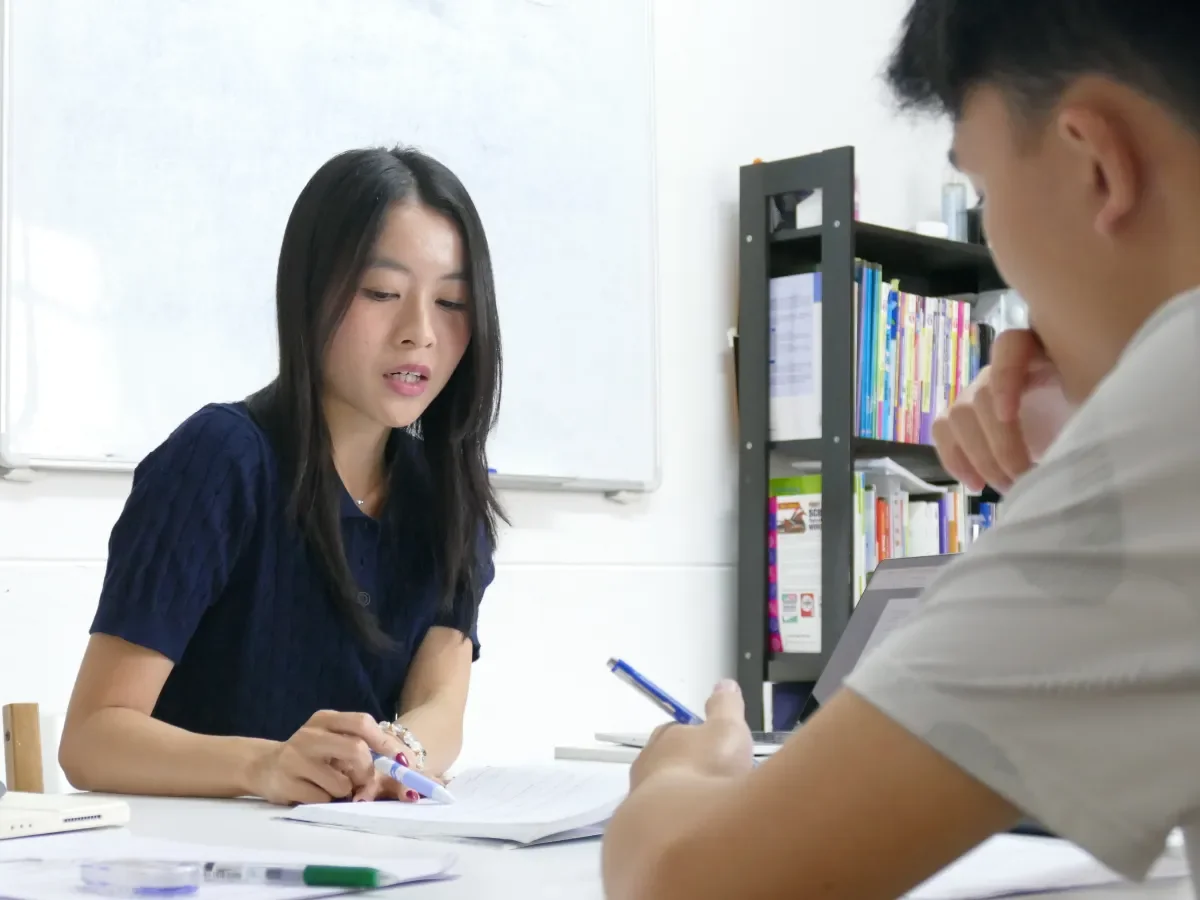
The transition from primary to secondary school is one of the most significant academic shifts in a Singapore student's education, and how well a child adapts during Sec 1 and Sec 2 sets the foundation for their entire Upper Secondary performance and SEC results at G1, G2 or G3. This guide covers the lower secondary curriculum, explains how Full Subject-Based Banding (Full SBB) affects Sec 1 and Sec 2 students, identifies common challenges, and helps parents evaluate tuition options — including Ancourage Academy's Sec 1 and Sec 2 programmes — that genuinely support their child during this critical period.
With a background in economics and mathematics from NTU, Gabriel has worked closely with Sec 1 and Sec 2 students at Ancourage Academy navigating the transition from primary to secondary school.
What Subjects Do Sec 1 and Sec 2 Students Take?
Sec 1 and Sec 2 students take English, Mother Tongue, Mathematics and Science — each at G1, G2 or G3 under Full SBB — plus Geography, History and Literature in English (also G-levelled, with a more demanding level possible from Sec 2) and the six common-curriculum subjects: Art, Character and Citizenship Education, Design and Technology, Food and Consumer Education, Music and Physical Education. Lower secondary students in Singapore follow a broad-based curriculum designed to build foundations across languages, mathematics, sciences, and humanities before they specialise in Upper Secondary. Under MOE’s secondary curriculum, the following subjects are compulsory for most Sec 1 and Sec 2 students.
| Subject | G-Levels Offered | Key Focus in Lower Secondary |
|---|---|---|
| English Language | G1, G2, G3 | Comprehension, composition, oral communication, grammar |
| Mother Tongue Language | G1, G2, G3 | Chinese / Malay / Tamil — oral, composition, comprehension |
| Mathematics | G1, G2, G3 | Algebra, geometry, number patterns, data handling |
| Science | G1, G2, G3 | Integrated science covering physics, chemistry, biology basics |
| Geography | G1, G2, G3 (more demanding level possible from Sec 2) | Physical and human geography, fieldwork skills |
| History | G1, G2, G3 (more demanding level possible from Sec 2) | Singapore history, Southeast Asian history |
| Literature in English | G1, G2, G3 (more demanding level possible from Sec 2) | Prose, poetry, drama analysis and response |
| Art / Music / Design & Technology | Common curriculum | Aesthetic and practical subjects (varies by school) |
| Physical Education | Common curriculum | Fitness, team sports, outdoor education |
| Character & Citizenship Education | Common curriculum | Values education, current affairs, community service |
Ancourage Academy's Sec 1 and Sec 2 programmes focus on building the foundations that determine Upper Secondary success, with targeted support in small groups of 3–6 at Bishan and Woodlands — book a trial class (usually $18) for a diagnostic assessment of your child's current gaps.
Important note on G-levels: Under Full SBB, the four core academic subjects (English, Mother Tongue, Mathematics, and Science) are taken at G1, G2, or G3 levels based on the student’s individual ability. A student may take Mathematics at G3 but English at G2. Humanities (Geography, History and Literature in English) are also taken at G1, G2 or G3 — at G1 as a combined, non-examinable G1 Humanities subject — with the option of a more demanding level from Secondary 2. Only the six common curriculum subjects — Art, Character and Citizenship Education, Design and Technology, Food and Consumer Education, Music and Physical Education — are taken together at a common level.
Co-curricular Activities (CCAs) are also compulsory and typically begin in Sec 1. While not examined, CCAs contribute to the student’s holistic development and are considered in Direct School Admission (DSA) applications and secondary school awards.
Why Is Lower Secondary a Critical Transition Period?
The jump from Primary 6 to Secondary 1 involves simultaneous changes in academic demands, social environment, and personal independence — and many students struggle to manage all three at once. For a detailed preparation checklist, see the primary-to-secondary transition guide.
Academic Expansion
In primary school, students focus on four core subjects: English, Mathematics, Science, and Mother Tongue. In secondary school, the subject count roughly doubles with the addition of Geography, History, and Literature taught at Ancourage Academy, and practical subjects. Each subject has its own textbook, assessment format, and teacher — requiring organisational skills that most 12-year-olds have not yet developed.
The depth of each subject also increases significantly:
- Mathematics introduces formal algebra, algebraic manipulation, and abstract reasoning — a major shift from the arithmetic-focused PSLE syllabus
- Science expands from the general PSLE science syllabus into structured physics, chemistry, and biology components with laboratory work
- English requires longer compositions, more sophisticated comprehension techniques, and formal oral presentation skills
Social and Emotional Adjustment
Students enter a new school with unfamiliar peers, often having left behind close friends from primary school. The larger school environment, different teaching styles, and increased expectations for independence can feel overwhelming. Students who were consistently top performers in primary school may find themselves in the middle of a new cohort — an experience that can dent confidence if not handled sensitively.
Post-PSLE Recovery
Many Sec 1 students arrive exhausted from the intensive PSLE preparation cycle. Some experience a "PSLE hangover" — a period of reduced motivation after months of high-pressure studying. Parents sometimes make the mistake of giving their child a complete academic break throughout the December-January holidays, only to find that the child struggles to re-engage when secondary school starts. A balanced approach — genuine rest combined with light preparatory reading — works better.
How Does Full SBB Affect Lower Secondary Students?
Full Subject-Based Banding, fully implemented from 2024, fundamentally changes how lower secondary students experience school by allowing them to take core subjects at different difficulty levels.
Posting Groups and Initial Placement
After PSLE, students are placed into one of three Posting Groups based on their PSLE Score, the sum of their four subject Achievement Levels.
| Posting Group | PSLE Score Range | Former Stream Equivalent | Starting G-Level |
|---|---|---|---|
| Posting Group 3 | 4 to 20 (plus 21-22 by option) | Express | Most subjects at G3 |
| Posting Group 2 | 23 to 24 (plus 21-22 or 25 by option) | Normal (Academic) | Most subjects at G2 |
| Posting Group 1 | 26 to 30 with AL7 or better in English and Mathematics (plus 25 by option) | Normal (Technical) | Most subjects at G1 |
Subject-Level Flexibility
The most important feature of Full SBB for lower secondary students is that subjects are no longer locked to a single level. Even from Sec 1, a Posting Group 2 student who demonstrated strong ability in PSLE Mathematics may be offered Mathematics at G3. This flexibility means:
- Students are challenged appropriately in each subject, not held back or overwhelmed across the board
- A student can excel in mathematics at G3 while receiving appropriate support in English at G2
- Mixed form classes for the Common Curriculum subjects (Art, Character & Citizenship Education, Design & Technology, Food & Consumer Education, Music and PE) bring students from all Posting Groups together, reducing stigma
Mid-Year and Year-End Upgrades
Schools assess student performance continuously and can recommend G-level upgrades at any appropriate point — not just at year-end. A Sec 1 student performing consistently well at G2 Science may be offered the chance to move to G3 Science by mid-year or at the start of Sec 2. These upgrades are based on holistic assessment, including classroom participation, assignment quality, and test results — not a single exam score.
For a detailed explanation of G-level differences and upgrade decisions, see Ancourage Academy's G2 vs G3 subject levels guide.
What Are Common Academic Challenges in Sec 1 and Sec 2?
The two academic challenges that surface most in Sec 1 and Sec 2 are the "algebra shock" in Mathematics — the shift from arithmetic to formal algebra — and English's move from formulaic composition to analytical writing; both show up as marks dropping despite effort, which is the signal that support is needed.
Mathematics: The Algebra Shock
Sec 1 Mathematics introduces formal algebra, which is a fundamentally different way of thinking compared to primary school arithmetic. Students must shift from "find the answer" to "express relationships using variables" — and many struggle with this abstraction. Common problems include:
- Confusion between arithmetic operations and algebraic manipulation (e.g., not recognising that "2x" means 2 × x and is a single algebraic term)
- Difficulty with negative numbers in algebraic contexts
- Inability to translate word problems into algebraic equations
- Weak number sense from primary school masking itself as "new" difficulties in secondary topics
English: From Structured to Analytical
Secondary English expects students to move beyond formulaic composition writing (introduction-body-conclusion) toward more sophisticated narrative and expository techniques. Comprehension questions require inference and evaluation, not just literal recall. Students who relied heavily on model compositions and drilling for PSLE English often struggle with the more open-ended secondary approach.
How Do Science and Time Management Affect Lower Secondary Performance?
Beyond Mathematics and English, lower secondary students face significant challenges in integrated Science and in managing the sheer volume of work across 8-10 subjects — both areas where early intervention prevents compounding problems.
Science: Three Disciplines in One
Sec 1 and Sec 2 Science integrates physics, chemistry, and biology into a single subject. Students must context-switch between disciplines, each with its own vocabulary, concepts, and problem-solving approaches. The introduction of laboratory work adds a practical dimension that some students find engaging and others find disorienting — particularly the need to plan experiments, record observations precisely, and draw evidence-based conclusions. See our full Secondary Science programme (Sec 1-4) for how Ancourage Academy supports students from lower secondary through O-Levels.
Time Management and Organisation
With 8-10 subjects, daily homework from multiple teachers, CCA commitments (typically 2-3 sessions per week), and longer school hours, Sec 1 students must develop time management skills they simply did not need in primary school. Many students do not struggle with content difficulty but with managing the sheer volume of work across subjects. This organisational gap is often misdiagnosed as "laziness" or "not paying attention" when it is actually a skills deficit that can be addressed directly.
What Should Parents Look for in Lower Secondary Tuition?
Lower secondary tuition should prioritise understanding over drilling, keep groups small, teach to each subject's G-level, start with a diagnostic, and stay aligned with the school's syllabus and exam schedule — drill-only or lecture-style tuition can be counterproductive during this transition period.
Prioritise Understanding Over Drilling
Lower secondary is when students build conceptual foundations. Tuition that focuses on drill-and-practice without explaining the "why" creates students who can solve familiar problems but collapse when questions are rephrased. Effective lower secondary tuition should develop reasoning and problem-solving skills, not just speed and accuracy on routine questions.
Look for Small Group Sizes
Large lecture-style tuition (20-30 students) may work for motivated Upper Secondary students who need exam practice, but it is poorly suited to Sec 1 and Sec 2 students who need individual attention as they navigate new subjects and concepts. Small groups of 3-6 students allow the tutor to identify and address each student's specific gaps — whether that is algebraic thinking in maths, inferential skills in English, or experimental design in science. See the class sizes FAQ for more on why small groups matter.
Check for G-Level Awareness
Under Full SBB, a student might take English at G2 and Mathematics at G3. Tuition centres that teach a single "Sec 1" or "Sec 2" curriculum without differentiating between G-levels are not aligned with how schools actually teach. Ask whether the centre tailors its content to your child's specific G-level for each subject.
Evaluate the Diagnostic Process
Quality tuition begins with understanding where the student is, not where the syllabus says they should be. Look for centres that conduct an initial diagnostic assessment — even an informal one — before placing your child in a class. This assessment should identify not just what the student gets wrong, but why they get it wrong (conceptual gaps, careless errors, reading comprehension issues, or time management problems).
Ensure School Alignment
The best lower secondary tuition is synchronised with the student's school curriculum and exam schedule. Tuition that is two topics ahead of school can confuse students; tuition that lags behind feels redundant. Ask how the centre keeps track of what your child's school is currently teaching.
How Does Ancourage Academy Support Lower Secondary Students?
Ancourage Academy teaches Sec 1 and Sec 2 students in small groups of 3-6, which allows Ancourage Academy tutors to adapt every lesson to each student's G-level, school syllabus, and individual learning needs.
Ancourage Academy's approach to lower secondary tuition is built on three principles:
Foundation-First Teaching
Ancourage Academy prioritises genuine understanding over surface-level performance. For Sec 1 Mathematics, this means ensuring students truly understand algebraic concepts before practising exam questions — see our full Secondary Mathematics programme (Sec 1-4) for how the curriculum builds from lower to upper secondary. For Sec 1 Science, it means building scientific thinking skills alongside content knowledge. Ancourage Academy's ESB methodology — combining spaced repetition (Ebbinghaus), guided discovery (Socratic questioning), and progressive complexity (Bruner) — ensures concepts are retained long-term, not just for the next test.
G-Level Differentiated Instruction
Ancourage Academy's small class sizes make it practical to teach students at different G-levels within the same session when appropriate, or to run G-level specific sessions for subjects with significant curriculum differences. A student taking G3 Mathematics and G2 English receives appropriately pitched support in each subject — not a one-size-fits-all programme.
Transition Support
Ancourage Academy recognises that Sec 1 students need more than subject content — they need help developing the study habits, time management skills, and organisational strategies that secondary school demands. Ancourage Academy tutors consistently find that the first term of Secondary 1 is the most critical period for establishing study habits — students who receive structured support during the Sec 1 transition adapt more quickly to secondary school expectations and build momentum that carries through to Sec 2. Ancourage Academy tutors provide practical guidance on managing homework across multiple subjects, preparing for secondary-style assessments, and building the independence that reduces parental nagging and student stress.
"The first term of Secondary 1 is make-or-break. Students who develop strong study habits and organisational skills early carry that momentum through to Sec 4 — those who drift in Sec 1 spend the rest of secondary school playing catch-up."
— Gabriel, Economics and Mathematics Educator
Ancourage Academy offers Sec 1 English, Sec 1 Mathematics, Sec 1 Science, Sec 2 English, Sec 2 Mathematics, Sec 2 Science, and more at both the Bishan and Woodlands centres. Start with a trial class (usually $18) to assess your child's current level and identify priority areas, or WhatsApp us with any questions.
Common Questions About Lower Secondary Tuition
When should my child start Sec 1 tuition?
Ideally within the first month of Sec 1. Many parents wait until mid-year results reveal problems, but by then conceptual gaps have compounded. Early diagnostic assessment identifies issues before they grow. If your child scored well for PSLE, a light-touch approach — one subject, once a week — may suffice initially.
Does my Sec 1 child need tuition for all subjects?
No. Focus on 1-2 core subjects where your child shows the most significant gaps — usually Mathematics and English or Science. Spreading tuition across too many subjects adds to an already heavy schedule without allowing deep work. Add subjects only if there is clear evidence of need.
How is Sec 1 Mathematics different from PSLE Mathematics?
The biggest shift is from arithmetic to algebra. P6 already introduces letters for unknowns, simple expressions and simple linear equations; Sec 1 extends them to expressions with brackets and fractional coefficients and harder equations, and adds inequalities — requiring abstract thinking rather than concrete calculation. Students who excelled at PSLE through memorised methods often struggle with this shift. Geometry also becomes more formal with proofs and properties.
My child is in Posting Group 2 — should they try to upgrade subjects to G3?
It depends on the subject and your child's readiness. Focus on upgrading one strong subject first, consolidate, then consider additional upgrades. Upgrading too many at once can overwhelm students performing well at G2. See Ancourage Academy's G2 vs G3 guide and the SBB strategy FAQ.
What is the difference between lower secondary and upper secondary tuition?
Lower secondary tuition (Sec 1-2) focuses on building foundations, developing study skills, and supporting the primary-to-secondary transition. Upper secondary tuition (Sec 3-4) is more exam-focused, targeting O-Level or SEC preparation with past-year O-Level papers (the first SEC sits in 2027). Lower secondary benefits from conceptual exploration; upper secondary requires more structured exam drill.
How does Full SBB affect tuition for Sec 1 and Sec 2?
Full SBB means your child may take different subjects at different G-levels, so tuition must match each subject's specific level. A centre teaching a generic "Sec 1" curriculum without G-level differentiation is not aligned with how schools teach. Ancourage Academy's small group format matches instruction to each student's G-level.
Related: Secondary Maths Tuition Guide · Secondary English Tuition Guide · Secondary Science Tuition Guide · Secondary Chinese Tuition Guide · G2 vs G3 Subject Levels Guide · Understanding the PSLE AL bands · Choosing a Secondary School · Woodlands Secondary Schools guide