
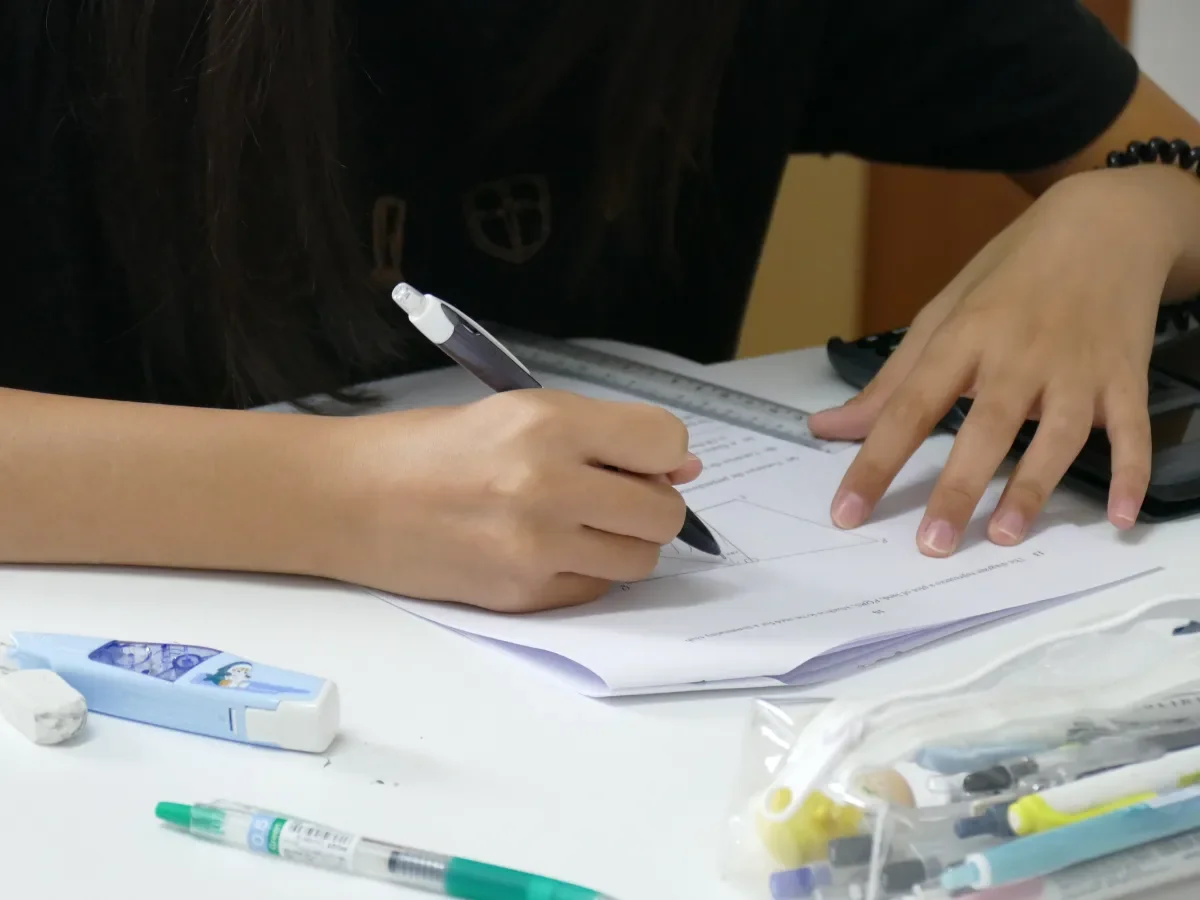
O-Level science subjects — Pure Physics, Pure Chemistry, Pure Biology, and Combined Science — are among the most important and challenging papers for Woodlands secondary students, requiring both deep conceptual understanding and rigorous exam technique to score well in the SEAB examinations. Whether your child is taking Pure Sciences or Combined Science, this guide covers the key subjects, common difficulties, and how families in Woodlands can access effective science tuition close to home. This guide is by Ancourage Academy, whose Woodlands centre supports students from local secondary schools through O-Level / SEC Sciences (K323, K324, K325).
With a background in early childhood and primary education and a degree from SUSS, Charmaine has spent years helping secondary students bridge conceptual gaps and develop the analytical thinking that O-Level science demands.
What Science Subjects Do O-Level Students in Woodlands Take?
Secondary students in Singapore choose between Pure Sciences and Combined Science at the end of Secondary 2, and the choice directly affects their post-secondary pathways. Under MOE’s secondary curriculum, science is a compulsory subject, but the level and combination vary by student.
If your child needs Science support, Ancourage Academy at our Woodlands centre offers targeted Secondary Science tuition in small groups of 3–6 — book a trial class (usually $18) for a diagnostic assessment.
Students typically take one of the following science pathways:
- Pure Sciences (two subjects): Physics + Chemistry, or Chemistry + Biology — each examined as a standalone O-Level paper
- Combined Science (one subject): Physics/Chemistry, Physics/Biology or Chemistry/Biology — two disciplines assessed across four papers for a single O-Level / SEC grade
- Triple Science (three Pure subjects): Physics + Chemistry + Biology — offered at some schools for high-performing science students
The table below summarises the SEAB syllabus codes, paper structure, and exam duration for each O-Level science subject.
| Subject | Code | Papers | Duration | Marks |
|---|---|---|---|---|
| Pure Physics | 6091 (K323 from 2027) | Paper 1 (MCQ) + Paper 2 (Structured/Free Response) + Paper 3 (Practical) | 1h + 1h 45min + 1h 50min | 40 + 80 + 40 |
| Pure Chemistry | 6092 (K324 from 2027) | Paper 1 (MCQ) + Paper 2 (Structured/Free Response) + Paper 3 (Practical) | 1h + 1h 45min + 1h 50min | 40 + 80 + 40 |
| Pure Biology | 6093 (K325 from 2027) | Paper 1 (MCQ) + Paper 2 (Structured/Free Response) + Paper 3 (Practical) | 1h + 1h 45min + 1h 50min | 40 + 80 + 40 |
| Combined Sci (Chem/Phy) | 5086 (K326 from 2027) | Paper 1 (MCQ) + 2 subject-specific theory papers + Paper 5 (Practical) | 1h + 1h 15min per component + 1h 30min | 40 + 65 + 65 + 30 |
| Combined Sci (Chem/Bio) | 5088 (K328 from 2027) | Paper 1 (MCQ) + 2 subject-specific theory papers + Paper 5 (Practical) | 1h + 1h 15min per component + 1h 30min | 40 + 65 + 65 + 30 |
| Combined Sci (Phy/Bio) | 5087 (K327 from 2027) | Paper 1 (MCQ) + 2 subject-specific theory papers + Paper 5 (Practical) | 1h + 1h 15min per component + 1h 30min | 40 + 65 + 65 + 30 |
Key distinction: Pure Science students sit separate full papers for each science subject, while Combined Science combines two disciplines into a single subject (one grade) at reduced depth. Pure Sciences provide the strongest foundation for students planning to take H2 Sciences in JC, though Combined Science students with strong grades (requirements vary by JC) can also take H2 Sciences at most JCs. Combined Science is most common among students whose strengths lie elsewhere or who are aiming for polytechnic pathways.
Important transition note: From 2027, the SEC examination replaces O-Levels as Singapore's national examination. The Science syllabuses, paper structures, and assessment standards remain equivalent under the new SEC framework — all preparation strategies in this guide continue to apply.
Which Secondary Schools Near Woodlands Offer Strong Science Programmes?
Woodlands Ring Secondary (STEM – Future of Transportation ALP), Riverside Secondary (Humanities ALP, G1/G2/G3 science under Full SBB) and Woodgrove Secondary (STEM – Sustainability ALP) are three secondary schools near Ancourage Academy's Vista Point centre, with Republic Polytechnic two TEL stops away as a common post-secondary destination.
| School | Science Highlights | Distance from Vista Point |
|---|---|---|
| Woodlands Ring Secondary (merged with Fuchun Secondary, January 2025) | Future of Transportation ALP (STEM); strong laboratory facilities; offers Pure and Combined Science tracks | Operating at 21 Woodlands Ave 1 (former Fuchun campus) until the Woodlands Ring Road rebuild completes, tentatively in December 2028; a short bus ride from Vista Point |
| Riverside Secondary | Humanities ALP (Global Citizenship Education through Critical Social Inquiry); G1/G2/G3 science classes under Full SBB | ~1.3 km / short bus ride |
| Woodgrove Secondary | STEM-Sustainability ALP (STEM for Sustainable Living in the Community); offers full science subject range with strong STEM foundation | ~0.4 km / 5 min walk |
| Republic Polytechnic (post-secondary) | Problem-Based Learning approach to applied sciences; a common post-secondary destination for Woodlands O-Level graduates — not a secondary school | ~1.8 km from Vista Point; two TEL stops, Woodlands South (TE3) to Woodlands North (TE1) |
Students from these schools regularly attend tuition at Ancourage Academy's Woodlands centre at Vista Point, which is a 5-minute walk from Woodlands South MRT (TE3). The convenience factor matters — secondary students juggling CCAs, homework, and exam preparation need tuition that does not eat into their limited free time.
What Are Common Challenges in O-Level Science?
O-Level science subjects demand a combination of factual recall, conceptual understanding, mathematical application, and exam technique — and most students struggle with at least one of these dimensions.
Physics Challenges
Physics is often regarded as the most difficult O-Level science because it requires strong mathematical skills alongside conceptual reasoning. Common problem areas include:
- Kinematics and dynamics: Interpreting speed-time and distance-time graphs, applying Newton's laws to multi-step problems
- Electricity: Circuit analysis, calculating resistance in series and parallel circuits, understanding potential dividers
- Electromagnetic induction: Applying Fleming's rules, understanding AC generators and transformers
- Energy and work: Conservation of energy calculations, efficiency problems, power equations
Many students can memorise physics formulas but cannot apply them to unfamiliar contexts — which is exactly what Paper 2 tests.
Closing that application gap is the main work of our Secondary Physics coaching for O-Level / SEC, which pairs every formula with unfamiliar-context questions.
Chemistry Challenges
Chemistry sits between physics and biology in difficulty. It requires both conceptual understanding and factual knowledge. For Sec 4 students approaching O-Levels, our Sec 4 Chemistry programme focuses on closing these gaps. Students frequently struggle with:
- Mole concept: Stoichiometry calculations, limiting reagents, percentage yield and purity
- Organic chemistry: Naming conventions, functional groups, characteristic reactions, isomerism
- Electrolysis: Selective discharge, predicting products at electrodes, industrial applications
- Qualitative analysis: Identifying unknown substances through systematic testing — a practical skill many students find difficult under exam conditions
What Are the Biggest Challenges in O-Level Biology and Combined Science?
Biology and Combined Science present distinct difficulties from Physics and Chemistry — Biology demands heavy factual recall with precise scientific language, while Combined Science students face the unique challenge of managing two disciplines within a single subject.
Students who take Pure Biology instead avoid that within-subject split and study Biology in greater depth; Pure Biology is the syllabus our Sec 3-4 Biology classes follow.
Biology Challenges
Biology has the heaviest content load of the three sciences. While it is sometimes perceived as the "easiest" pure science, achieving A1/A2 grades requires precise scientific language and structured answers. Our Sec 4 Biology tuition helps students master the structured answering techniques that examiners reward. Common difficulties include:
- Genetics: Monohybrid crosses and genetic diagrams, co-dominance and the ABO blood groups, sex determination, and mutation — marks are lost on ratio reasoning and on explaining why observed ratios differ from expected ones
- Transport in organisms: Osmosis, diffusion, active transport — understanding when and why each occurs
- Ecology: Energy flow, nutrient cycling, and the precision required in explaining food web dynamics
- Structured answer technique: Biology examiners reward specific keywords and logical sequencing — vague explanations lose marks even when conceptually correct
Combined Science Specific Challenges
Combined Science students face a unique difficulty: they must cover two disciplines within a single subject, which means less class time per topic — see Ancourage Academy's FAQ on Pure vs Combined Science. Combined Science is not simply a "lighter" version of Pure Science — the exam still tests conceptual depth, and students must manage their revision across two distinct content areas with different thinking skills.
How Should Woodlands Students Prepare for O-Level Science?
Effective O-Level science preparation requires a structured approach that builds understanding progressively from Sec 3, rather than relying on last-minute revision in Sec 4.
Start Concept Mastery in Sec 3
The single biggest mistake students make is treating Sec 3 as a "settling in" year and leaving serious revision to Sec 4. O-Level science syllabuses are cumulative — Sec 4 topics build directly on Sec 3 foundations, which in turn rest on the Sec 1–2 integrated science foundation. A student who does not understand forces in Sec 3 Physics will struggle with pressure, turning effects, and energy in Sec 4.
- Review each topic within a week of completing it in school
- Use past-year questions topic by topic, not full papers (full paper practice comes later)
- Build a personal error log — most students repeat the same mistakes without realising it
Develop Exam Technique Early
Science examiners award marks for specific keywords, logical structure, and precise calculations. Students who understand the concept but cannot express it in exam language will lose marks consistently. Key practices:
- Study the SEAB marking schemes to understand exactly what examiners expect
- Practice writing concise, keyword-rich answers (not essays)
- For calculation questions: show every step, include units, and circle your final answer
- For MCQ: use elimination strategy and be disciplined about time (approximately 1.5 minutes per MCQ question)
How Can Practical Skills and Targeted Revision Boost Science Grades?
The practical examination and strategic revision planning are two areas where Woodlands students can gain marks efficiently — yet both are commonly neglected in favour of content memorisation alone.
Use Practical Skills Strategically
The Paper 3 Practical examination contributes to the final grade — see Ancourage Academy's FAQ on science practical preparation. Many students treat practicals as an afterthought, but consistent lab technique development throughout Sec 3 and Sec 4 makes a meaningful difference. Focus on recording observations accurately, planning experiments logically, and drawing conclusions supported by data.
Plan Revision by Subject Weakness
Identify your weakest topics in each science discipline and allocate proportionally more revision time to them. A student scoring 80% in organic chemistry but 50% in mole concept should spend three times more time on mole concept — yet most students instinctively revise what they already know well, because it feels more productive.
Why Choose Science Tuition Near Woodlands MRT?
Location matters for secondary students with packed schedules — and Ancourage Academy's Woodlands centre at Vista Point is designed to be accessible for families across the northern corridor.
Practical benefits of tuition near Woodlands MRT:
- Travel time: Students from Woodlands Ring, Riverside, and Woodgrove secondary schools can reach Vista Point — a 5-minute walk from Woodlands South MRT (TE3), the nearest station — within 10-15 minutes by bus or walking
- After-school convenience: Classes can be scheduled after school dismissal without requiring long commutes across Singapore
- Parental peace of mind: Woodlands South MRT (TE3) and the surrounding Vista Point area are well-connected and familiar to families living in Blocks 301-899 and neighbouring estates
- Small group advantage: Ancourage Academy's science classes have 3-6 students per group, allowing tutors to address individual conceptual gaps — critical for science subjects where one misunderstood concept cascades into multiple topics
Ancourage Academy's science tutors are familiar with the exam patterns and school-based assessment schedules of Woodlands secondary schools. At Ancourage Academy's Woodlands centre, science tutors observe that students who combine conceptual understanding with regular practical paper practice outperform those who rely on memorisation alone — the application questions in Pure and Combined Science papers reward deep understanding over rote recall. This means your child's tuition is aligned with what they are learning in school, not a generic curriculum that may be out of sync.
"The most common mistake in O-Level science is memorising definitions without understanding the underlying principles — students who can explain why a concept works score significantly higher on application questions," notes Charmaine, Early Childhood & Primary Education Specialist at Ancourage Academy. "Ancourage Academy focuses on building that 'why' understanding through structured questioning before any formula practice."
Ancourage Academy offers O-Level Physics, O-Level Chemistry, and Combined Science tuition. Start with a trial class (usually $18) at the Vista Point centre, a 5-minute walk from Woodlands South MRT (TE3) to assess your child's current understanding and identify priority areas for improvement. You can also WhatsApp us if you have any questions. Browse the Science article hub for more O-Level / SEC Science study guides.
Common Questions About O-Level Science in Woodlands
Should my child take Pure Science or Combined Science?
For JC Science stream and H2 Sciences, Pure Sciences provide the strongest foundation — most H2 syllabuses assume Pure Science knowledge. Combined Science students can still take H2 Sciences at most JCs with strong grades (typically A1–A2 in Combined Science; requirements vary by JC) but will need to bridge content gaps. For polytechnic or JC Arts stream, Combined Science reduces subject load while demonstrating competence. This decision is made at end of Sec 2 during subject combination selection.
Which Pure Science combination is best — Physics/Chemistry or Chemistry/Biology?
Physics/Chemistry is the most versatile combination for engineering, computing, and physical science pathways. Chemistry/Biology is the natural fit for life sciences and healthcare pathways (medicine itself needs H2 Chemistry plus either Biology or Physics). Chemistry appears in both combinations because it is considered foundational. Your child's strengths and career interests should guide this choice, not peer pressure or perceived difficulty.
Is Combined Science easier than Pure Science?
Combined Science covers less depth per discipline but is not inherently easier — the exam still requires solid conceptual understanding. Many students underestimate it, assuming reduced content means easier questions. In practice, questions test the same analytical skills at narrower scope, and neglected preparation often leads to worse-than-expected scores.
How many hours per week should my child spend on science revision?
From Sec 3, aim for 2-3 hours per Pure Science subject weekly (beyond homework), or 3-4 hours total for Combined Science. Increase to 5-6 hours per subject during Sec 4 revision (July-October). Focused practice with past-year questions is more effective than passively re-reading notes.
Can a Combined Science student switch to Pure Science?
Switching mid-stream is very difficult and rarely approved — Pure Science covers significantly more content from Sec 3. The decision should ideally be made during Sec 2 subject selection. If currently in Combined Science and considering JC Science stream, speak with the school early about possible bridging support.
What science tuition is available near Woodlands?
Ancourage Academy offers O-Level Physics, Chemistry, and Combined Science (Chemistry/Physics) tuition at the Vista Point centre, a 5-minute walk from Woodlands South MRT (TE3). Browse all our secondary Science courses for the full range. Classes run in small groups of 3-6, scheduled around local school dismissal times. Book a trial class (usually $18) to get started.
Related: O-Level Prep for Woodlands Students · O-Level Maths Woodlands · O-Level English Woodlands · O-Level Chinese Woodlands · Woodlands Secondary Schools Guide · O-Level Science Preparation for Bishan Secondary Schools · Secondary Science Tuition