
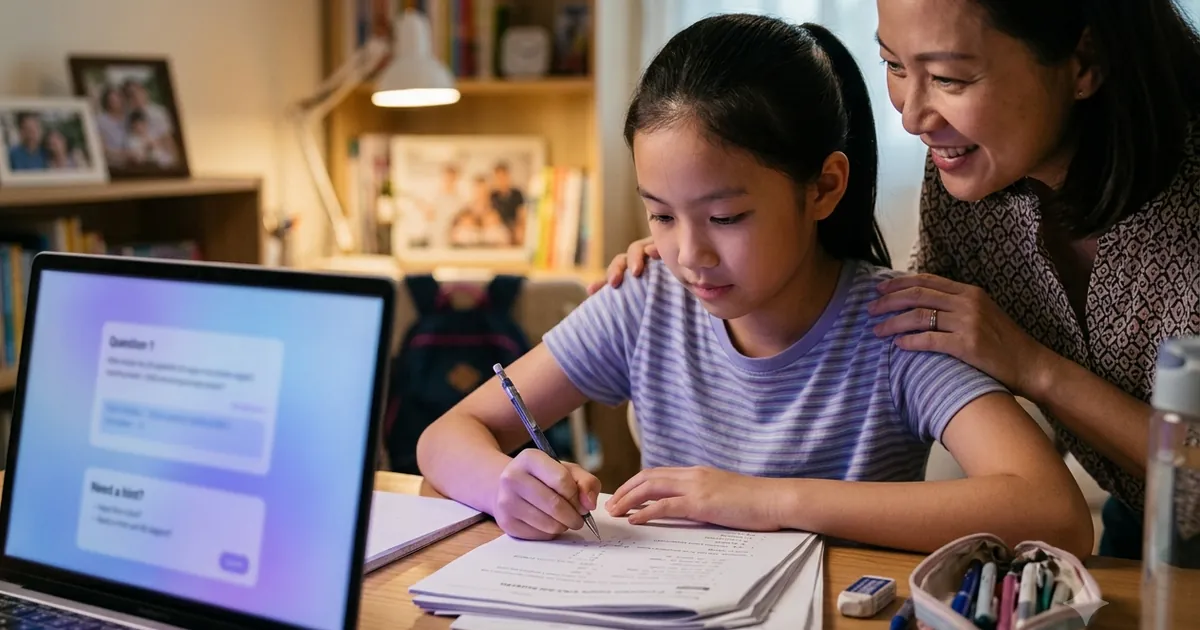
AI can genuinely help PSLE preparation when it is used to explain concepts, generate practice, and give feedback — but it cannot replace timed exam-condition practice or a teacher's diagnosis, and used as an answer machine it actively harms a Primary 6 student's results. At Ancourage Academy, we treat AI as a supplement to structured primary tuition, not a substitute for it — and our AI classes for kids teach safe, supervised use from the start. For the bigger question many parents ask, see our take on whether AI can replace a tutor.
MOE has already built AI into national PSLE-level learning. According to MOE's AI in education guidance, students from Primary 4 use MOE-developed AI features in the Student Learning Space under teacher supervision — the Learning Assistant (LEA) is available from Primary 4, while the Adaptive Learning System currently covers Primary 5 to Secondary 2 Mathematics and Upper Secondary Geography. The goal for parents is to extend that responsible use at home.
How Can AI Help with PSLE Preparation?
Used as a study partner rather than an answer source, AI is good at four things that support PSLE revision: explaining a concept a different way, generating extra practice questions, quizzing for active recall, and giving feedback on the structure of an open-ended answer without writing it.
- Explaining concepts a different way: When a textbook explanation does not click, AI can re-explain a fraction problem or a science concept with a simpler analogy.
- Generating extra practice: "Give me five P6 Maths questions on ratio at medium difficulty" creates fresh material once a child has exhausted their assessment books.
- Active recall: Asking AI to quiz the child one question at a time turns passive reading into the kind of retrieval practice that actually builds memory.
- Feedback on structure: For open-ended Science or English answers, AI can point out what is missing — without writing the answer.
For the deeper "how", see our guide to prompt engineering for students, and our broader overview of AI study tools for students.
What AI Is Built Into MOE's SLS for PSLE?
MOE's Student Learning Space (SLS) has eight AI-enabled features, six of which a student uses directly — the Adaptive Learning System (ALS), Learning Assistant (LEA), Feedback Assistant–Mathematics (FA-Math), Annotated Feedback Assistant (AFA), Short Answer Feedback Assistant (SAFA) and Speech Evaluation Tool (SET); Authoring Copilot and Data Assistant are teacher tools — and because they run inside the MOE curriculum under teacher supervision they are the safest, most curriculum-aligned starting point for primary students.
- Adaptive Learning System (ALS): Adjusts question difficulty to the student's level — currently covers Mathematics (upper primary to lower secondary) and Upper Secondary Geography, under teacher guidance.
- Learning Assistant (LEA): Guides students toward answers with hints rather than handing them over.
- Feedback Assistant–Mathematics (FA-Math): Gives step-by-step hints and suggested marks on a pupil's written working — the most directly useful of the six for PSLE Mathematics practice.
- Annotated Feedback Assistant (AFA): Highlights specific parts of a written response for feedback and revision, across subjects.
- Short Answer Feedback Assistant (SAFA): Gives automated feedback on short free-response answers, helping students see where an answer is incomplete.
- Speech Evaluation Tool (SET): Gives feedback on pronunciation and fluency — useful for English and Mother Tongue oral practice.
Because these tools are curated and supervised within the MOE curriculum, they are a safer first step than a general chatbot. Our dedicated guide to MOE's SLS AI features explains each one in detail.
How Should Students Use AI by PSLE Subject?
The right AI use differs by subject — explain a heuristic or model-drawing step in Mathematics, check whether an open-ended Science answer covers the key points, brainstorm and get draft feedback in English, and practise vocabulary and oral prompts in Mother Tongue — and in every case the AI should support thinking, not replace it.
| Subject | Good AI use | What to avoid |
|---|---|---|
| Mathematics | Explain a heuristic or model-drawing step; generate similar practice | Letting AI solve the problem instead of the child |
| Science | Check whether an open-ended answer covers the key points | Copying AI explanations as exam answers without verifying |
| English | Brainstorm composition ideas; get feedback on a draft | Asking AI to write the composition — voice is what's assessed |
| Mother Tongue | Practise vocabulary and oral conversation prompts | Trusting AI translations without a parent or teacher check |
For Maths specifically, AI complements but never replaces the PSLE Maths heuristics a child must internalise to solve unfamiliar problems.
What Are the Pitfalls Parents Should Watch For?
The biggest risks are over-reliance, confident-but-wrong answers, and the loss of real exam-condition practice.
- Over-reliance: A child who consults AI before attempting anything stops developing independent problem-solving — the exact skill the PSLE tests.
- Confident errors: AI can produce wrong answers that sound authoritative. Primary students rarely have the knowledge to catch them, so answers must be verified against textbooks.
- No exam conditions: The PSLE is a timed, paper-based, no-AI exam. Students who only ever revise with AI assistance are unprepared for the real thing.
- Supervision gap: General chatbots are not designed for young children. Primary use should be on age-appropriate tools, supervised by an adult.
How Can Students Use AI Honestly for PSLE?
The honest rule is simple: attempt first, ask AI for hints not answers, and always finish with AI-free practice.
- Attempt first: The child tries every question independently before turning to AI.
- Ask for hints: "Give me a hint, don't tell me the answer" keeps the thinking with the child.
- AI-free practice papers: At least weekly, complete a past year paper under timed conditions with no AI — this mirrors the real exam.
- Verify everything: Cross-check AI explanations against notes and textbooks.
How Ancourage Academy Prepares Students for PSLE
At Ancourage Academy, technology supports tuition but never replaces the diagnostic, human-guided teaching that produces PSLE results. Our tutors identify the specific gap behind a wrong answer — something AI cannot do because it sees only the output, not the child's thinking. We run mock exams under real conditions, teach in small groups of 3-6, and use AI only where it adds value.
Book a trial class (usually $18) at Bishan or Woodlands, or explore our PSLE revision guide to plan a balanced timetable.
"A PSLE student doesn't need AI to do the work — they need it to understand the work," says Archer Yu, Ancourage Academy's AI and Computer Science Educator. "Used to explain a heuristic or to quiz themselves, it helps; used to produce answers, it quietly costs them the practice the exam rewards."
Common Questions About AI and PSLE Preparation
Can AI tools improve my child's PSLE score?
They can help indirectly, by explaining concepts, generating practice, and giving feedback — but only if the child still does the thinking. AI used to check and reinforce understanding supports learning; AI used to produce answers replaces it. The score improvement comes from the practice and understanding, not the tool itself.
Which AI tools are safe for a Primary 6 student?
MOE's SLS tools (ALS, LEA, SAFA and SET) are the safest, most curriculum-aligned option as they are designed for educational use under teacher supervision. For general tools, note that ChatGPT's minimum age is 13 (with parental consent required under 18), so most Primary 6 pupils — who are under 13 — should rely on MOE's SLS or age-appropriate, school-provided tools rather than on ChatGPT. Pupils aged 13 and older can use ChatGPT Study Mode with parental consent and adult supervision, which is preferable to homework-solver apps that encourage answer-copying. Younger children should always use AI with an adult present.
Is it cheating to use ChatGPT for PSLE homework?
It depends on how it is used. Using AI to understand a concept, check work, or generate practice is legitimate study. Submitting AI-generated answers as the child's own work is dishonest. Many schools are setting their own AI-use rules — check your child's school guidelines.
Should my child revise only with AI?
No. The PSLE is a timed, paper-based examination with no AI access. A child who revises only with AI assistance will be unprepared for real exam conditions. AI should be one tool among many, alongside past year papers, AI-free practice, and structured teaching.
Explore our AI workshops, primary courses, or read more on AI study tools for students.