
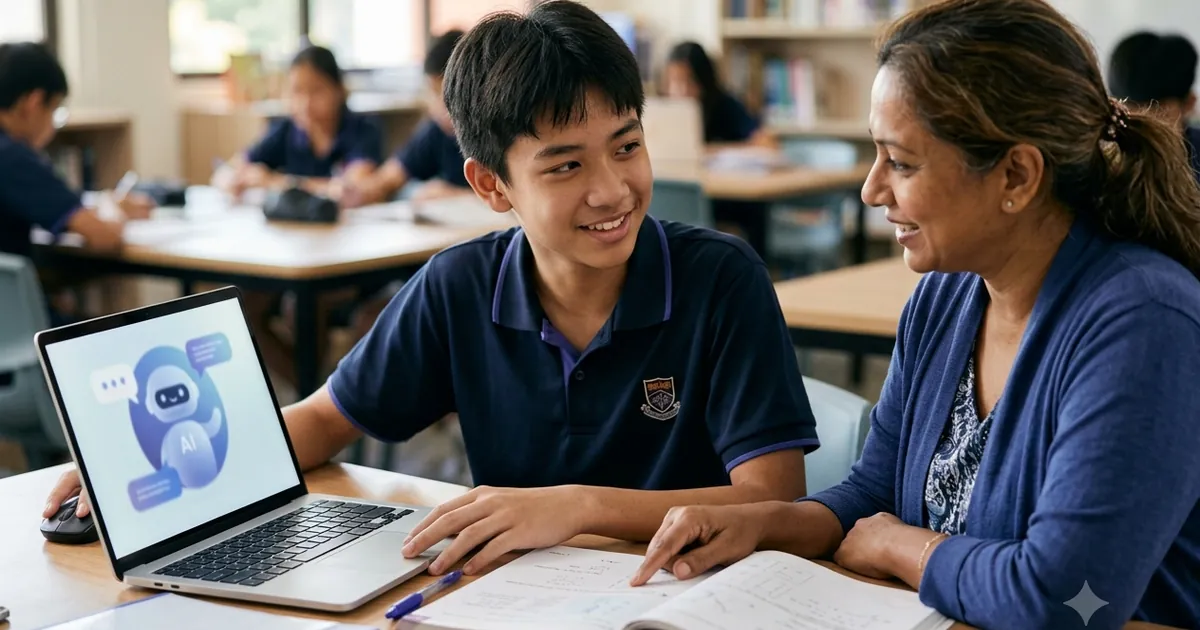
No — AI can support studying, but it cannot replace a skilled human tutor: it cannot watch how a child actually thinks, notice the confusion a student does not voice, or build the trust that re-engages a discouraged learner. At Ancourage Academy, we use AI ourselves and teach students to use it well, so this guide gives a straight answer to a question many Singapore parents are asking — where AI genuinely helps, where human tuition still wins, and how to combine the two. For the broader question of value, see our guide on whether tuition is worth it.
AI tools like ChatGPT, Google Gemini, and MOE's Student Learning Space have made on-demand help cheaper and more available than ever. That naturally raises the question: if a chatbot can answer almost any question instantly, do students still need a tutor? The honest answer depends on understanding what each is actually good at.
What AI Does Well as a Study Aid
AI is a genuinely useful study aid for explanation, practice, and instant feedback — used as a supplement, it adds real value. A student can ask AI to explain a concept a different way, generate extra practice questions, or give feedback on a draft at midnight when no tutor is available. For these tasks — see our guide to AI study tools for students — AI is fast, patient, and endlessly available. Used as a study partner that makes a child think harder, it is a real asset.
What AI Cannot Do That a Tutor Can
A skilled tutor does four things AI fundamentally cannot — see how a child thinks from their working, detect unspoken confusion, build motivation and trust, and be accountable for being correct — and these are the things that change results.
- See how a child thinks. A tutor watches the working, spots the exact step where reasoning breaks down, and corrects the cause. AI only sees what a student chooses to share — typed words, an uploaded photo of their working, or speech — and a child who cannot articulate their confusion cannot get the right help from it.
- Detect unspoken confusion. A tutor reads a frown, a hesitation, or a too-quick "I get it" and probes further. AI takes every input at face value and cannot tell when a student is quietly lost.
- Build motivation and trust. Much of a tutor's impact is relational — encouragement, accountability, and the confidence that comes from a person who believes in a child. This is often what turns a disengaged student around, and it is something software cannot supply.
- Be reliably correct. AI can be confidently wrong — it produces plausible but incorrect explanations, and a struggling student is the least able to catch the error. A tutor is accountable for accuracy in a way a chatbot is not.
The strongest evidence for the power of human, one-to-one teaching predates AI. In a landmark 1984 study, educational researcher Benjamin Bloom found that students taught one-to-one performed about two standard deviations better than students in an ordinary classroom — the average tutored student outscored 98% of the class. Decades of technology have tried, and so far failed, to fully replicate that effect with software alone.
| What matters | AI tool | Human tutor |
|---|---|---|
| Instant answers and practice | Excellent — fast and always available | Limited to lesson time |
| Seeing how a student thinks | Cannot directly — only sees what the student provides | Core strength — diagnoses the real gap |
| Spotting unspoken confusion | No | Yes — reads cues and probes |
| Motivation and accountability | No relationship | Encouragement, trust, follow-through |
| Reliable accuracy | Can be confidently wrong | Accountable for correctness |
Is AI Cheaper Than Tuition?
AI is far cheaper than tuition — but cost is not the same as value. A free or low-cost chatbot will always undercut a tutor on price. The fair comparison, though, is not price-per-hour but outcome-per-dollar. AI handles the cheap, repetitive parts of learning — drilling, explaining, first-pass feedback — very well. The expensive, high-value part — diagnosing why a specific child is stuck and re-engaging them — is exactly what AI cannot do. For many families, the most cost-effective approach is to let AI absorb the routine work so that paid tutoring time is spent only on what a human uniquely provides.
Is AI Enough for Exam Preparation?
For high-stakes Singapore exams, AI is a useful practice tool but not a complete preparation plan. Real exam readiness depends on diagnosing a student's specific weak spots, drilling them under timed conditions, and holding the student accountable week to week — work that needs a person who can see the pattern in a child's mistakes. AI can generate practice questions and mark a draft, but it cannot run a genuine diagnosis of why a student keeps losing marks, or notice that they have quietly avoided their weakest topic. For PSLE, O-Level / SEC, and A-Level preparation, AI works best filling the gaps between lessons, while a tutor sets the strategy and keeps it on track.
The Best Approach: Use Both
The strongest results come from pairing a human tutor with AI used as a supplement — not from choosing one over the other. MOE's approach to AI in education treats AI the same way: a tool to personalise and support learning, not to replace the teacher. In practice that means a child uses AI for extra practice and quick explanations between lessons, while a tutor sets the direction, diagnoses gaps, checks that AI use is honest, and provides the accountability that keeps a student moving.
How Ancourage Academy Uses AI Alongside Teaching
At Ancourage Academy, AI sits firmly in a supporting role around human teaching. Our tutors diagnose each student's real gaps and teach to them in small groups, while our AI workshops for students teach learners to use tools like ChatGPT honestly and effectively for their own revision. The two reinforce each other: stronger fundamentals make AI more useful, and good AI habits free up lesson time for the teaching that only a person can do. Browse our full AI in education guides to see how we think about it.
Book a trial class (usually $18) at Bishan or Woodlands, or read whether tuition is worth it.
Common Questions About AI vs Tuition
Can ChatGPT replace a private tutor?
No. ChatGPT can explain concepts and generate practice on demand, but it cannot see how a child thinks, detect unspoken confusion, or provide the motivation and accountability that drive real progress. It also produces confident mistakes a struggling student may not catch. It is best used as a supplement to a tutor, not a replacement.
Is AI good enough for my child to study on their own?
For independent, motivated students AI can be a strong study aid — for extra practice, explanations, and feedback. But it works best for a child who already has solid fundamentals and good judgement, because AI can be wrong and cannot tell when a student is lost. Younger or struggling learners still benefit most from human guidance.
Should I cancel tuition because we have AI tools now?
Usually not. The most cost-effective approach is to use both: let AI handle routine drilling and quick explanations, and keep tutoring focused on diagnosing gaps and re-engaging your child — the high-value work AI cannot do. Cancelling tuition entirely tends to remove exactly the support that makes the biggest difference.
Does MOE think AI can replace teachers?
No. MOE's direction treats AI as a tool to personalise and support learning, not to replace the teacher. AI features in the Student Learning Space are designed to assist teaching under teacher supervision, reflecting the same conclusion: AI supports learning best when it works alongside a skilled human, not instead of one.
Explore our AI in education hub, read about AI study tools for students, see which AI tools teachers and tutors use, or whether tuition is worth it.