
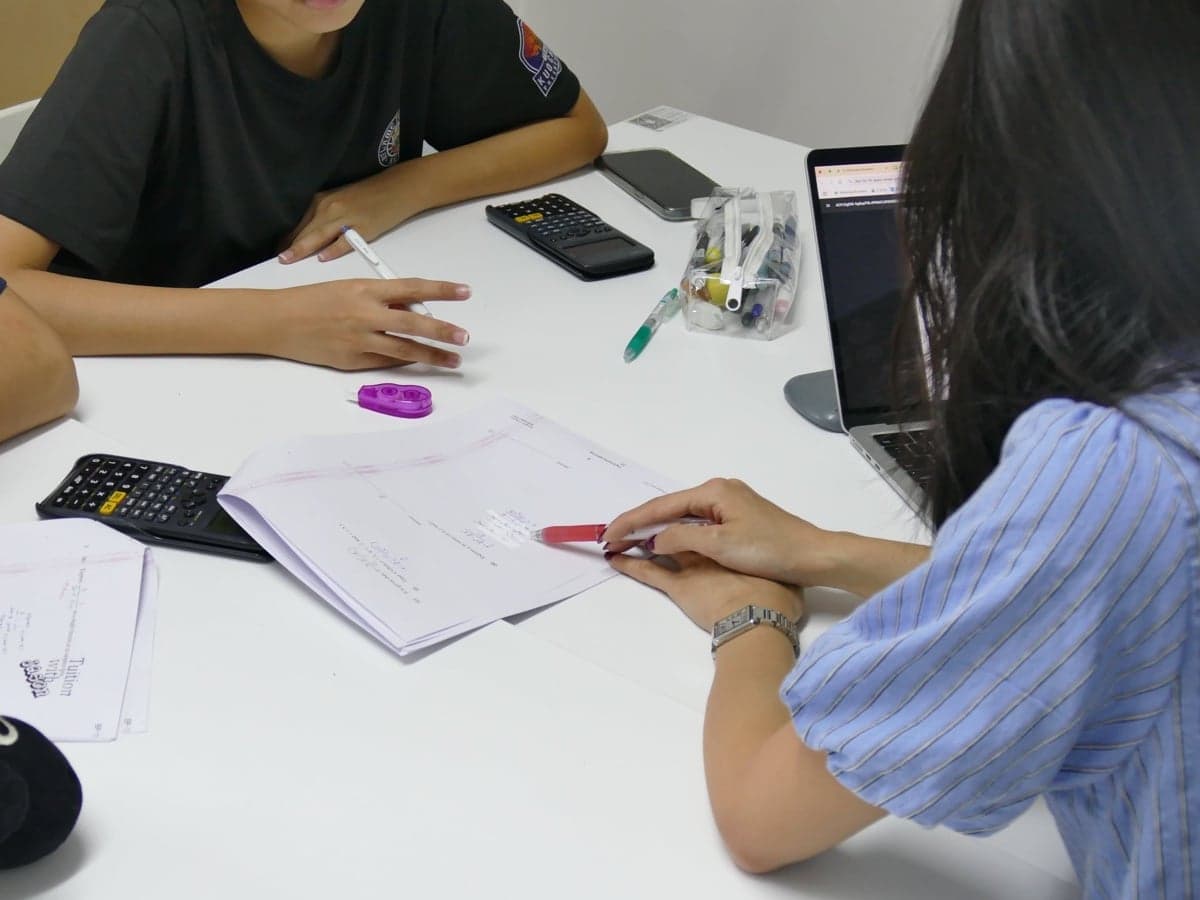
Past year exam papers are the single most valuable revision resource for PSLE, O-Level / SEC, and A-Level students — but most students use them ineffectively, doing paper after paper without a system for learning from mistakes — a pattern Ancourage Academy addresses with a structured four-phase method. SEAB-authorised publishers produce past papers for most subjects, with papers commonly available going back several years. The question is not whether to use them, but how to extract maximum learning from each one.
As Founder and Academic Director at Ancourage Academy, Min Hui has refined a four-phase past paper method over years of guiding students through PSLE and O-Level preparation. This guide covers that method — from topic analysis to timed practice to error journals — with subject-specific adaptations for English, Mathematics, Science, and Chinese, as applied weekly in our secondary Maths tuition classes.
Why Most Students Use Past Papers Incorrectly
The most common mistake is treating past papers as a test of readiness rather than a learning tool — completing a paper, checking the score, and moving on to the next one without analysing what went wrong.
This "do-and-discard" approach wastes the most valuable part of each paper: the mistakes. A student who does 20 past papers but repeats the same types of errors is practising those errors, not correcting them. Research consistently shows that the learning happens during the review, not during the attempt.
Other common mistakes:
- Starting papers too early: Attempting full papers before completing the syllabus means encountering questions on untaught topics, which is demoralising and unproductive.
- Doing only untimed practice: Past papers done without time pressure do not replicate exam conditions and overestimate readiness.
- Using papers from only one school: Each school has question-setting tendencies. Exposure to papers from multiple schools builds flexibility.
- Ignoring marking schemes: Many students check answers but not the marking scheme. Understanding how marks are awarded reveals what examiners expect — which is often more specific than students assume.
The Four-Phase Past Paper Method
Effective past paper use follows four phases: topic completion, untimed topical practice, timed full papers, and error-targeted revision.
- Phase 1 — Complete the syllabus first: Finish learning all topics before attempting full papers. Use topical assessments (chapter-by-chapter practice) during this phase instead. Ancourage Academy's weekly programme follows this principle — each week focuses on the topics currently being taught.
- Phase 2 — Untimed topical practice: Once the syllabus is complete, use past paper questions sorted by topic. Focus on weak areas identified during Phase 1. The goal is accuracy, not speed. Check answers AND marking schemes after each question.
- Phase 3 — Timed full papers: Begin doing complete papers under exam conditions — strict timing, no notes, no interruptions. This phase typically starts 8-12 weeks before the exam. Aim for one paper per subject per week.
- Phase 4 — Error-targeted revision: In the final 2-4 weeks, review your error journal (see below) and focus exclusively on the topics and question types where you continue to lose marks. This is the highest-yield revision possible.
Ancourage Academy integrates this four-phase approach into tuition sessions — book a trial class (usually $18) at Bishan or Woodlands to experience the method in small groups of 3-6.
How Many PSLE, O-Level / SEC and A-Level Past Year Papers to Do, and How Far Back to Go
For most subjects, 6-10 past papers provide sufficient coverage — doing more than 10 rarely adds value unless the student is specifically targeting A1/Distinction.
| Exam Level | Recommended Papers | How Far Back | Sources |
|---|---|---|---|
| PSLE | 6-8 full papers per subject | 5 years (syllabus changes make older papers less relevant) | School prelim papers + SEAB past papers |
| O-Level / SEC | 8-10 full papers per subject | 5-7 years for content subjects; 3-5 for English | Multiple school prelims + SEAB papers |
| A-Level | 8-10 full papers per subject | 5-10 years (A-Level syllabuses change less frequently) | School prelims + SEAB past papers |
Quality trumps quantity. A student who does 6 papers with thorough error analysis after each one will outperform a student who rushes through 15 papers without review. The PSLE revision guide and O-Level preparation guide provide level-specific revision timelines that integrate past paper practice.
Building an Error Journal That Actually Helps
An error journal is a record of every mistake made during past paper practice, categorised by topic and error type — it becomes the single most useful revision document in the final weeks before an exam.
How to build one:
- After each paper, list every question where marks were lost
- For each question, record: the topic, the error type (conceptual, careless, time, or misread), and a brief note on what went wrong
- Review weekly: Look for patterns — if 40% of errors are in trigonometry, that is where revision time should go
- Before each new paper, read through the journal to prime awareness of common pitfalls
Error types to track:
- Conceptual: Did not know the method or concept — requires re-learning
- Careless: Knew the method but made a computation or reading error — requires checking habits
- Time: Knew the method but ran out of time — requires practice for speed
- Misread: Solved a different question than what was asked — requires question interpretation practice
Timed Practice vs Untimed Practice: When to Use Each
Untimed practice builds accuracy and understanding; timed practice builds speed and exam stamina. Both are necessary, but they serve different purposes and should not be mixed.
Use untimed practice when:
- Learning a new topic or method for the first time
- Working through a topic where you consistently lose marks
- Studying marking schemes to understand what examiners expect
- Early in the revision cycle (Phase 2 of the four-phase method)
Use timed practice when:
- The syllabus is complete and you need to build exam readiness
- You want to identify time management problems
- Practising paper-specific strategy (e.g., which questions to attempt first)
- Final 8-12 weeks before the exam (Phase 3)
A common mistake is doing timed papers too early: if a student has not yet mastered the content, timed conditions add stress without building useful skills. Complete Phase 2 (untimed topical practice) before moving to Phase 3 (timed full papers).
Subject-Specific Paper Strategies: English, Maths, Science, Chinese
English papers are most useful for inference and summary comprehension and for practising composition planning; Mathematics papers show which topics recur and are best worked Paper 1 and Paper 2 separately; Science papers should be checked against the marking scheme to see where an explanation falls short; Chinese papers are for comprehension and composition, since oral and listening are assessed separately.
English: Past paper practice is most valuable for comprehension and composition. For comprehension, focus on inference and summary questions — these are the highest-mark components. For composition, practise the planning stage (5-minute outlines) using past paper topics rather than writing full compositions every time, including drilling situational-writing formats with past papers. The secondary English strategies guide covers O-Level-specific approaches.
Mathematics: Past papers reveal topic frequency — certain topics appear in every paper, while others rotate. Track which topics appear most often and ensure those are mastered first. For secondary Maths, practise Paper 1 and Paper 2 separately to build format-specific skills — approved scientific calculators are permitted in both papers of O-Level / SEC E-Maths (4052 / K310) and A-Maths (4049 / K341), and Paper 2 carries the longer structured and real-world-scenario questions; A-Level candidates in our JC H2 Mathematics classes apply the same topic-frequency tracking across the longer ten-year paper bank.
Science: Marking schemes are critical for Science past paper practice. Many students lose marks not because they lack knowledge but because their explanation does not carry the concept the question is asking about. After each paper, compare your answer with the marking scheme and ask which idea is missing, rather than which word is missing. The PSLE Science answering techniques guide sets out how to build a complete, context-specific explanation.
Chinese: Past paper practice for Chinese should focus on comprehension and composition, as oral and listening are assessed separately. For composition, practise using the four-paragraph framework with past paper topics. For comprehension, focus on the vocabulary-in-context questions that frequently appear.
When Past Papers Are Not Enough
Past papers are a revision tool, not a teaching tool — a student who lacks foundational understanding of a topic will not learn it by attempting past paper questions on that topic.
Past papers are not enough when:
- The student has conceptual gaps: If a student consistently cannot attempt questions on certain topics, the issue is understanding, not practice. They need re-teaching of the concept before past papers become useful.
- The exam format has changed: For the SEC examination from 2027, no past papers exist yet. Students must use O-Level papers as proxies while adapting to the new format.
- The student is not reviewing errors: A student who does 10 papers without an error journal is repeating mistakes, not fixing them. The paper itself is only half the process.
- Time is very limited: With less than 4 weeks to an exam, targeted topical revision of weak areas is more efficient than completing full papers.
In all these cases, structured tuition can bridge the gap. At Ancourage Academy, tutors use past paper analysis to identify each student's specific weak areas and build a targeted revision plan. Small groups of 3-6 allow for individual feedback on past paper performance.
Book a trial class (usually $18) at Bishan or Woodlands — or WhatsApp Ancourage Academy to discuss your child's exam preparation strategy.
Common Questions About Using Past Year Papers
How many past year papers should I do before PSLE?
Aim for 6-8 full papers per subject, starting approximately 12 weeks before PSLE. Use a mix of school prelim papers and SEAB past papers. Focus on papers from the last 5 years — the 2026 PSLE is the first sat on the revised Primary Mathematics and Science syllabuses (see our PSLE 2026 syllabus changes guide), so older Mathematics and Science papers may include question types or topics that no longer apply.
Should I use school papers or SEAB papers?
Use both. SEAB past papers reflect the actual exam standard and format. School prelim papers provide variety in question styles and are often set at a slightly higher difficulty, which is good preparation. For O-Level / SEC, using papers from 4-5 different schools exposes students to diverse question-setting approaches.
Is it better to do full papers or topical practice?
Start with topical practice (Phase 2) to build accuracy in weak areas, then move to full papers (Phase 3) to build exam stamina and time management. Full papers without topical mastery first are less effective because the student encounters too many unfamiliar questions to learn efficiently from the experience.
When should I start doing past year papers?
Begin topical practice as soon as each topic is completed in school. Begin full timed papers 8-12 weeks before the exam. For PSLE, this typically means starting full papers in July-August. For O-Level / SEC, August-September. Starting earlier is fine for topical practice but premature for full timed papers.
What should I do after marking a past paper?
Marking is only the first step. After scoring the paper: (1) record every error in your error journal with topic, error type, and a brief explanation, (2) review the marking scheme for questions you got wrong to understand what examiners expected, (3) attempt the same questions again 1-2 weeks later to confirm the mistake is corrected, and (4) identify the 2-3 topics where you lost the most marks and prioritise them in your next study session.
Visit Ancourage Academy at Bishan or Woodlands, check primary courses or secondary courses, or WhatsApp us with any questions.
Related: PSLE Revision Planner · O-Level / SEC revision plan · PSLE Maths Tips · Supporting a stressed student · How to Score Well in PSLE · SEC Exam 2027 · Is Using ChatGPT Cheating? · N(A)/N(T) Pathways After Secondary · PSLE Science mistakes to avoid · Sec 1 English struggles after a strong PSLE · Marsiling Primary vs Fuchun Primary guide · a guide to Vista Point Access from Woodlands South MRT · Quantum, nuclear & modern physics · Writing H2 Econs essays & CSQs