
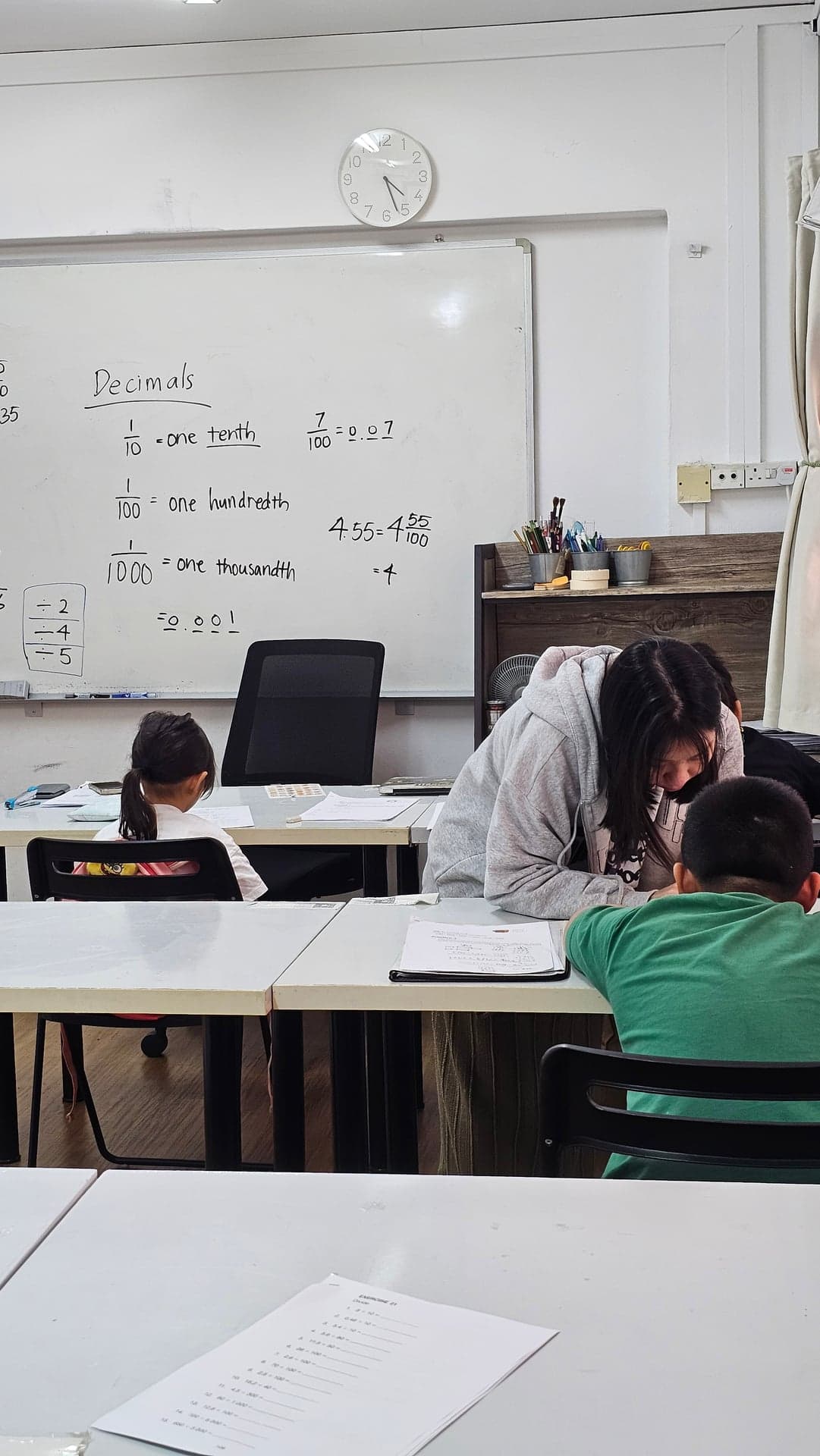
Singapore's maths olympiad pathway runs from two primary competitions — NMOS for Primary 5 and APMOPS for Primary 5 and 6 — to the Singapore Mathematical Olympiad (SMO), whose Junior, Senior and Open sections take students from Secondary 1 through junior college; entry is almost always through the school, and no organiser or Ministry of Education (MOE) page promises a DSA place for a result. Ancourage Academy teaches upper-primary Mathematics to the MOE syllabus, and this guide sets out the pathway level by level using the organisers' own published rules, explains how Direct School Admission actually reads a competition result, and gives an honest view of which children should enter. For most families the foundation is the school syllabus itself, which our P5 Mathematics programme is built around.
Ancourage Academy's Primary 4 Mathematics classes run in small groups of 3 to 6; book a trial class (usually $18) to start with a diagnostic of where your child stands.
What Is the Maths Olympiad Pathway in Singapore?
The pathway is not a single ladder run by one body: each competition has its own organiser, eligibility and rounds, and none feeds automatically into the next.
Three organisers run the competitions most Singapore families meet. NUS High School runs the National Mathematical Olympiad of Singapore (NMOS), which its introduction page describes as "an NUS High School initiative, working in partnership with the Singapore Mathematical Society." Hwa Chong Institution runs the Asia-Pacific Mathematical Olympiad for Primary Schools (APMOPS), which was renamed from SMOPS in 2002. The Singapore Mathematical Society (SMS) runs the SMO for secondary and pre-university students. A fourth, SASMO, is run by a separate international organiser and is covered in our SASMO and APMOPS formats guide.
| Level | Competition | Organiser | Who can enter | Rounds and format (2026, as published) |
|---|---|---|---|---|
| P5 | NMOS | NUS High School, with SMS | Primary 5 only, registered by the school | One 1 h 30 min paper, 35 questions, on 14 July 2026; no calculators |
| P5 and P6 | APMOPS (formerly SMOPS) | Hwa Chong Institution | All P6 students; Singapore P5 students | Online Round 1, 2 hours, 30 questions, 150 marks (16 April for P6, 18 April for P5); Invitation Round for the top 50 Singapore P6 participants on 30 May |
| Several levels | SASMO | SIMCC (Singapore International Mastery Contests Centre) | A differentiated paper at each level | See our SASMO guide |
| Sec 1 to 2 | SMO Junior Section | Singapore Mathematical Society | Sec 1 and 2, born on or after 2 January 2012 | Round 1: 2.5 h, multiple choice and short questions; top 10% invited to a 3-hour Round 2 |
| Sec 3 to 4 | SMO Senior Section | Singapore Mathematical Society | Sec 3 and 4, born on or after 2 January 2010 | Round 1: 2.5 h; top 10% invited to a 4-hour Round 2 |
| Sec 1 to JC | SMO Open Section | Singapore Mathematical Society | Full-time Sec 1 to 4 and JC students | Round 1: 2.5 h, short questions; selected participants invited to a 4-hour Round 2 |
Dates are the 2026 dates the organisers published and change every year; check the organiser's page each January.
How Do NMOS and APMOPS Work in Primary School?
NMOS is a Primary 5 competition that only schools can enter, while APMOPS takes Primary 6 students through their schools and Singapore Primary 5 students through a parent-completed online registration.
NMOS is tightly defined. Its rules page says the competition is "opened to Primary 5 school students only", that "ALL participants have to be registered via their primary school and schools have discretion to select their students for participation", and that "No individual registration will be allowed." The 2026 paper was "a 1 hour 30 minutes written paper comprising 35 questions", with questions worth 1 mark (Q1 to Q10) rising to 4 marks (Q31 to Q35). Registration ran from 20 February to 20 March 2026 at $25 per participant. Every participant receives a certificate "showing their level of achievement (Gold, Silver, Bronze, Honourable Mention or Participation)", and results go to schools, not parents.
APMOPS is broader: Hwa Chong Institution opens Round 1 to all Primary 6 students and to Singapore Primary 5 students, with P6 sitting at school and P5 at home under video recording, and invites the top 50 Singapore P6 participants to an Invitation Round. The round formats, marks and yearly calendar are set out in our SASMO and APMOPS guide.
What Happens in the Singapore Mathematical Olympiad (SMO)?
The SMO is a two-round competition in three sections, and only the students invited to Round 2 can be considered for Gold certificates and individual prizes.
The Singapore Mathematical Society says on its SMO page that it "has been organizing annual national mathematical competitions since the 1950's" and adopted the SMO name in 2001. All three sections share the same award rule, set out in the Junior Section rules: silver, bronze and honourable mention certificates are based on Round 1, and "Only participants invited for round 2 will be considered for individual prizes and the award of Gold certificates."
- Junior Section (Sec 1 and 2). Topics "would normally be within the curriculum of Secondary One and Two mathematics education." Participants "in the top 10% of round 1" go to a three-hour Round 2 "consisting of questions requiring full-length solutions."
- Senior Section (Sec 3 and 4). The Senior rules cover Secondary One to Four mathematics, with the same top-10% invitation to a four-hour Round 2.
- Open Section (Sec 1 to JC). The Open rules set topics "within the curriculum of a pre-university education", and state that Round 2 results "will be used as a key criterion for the selection of the Singapore National Training Team for the International Olympiad in the following year."
Registration is by the school. The rules say names and fees are forwarded "by the Head of Department of Mathematics (of the competing school)", and the 2026 registration instructions closed on 31 March 2026 with walk-in registration no longer allowed.
The Junior and Senior rules also state: "There will be a significant number of questions based on school mathematics syllabus."
How Does DSA Read Competition Results?
MOE lists "Science, mathematics and engineering" among the talents a P6 student can apply for through DSA-Sec, but each school decides whether it offers Mathematics as a talent area and how it selects — and schools state that meeting their criteria does not guarantee an offer.
MOE's DSA-Sec eligibility page says "P6 students can apply for DSA-Sec based on a wide range of talents, including:" a list that names "Science, mathematics and engineering". The same page adds that "Your child's PSLE score still matters", because a student admitted through DSA still needs a PSLE score within a Posting Group the school offers.
Few schools list Mathematics itself. Among the 17 schools in our DSA-Sec talent areas directory, only Hwa Chong Institution and Catholic High School (IP track) list it as a subject talent area. What they ask for is instructive:
| School | Talent area | What the school's DSA page says |
|---|---|---|
| Hwa Chong Institution | Mathematics | "For students who demonstrate strong logical reasoning and mathematical problem-solving skills." Also: "Applicants who do not have prior experience may also apply." |
| Catholic High School | Mathematics (IP) | "Have a portfolio of outstanding achievements and work that demonstrates passion and aptitude for Mathematics." Shortlisted applicants are invited to an interview. |
Neither page names a specific competition. Hwa Chong's admission page warns that "meeting all the criteria does not guarantee that the student will be shortlisted for an interview or given an offer", and Catholic High's DSA-Sec page says the same. NUS High's own NMOS FAQ, asked whether NMOS is related to DSA, answers only that it is "an excellent platform for students to showcase aptitude in mathematics. Participants who show outstanding performance will be noted." A certificate is evidence a school may weigh; it is not an admission route. Our DSA guide covers the full exercise, including the commitment a DSA place carries: four years in an SEC programme or six in an Integrated Programme.
Should Your Child Pursue Maths Olympiad?
For a mainstream child, olympiad is worth pursuing when school Mathematics is already secure and the child enjoys hard problems for their own sake; it is the wrong priority when school marks are uneven or when the only motive is a DSA offer.
Neither primary competition is restricted to GEP pupils: NMOS is open to any Primary 5 student a school selects, and APMOPS Round 1 to every P6 student, entered through their school. The decision is a family one, not a label; our GEP guide covers that separate programme.
- A good fit: the child finishes school worksheets comfortably, asks for harder questions, and is happy to spend twenty minutes on one problem without an answer.
- A good fit: the family is considering a DSA talent area in Mathematics and wants evidence of interest built over time, not in a single term.
- Not yet: the child is losing marks on fractions, ratio or model drawing in school papers. Those gaps cost more at the PSLE than any competition can return.
- Not yet: the child finds non-routine problems stressful rather than interesting. Competition papers can make the subject feel like a burden.
School syllabus mastery comes first. Ancourage Academy does not run an olympiad or competition programme: its P4, P5 and P6 Mathematics classes teach the MOE syllabus and PSLE problem solving, which is the base every competition on this page assumes.
How Do Olympiad Problems Differ From PSLE Heuristics?
PSLE problem sums reward choosing the right heuristic for a question built on the syllabus; olympiad papers reward the same reasoning applied to topics and question shapes the organiser, not the Singapore Examinations and Assessment Board (SEAB), defines.
PSLE problem solving leans on a known set of strategies — draw a model, work backwards, make a systematic list, look for a pattern — explained in our PSLE Maths heuristics guide and our model method guide. Olympiad questions use those same heuristics, but the organiser sets the scope. Hwa Chong lists the APMOPS scope as including "Arithmetic and Algebra", "Number Theory", "Geometry", "Combinatorics and Counting Principles", "Number Pattern and Puzzle", "Word Problems" and "Logic Problems".
| Feature | PSLE Mathematics | Primary olympiads (NMOS, APMOPS) |
|---|---|---|
| Who sets the scope | The MOE syllabus, examined by SEAB | The organiser's published topic list |
| What a question tests | Choosing and executing a heuristic within syllabus topics | Finding an approach to an unfamiliar structure, often counting, number or logic |
| Who sits it | Every Primary 6 pupil | Students a school selects (NMOS); P6 entered by their school, P5 by parents (APMOPS) |
| Calculators | Not allowed in Paper 1; allowed in Paper 2 | Not allowed in NMOS or either APMOPS round |
Olympiad practice gives a child more experience of unfamiliar problems. It does not fix careless errors or weak basics — the issues set out in our common primary maths mistakes guide.
What Does a Realistic Preparation Plan Look Like?
A realistic plan keeps school Mathematics as the main work, adds a small amount of genuine problem solving each week, and uses the organisers' own past papers and sample questions rather than volume.
- Secure the syllabus first. Check the last two school tests. If marks are being lost on routine questions, fix that before anything else.
- Use official material. NUS High says past NMOS questions are available through its NMOS Solution Books, and Hwa Chong publishes APMOPS sample questions on its competition site. The SMS offers sample SMO questions on its site.
- Work one problem deeply rather than ten quickly. Ask the child to explain the approach aloud afterwards.
- Practise without a calculator. NMOS rules state "NO CALCULATORS", and the APMOPS rounds disallow calculators, mathematical sets and tables.
- Talk to the school early. NMOS and SMO entries go through the school's Mathematics department, and the school decides who is registered.
- Keep a simple record. If DSA is in view, keep certificates and a short note of what the child worked on. Catholic High asks for "a portfolio of outstanding achievements and work", not a single result.
For children moving into secondary school, the SMO Junior Section builds on Secondary 1 and 2 Mathematics, so a secure start in Secondary 1 Mathematics matters more than any primary competition result. Our guide to the primary-to-secondary maths bridge explains how model drawing turns into algebra.
Common Questions About the Maths Olympiad Pathway
Can my child sign up for NMOS on their own?
No. NUS High's NMOS rules state that all participants must be registered through their primary school, that schools have discretion to select students, and that "No individual registration will be allowed." NMOS is open to Primary 5 students only. If your child is keen, ask the school's Mathematics department early in the year, before the February to March registration window.
Does a maths olympiad medal guarantee a DSA place?
No. MOE names "Science, mathematics and engineering" as a DSA-Sec talent area, but each school decides whether to offer Mathematics and how to select. Hwa Chong and Catholic High both state that meeting the criteria does not guarantee a shortlist or an offer, and a DSA student still needs a qualifying PSLE score.
What is the difference between NMOS and APMOPS?
NMOS, run by NUS High School with the Singapore Mathematical Society, is a single 90-minute paper for Primary 5 students entered by their school. APMOPS, run by Hwa Chong Institution, has an online Round 1 open to all P6 students and to Singapore P5 students, and an Invitation Round for the top 50 Singapore P6 participants.
Which SMO section should a secondary student take?
The SMS sets the Junior Section for Secondary 1 and 2 students and the Senior Section for Secondary 3 and 4, each with a birth-date limit, while the Open Section is open to full-time Secondary 1 to 4 and junior college students. Round 1 is a two-and-a-half-hour paper in every section, and the school registers participants.
Should my child do olympiad maths if they are struggling in school?
Usually not yet. Olympiad problems assume secure school Mathematics, and even the SMO rules say a significant number of questions are based on the school syllabus. Closing gaps in fractions, ratio and model drawing will do more for the PSLE. Ancourage Academy's P4 to P6 Mathematics classes teach the MOE syllabus; a trial class (usually $18) starts with a diagnostic.
Does Ancourage Academy run a maths olympiad programme?
No. Ancourage Academy teaches the MOE Mathematics syllabus at primary and secondary level and does not run olympiad or competition classes. Its P4 to P6 Mathematics classes focus on the school syllabus and PSLE problem solving, which is the foundation every competition on this page assumes. If your child wants competition practice, the organisers' own sample questions are the place to start.