
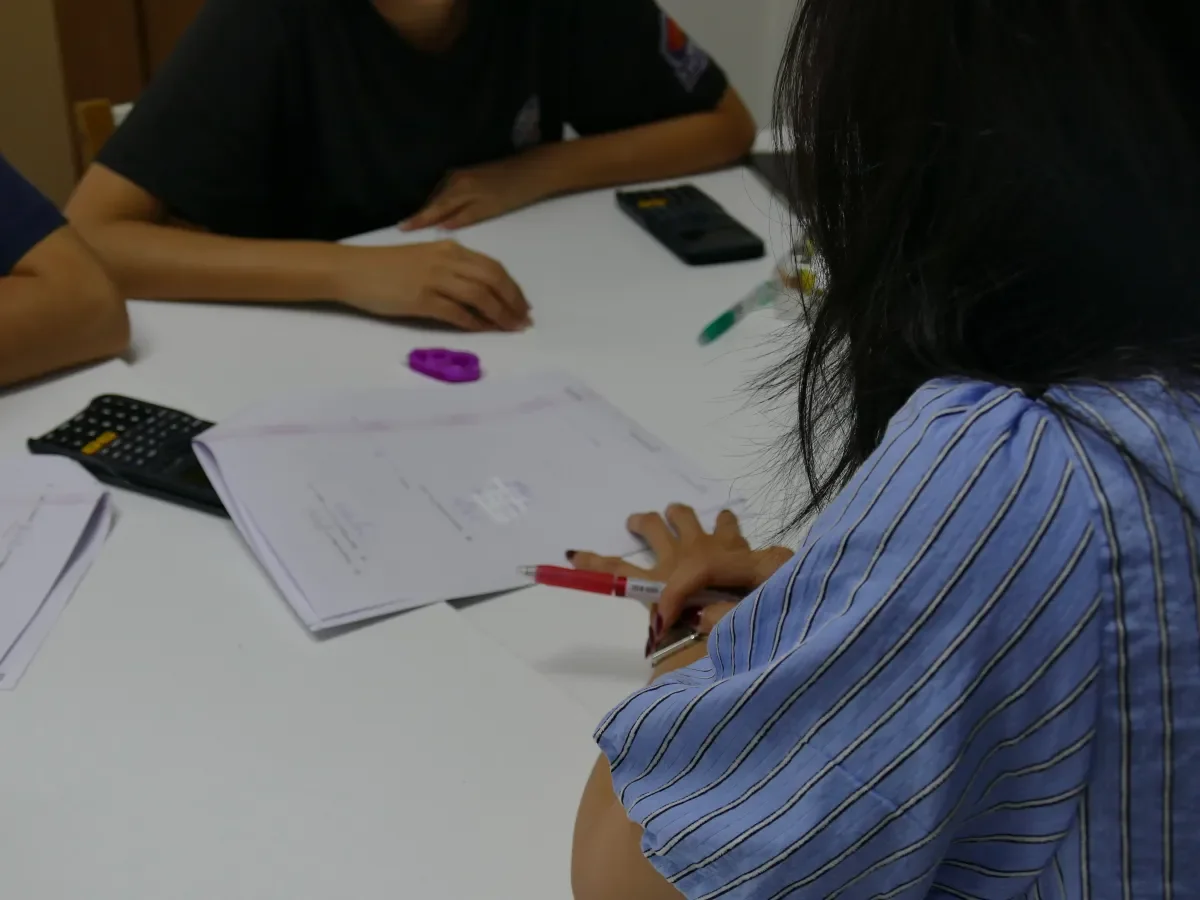
Ancourage Academy provides primary Chinese tuition in Bishan and Woodlands in small groups of 3 to 6 students, with targeted support for SAP school families. Bishan is home to two prominent SAP schools — Ai Tong School and Catholic High School (Primary) — where students follow an enriched Chinese curriculum from Primary 1 (P1) — and where MOE's Primary 1-2 Higher Chinese course runs, because it is offered only in SAP schools, so these pupils are on the Higher Chinese track years before the PSLE Higher Chinese paper at the end of P6. Ancourage Academy's tutors understand what these schools expect and how to help your child thrive.
As a multilingual educator and founder of Art by Ancourage, Angie has worked with families across Singapore to strengthen their children's Chinese foundations — particularly for SAP school students navigating the demands of Higher Chinese.
Chinese tuition for SAP school families requires a fundamentally different approach from standard Chinese tuition. SAP students are not struggling with basics — they are navigating an advanced curriculum that demands literary appreciation, formal written register, and cultural depth well beyond the standard syllabus. Generic Chinese enrichment programmes often pitch content too low for these students, wasting time and money. What SAP families need is targeted support that builds on existing strengths while closing specific gaps in examination technique, composition structure, and Higher Chinese readiness — the focus of Ancourage Academy's P1 to P6 Chinese tuition for SAP families.
Understanding Bishan's SAP School Chinese Curriculum
Special Assistance Plan (SAP) schools are a unique category of schools in Singapore that offer both English and Chinese as first languages. Unlike mainstream schools where Chinese is taught as a Mother Tongue subject, SAP schools integrate Chinese language and culture deeply into school life. Students use Chinese in daily communication, participate in cultural immersion activities, and follow a curriculum designed to produce genuinely bilingual individuals.
Ancourage Academy's Primary Chinese programme helps students from these schools in small groups of 3–6 at our Bishan centre — book a trial class (usually $18) for a diagnostic assessment.
Bishan has two SAP primary schools that most families in the area attend:
- Ai Tong School: A co-educational SAP school under the Singapore Hokkien Huay Kuan, known for strong Chinese immersion and cultural programmes
- Catholic High School (Primary): An all-boys SAP school with a competitive academic environment and rigorous Higher Chinese expectations
Both schools follow an enriched Chinese curriculum from Primary 1, exposing students to advanced Chinese content years earlier than their peers in mainstream schools: under MOE's 2024 primary Chinese syllabus the Primary 1-2 Higher Chinese Language (HCL) course runs only in SAP schools, and these pupils sit the PSLE Higher Chinese paper at the end of P6. This creates a strong foundation but also places sustained demands on students throughout primary school. For a comprehensive overview of Higher Chinese benefits and demands, read the Higher Chinese Singapore guide.
P1-P2 Chinese: Building the Foundation
The Primary 1 and Primary 2 years establish the building blocks that every subsequent level depends on. According to the MOE Primary Chinese syllabus, P1-P2 Chinese covers:
- Hanyu Pinyin (汉语拼音): Accurate pronunciation, tonal recognition, and pinyin-to-character mapping
- Basic character recognition: Stroke order, radical identification, and the 2024《小学华文课程标准》 recognition target of 700-750 characters, which MOE sets for the whole P1-P2 stage rather than for a single year (the superseded 2015 syllabus set 600-650)
- Sentence construction: Simple sentence patterns, punctuation, and basic grammar structures
- Oral confidence: Reading aloud with expression, answering questions in complete sentences, and show-and-tell activities
For SAP school students, these two years carry extra weight. Because Higher Chinese builds directly on P1-P2 foundations, gaps in pinyin accuracy or character recognition compound rapidly at upper primary levels. A child who confuses similar-sounding tones at P1 will struggle with dictation, comprehension, and even oral examinations through P6.
Ancourage Academy's P1 Chinese programme focuses on pinyin mastery and character confidence. The P2 Chinese programme then develops early sentence writing and reading fluency through structured 听写 (dictation) practice and guided reading — both essential for SAP students heading into the more demanding middle primary years.
P3-P4 Chinese: Developing Reading and Writing
Primary 3 and 4 represent a significant step up in Chinese language demands. Students transition from sentence-level work to paragraph and passage-level tasks. Key areas covered at this stage include:
- Paragraph writing: Structured compositions with introduction, body, and conclusion
- Idiom usage (成语): Learning and applying four-character idioms in context — critical for Higher Chinese
- Comprehension skills: Answering questions that require inference, not just literal recall
- Oral discussion: Expressing opinions on given topics with supporting reasons
One of the most important distinctions that emerges at P3-P4 is the difference between 书面语 (formal written Chinese) and 口语 (spoken Chinese). Many students — even those in SAP schools — write compositions using spoken Mandarin patterns. For example, they might write 很多 instead of the more formal 许多, or repeatedly use 然后 instead of 接着, 随后, or 之后. PSLE markers at both standard and Higher Chinese levels reward compositions that demonstrate command of written register.
Ancourage Academy's P3 Chinese programme introduces paragraph writing and idiom usage systematically, while the P4 Chinese programme bridges the gap between lower and upper primary composition demands. Both programmes help students develop the 书面语 awareness that becomes essential at P5-P6.
P5-P6 Chinese: PSLE and Higher Chinese Preparation
The upper primary years are where everything converges — school examinations intensify, PSLE preparation begins, and Higher Chinese decisions become concrete. The PSLE Chinese examination structure includes:
- Paper 1 — Composition Writing (40 marks): Choose one of two composition options — topic-based (命题作文) or picture-based (看图作文)
- Paper 2 — Comprehension (90 marks): Vocabulary MCQ, grammar cloze, comprehension passages with open-ended questions
- Paper 3 — Oral and Listening (70 marks): Reading aloud (20), video conversation (30), and listening comprehension (20)
For SAP school students, a critical strategic decision arises at this stage: whether to sit for Higher Chinese Language (HCL) at PSLE. Under the current PSLE Achievement Level scoring system, HCL does not provide bonus points. However, students with a Distinction, Merit, or Pass in HCL (and a PSLE score of 14 or better) gain a posting advantage to SAP secondary schools when competing with students who have the same PSLE Score — a meaningful advantage for families targeting schools like Catholic High Secondary or CHIJ St Nicholas Girls'.
Ancourage Academy's P5 Chinese programme builds the exam-specific skills needed for both standard and Higher Chinese papers, while the P6 Chinese programme provides intensive PSLE preparation with timed practice, composition marking, and oral simulation. For detailed PSLE Chinese strategies specific to Bishan SAP schools, read the PSLE Chinese preparation guide for Bishan SAP schools, or our focused walkthrough on scoring AL1 in PSLE Chinese composition.
Higher Chinese: Is It Worth the Effort?
For most SAP school students with solid Chinese foundations, Higher Chinese is worth it: it gives a SAP secondary posting advantage (Pass or better in HCL with a PSLE Score of 14 or better), sets up the O-Level / SEC G3 HCL pathway to a JC Mother Tongue exemption and 2 JC bonus points, and builds genuine bilingual command — against 3 to 5 extra study hours a week, a 200-character composition floor and a written-only paper. The answer depends on your child's specific situation, but here are the key considerations:
Benefits of Higher Chinese:
- SAP school posting advantage: A Distinction, Merit, or Pass in HCL (with PSLE score ≤ 14) gives priority over students with the same PSLE Score when applying to SAP secondary schools
- O-Level / SEC Higher Chinese pathway: Taking HCL at PSLE sets up the pathway to O-Level / SEC Higher Chinese at secondary level, where D7 or better exempts from H1 Mother Tongue at JC and A1-C6 (in both English and HCL) earns 2 JC bonus points
- Bilingual proficiency: Genuine command of formal Chinese opens doors in academia, business, and cultural engagement
Demands of Higher Chinese:
- Classical Chinese (文言文): not examined in the Higher Chinese paper, but SAP schools introduce it as enrichment, so stronger students meet archaic vocabulary and sentence structures early
- Longer compositions: SEAB sets a floor of 200 characters for HCL composition (字数须在200以上) against 100 for Standard Chinese, and markers expect more sophisticated narrative techniques
- Written-only assessment: The HCL exam has no oral or listening papers — results depend entirely on composition quality and comprehension accuracy, raising the stakes for written precision
- Time commitment: Expect 3 to 5 additional study hours weekly on top of standard Chinese work
For most SAP school students with solid foundations, Higher Chinese is worth pursuing. These students have been immersed in Chinese since P1 and already possess the vocabulary and cultural familiarity that mainstream students lack. The additional effort required is incremental rather than monumental. However, if your child consistently scores below 65 in HCL school examinations or shows visible stress around Chinese homework, it may be worth discussing alternatives with the school.
School-Specific Chinese Strategies
Each SAP school in Bishan has a distinct Chinese curriculum emphasis, and effective tuition must align with what the school expects.
Ai Tong School
Ai Tong is a co-educational SAP school under the Singapore Hokkien Huay Kuan. The school has a strong Chinese immersion culture — morning assemblies, Chinese calligraphy, cultural festivals, and Chinese chess clubs all contribute to an environment where Chinese is used naturally throughout the school day.
Ai Tong students typically have strong oral Chinese and cultural vocabulary but may need support in:
- English language balance: The intensive Chinese environment can mean less English reading and writing practice — families should ensure English exposure at home
- Examination technique: Strong language ability does not automatically translate to strong examination performance, especially for comprehension open-ended questions
- Composition structure: Students often have rich vocabulary but need guidance on PSLE-specific writing structures and time management
Catholic High School (Primary)
Catholic High is an all-boys SAP school known for its competitive academic environment. The school has particularly high expectations for Higher Chinese, and the peer culture reinforces academic achievement across all subjects.
Catholic High students typically face these specific challenges:
- Higher Chinese rigour: The school's internal HCL examinations are demanding, and boys may feel pressure to maintain high grades in a competitive environment
- Subject balance: The strong emphasis on both languages means Maths and Science sometimes receive less attention than they should
- Writing stamina: Boys at this age sometimes find sustained composition writing challenging — building writing endurance through regular practice is essential
Ancourage Academy tutors are familiar with the examination styles, curriculum expectations, and homework patterns of both schools. This allows Ancourage Academy to provide tuition that complements rather than duplicates what students already receive in school.
Oral Communication Skills Across P1-P6
The PSLE Chinese oral examination carries 50 marks — a significant portion of the total score — yet many families underinvest in oral preparation compared to written components. Oral proficiency develops across all six primary years and cannot be crammed in the final term.
Key oral skills by stage:
- P1-P2 — Reading aloud: Clear pronunciation, accurate tones, natural pacing, and appropriate expression. Students should practise reading Chinese storybooks aloud to develop fluency
- P3-P4 — Speaking with structure: Answering questions in complete sentences, providing reasons for opinions, and using connectors to link ideas logically
- P5-P6 — Video conversation: Watching a short video clip and discussing the topic with the examiner, offering personal opinions supported by examples and reasoning
The video conversation component is where many students — including SAP students — lose marks unnecessarily. The key is specificity: examiners reward answers that include personal experiences, concrete examples, and well-reasoned opinions. Generic responses like "I think it is good because it is important" earn minimal marks regardless of how fluently they are delivered.
"SAP students often surprise parents by scoring lower on oral than expected — their conversational Chinese is fluent, but exam oral requires structured argumentation with specific examples, which is a different skill entirely," notes Angie, founder of Art by Ancourage and a multilingual educator at Ancourage Academy. "Regular practice with video-based discussion topics closes this gap quickly."
Building oral confidence requires regular practice in a supportive environment where students feel comfortable speaking Chinese without fear of judgement. Ancourage Academy's small group classes of 3 to 6 students create this environment naturally, giving every student multiple opportunities to speak and receive feedback in each session.
When to Consider Chinese Tuition
The decision to start Chinese tuition is different for SAP and non-SAP families. For SAP school students, watch for these indicators:
- Scores declining from P3 onwards: The jump in difficulty at P3-P4 reveals foundation gaps that need addressing
- Reluctance to read Chinese independently: SAP students should enjoy Chinese reading — if they avoid it, something is undermining confidence
- Struggling with 书面语 in compositions: Writing that reads like spoken Chinese suggests a gap between conversational ability and academic language
- Anxiety about Higher Chinese: If HCL is causing stress rather than challenge, targeted support prevents the situation from worsening
- Strong oral but weak written skills: Common in SAP schools where the immersive environment builds speaking confidence but formal writing requires separate development
For non-SAP students considering Bishan tuition centres, the indicators are different — you are looking for signs that standard Chinese is becoming difficult, rather than Higher Chinese specifically.
Visit the Bishan centre at 152 Bishan Street 11 to discuss your child's needs, or book a trial class (usually $18) to experience Ancourage Academy's teaching approach firsthand. For more SAP-school and Higher Chinese guidance, explore our Chinese learning hub. You can also WhatsApp us if you have any questions.
Common Questions About Chinese Tuition in Bishan
Should my SAP school child take Higher Chinese?
For most SAP students with consistent scores above 70 in school HCL assessments, yes. HCL Distinction, Merit, or Pass (with PSLE score ≤ 14) provides a posting advantage to SAP secondary schools when PSLE Scores are tied, and continuing HCL at secondary level opens the pathway to JC Mother Tongue exemption via O-Level / SEC Higher Chinese. Only consider dropping HCL if it causes severe stress affecting other subjects.
When should P1 Chinese tuition start?
For SAP families, starting in P1 or P2 builds the pinyin and character foundations that Higher Chinese demands at upper primary. Early intervention prevents gaps from compounding. Even one weekly session focused on reading fluency and writing accuracy makes a measurable difference by P3.
How is Chinese tuition different for SAP school students?
SAP students need tuition that builds on existing strengths rather than teaching basics from scratch. Effective tuition focuses on examination technique, 书面语 register and composition structure, and Higher Chinese comprehension strategies — not pinyin drills that SAP schools already cover thoroughly.
What does the PSLE Chinese oral exam involve?
The PSLE Chinese oral (50 marks) comprises reading aloud (20 marks) and a video conversation (30 marks). Students watch a video clip and discuss the topic with the examiner, earning marks for fluency, pronunciation, content, and personal opinions with supporting reasons. See the Primary Chinese tips guide.
How can I support my child without adding pressure to an already heavy Chinese load?
If your child seems stretched between two first languages, start with reassurance rather than more worksheets. SAP school students in Bishan carry a heavier Chinese load than most primary children, so some fatigue is normal, not a sign of failure. Watch the balance: if Chinese reading is being avoided or English practice is slipping, gently rebalance home routines before adding pressure. Talk with your child's school about realistic Higher Chinese expectations, and remember progress at this age is gradual. At Ancourage Academy, our small groups of 3 to 6 are designed to build confidence calmly rather than pile on stress. For the wider picture on Higher Chinese demands, read the Higher Chinese Singapore guide, and the Primary Chinese tips guide offers gentle at-home ideas.
Related: P2-P4 Maths Tuition in Bishan · Primary English Tuition in Bishan · Primary Science Tuition in Bishan · P5-P6 Chinese Tuition in Bishan · PSLE Chinese for Bishan SAP Schools · Higher Chinese Singapore Guide · Bishan schools guide · Pricing