
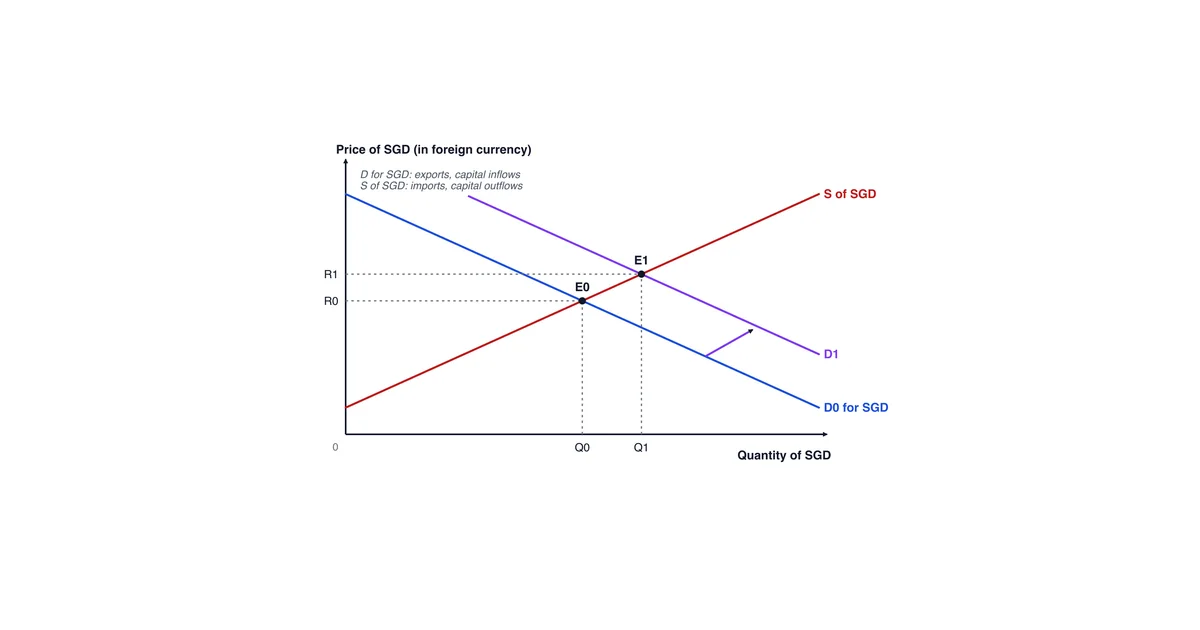
Singapore's monetary policy works through the exchange rate, not an interest rate: the Monetary Authority of Singapore (MAS) guides the Singapore dollar against a trade-weighted basket of currencies inside a policy band, and a stronger dollar lowers the Singapore-dollar price of imports, which dampens inflation. Ancourage Academy teaches this transmission step by step in its JC Economics programme, because it is the part of Theme 3 that H2 Economics students most often describe as if Singapore had a Federal Reserve. This guide covers what the 9570 syllabus asks for, the three policy families, the S$NEER mechanism and a worked essay plan built on the 2026 policy decisions.
Ancourage Academy's JC1 H2 Economics classes run in small groups of 3 to 6; book a trial class (usually $18) to start with a diagnostic of where your child stands.
What Does the 9570 Syllabus Ask You to Know About Macro Policy?
The Singapore Examinations and Assessment Board (SEAB) H2 Economics syllabus (9570) names three policy families in Theme 3.2 and is explicit that monetary policy works through "the management of exchange rates (case of Singapore) and interest rates".
The 9570 syllabus for the 2027 examination lists the macroeconomic objectives as "sustainable and inclusive economic growth, low unemployment, price stability and a favourable balance of trade position". Section 3.2.3 then lists the policies:
- Fiscal policy — "How discretionary fiscal policy can influence the level of economic activities and living standards through government spending and taxation".
- Supply-side policies — "How supply-side policies can improve quantity, quality and mobility of factors of production to increase the productive capacity of an economy".
- Conflicts — "Possibilities of conflicts between macroeconomic objectives and how this may affect governments' decision on macroeconomic policy".
The syllabus also requires knowledge of the Marshall-Lerner condition (without derivation). Paper 2 sets six essays, and candidates answer three, "of which one must be from Section A, one from Section B" — Section B being the macroeconomics section. So at least one of your three A-Level essays will be macro. The full paper structure is in our H2 Economics 9570 guide.
Why Does MAS Manage the Exchange Rate Instead of Interest Rates?
MAS states that in Singapore "the exchange rate has a much stronger influence on inflation than the interest rate", because trade is so large relative to the economy and so much domestic spending goes on imports.
MAS's own monetary policy framework page gives the reasoning: "In a small and open economy such as Singapore, where gross exports and imports of goods and services are more than 300 percent of GDP and domestic expenditure has a high import content, the exchange rate has a much stronger influence on inflation than the interest rate." The MAS FAQs on the framework put the import share more concretely: "almost 40 cents of every dollar spent domestically is on imports".
The second reason is the policy trilemma. Singapore keeps its capital account open, and MAS explains that it "is unable to target both the exchange rate and the interest rate because it has an open capital account". Domestic interest rates "are largely determined by global interest rates and foreign exchange market expectations of the Singapore dollar", and MAS says its exchange rate policy "is Singapore's only form of monetary policy".
MAS describes the operating framework as the "'Basket', 'Band', and 'Crawl' or 'BBC' system":
- Basket — the Singapore dollar nominal effective exchange rate (S$NEER) is "a trade-weighted basket of currencies".
- Band — the S$NEER "is allowed to float within a policy band that is set around the targeted crawl rate".
- Crawl — the band follows "a typically appreciating path".
What Do the Slope, Width and Centre of the Policy Band Mean?
MAS changes policy by adjusting three parameters of the S$NEER band: its slope (the rate at which the band crawls upward, so a steeper slope means faster appreciation and tighter policy), its width (how far the exchange rate may move either side of the centre) and the level at which it is centred (re-set only when the outlook changes abruptly) — and its decisions "are thus typically characterised by shifts in the slope".
- Slope (the rate of crawl). MAS says "A positive slope to the band is typically equivalent to a tightening of monetary policy, in the same way that other central banks, such as the US Federal Reserve, tighten monetary policy by raising their policy interest rate." Easing means reducing the slope, which "has been set as low as 0%".
- Centre (the mid-point). Re-centring is the larger move, used when "the outlook for growth and inflation changes abruptly and rapidly", as in April 2009.
- Width. The band "is widened when there is a significant increase in the level of uncertainty", as in October 2001.
The S$NEER is kept inside the band by intervention. In MAS's words, "The primary tool for managing the S$NEER is intervention operations in the spot foreign exchange (FX) market." The full FAQ set is published by MAS as FAQs on Singapore's Monetary Policy Framework.
How Do Fiscal, Monetary and Supply-Side Policies Compare in Singapore?
Each policy family works through a different part of the AD/AS model, and Singapore's openness weakens some channels while strengthening others — which is exactly the evaluation examiners want in a Section B essay.
| Policy family | Instrument | Transmission (AD/AS in words) | Singapore constraint to evaluate |
|---|---|---|---|
| Fiscal | Government spending, taxes, transfers | Higher G or lower taxes raises AD; the multiplier enlarges the rise in national income; targeted transfers change income distribution | A high import content means a large leakage, so the multiplier is small and much of any stimulus spills abroad; the government aims "to keep the budget balanced over time" |
| Monetary (exchange rate) | Slope, centre and width of the S$NEER band, delivered by FX intervention | Appreciation lowers the S$ price of imports, cutting costs and shifting AS right; it also dampens net exports, slowing AD growth | Interest rates cannot be set independently under an open capital account; appreciation squeezes price-sensitive exporters |
| Supply-side | Training, productivity and industry schemes | Raises the quantity, quality and mobility of factors, shifting long-run AS right and raising productive capacity | Long time lags; results depend on take-up by firms and workers; little help against an inflation spike in the same quarter |
The constraints cut both ways: the openness that makes fiscal stimulus leak abroad is what makes the exchange rate powerful against imported inflation. For how to draw the AD/AS shifts in the table accurately, see the sibling H2 Economics diagrams atlas.

How Does an S$NEER Appreciation Bring Inflation Down?
MAS identifies two channels — the "imported inflation" channel and the "derived demand" channel — and a full answer traces both, then weighs the cost to exporters.
- MAS steepens the slope of the band. The S$NEER follows a faster appreciation path against the trade-weighted basket.
- Import prices fall in Singapore-dollar terms. MAS: "an appreciation of the Singapore dollar against the currencies of our major trading partners reduces the S$ prices of imported goods and services". MAS reports "strong, and almost full, pass-through of exchange rate changes to import prices".
- Costs of production fall. Imported fuel, food and intermediate inputs become cheaper, so unit costs fall and AS shifts right (or shifts left by less than it would have). This works directly against cost-push inflation.
- Consumer prices follow with a lag. The lower import prices "filter through to consumer prices with a time-lag", so the effect on CPI is not immediate.
- Export prices rise in foreign-currency terms. With short-run price rigidities, MAS says an appreciation "will dampen aggregate demand, leading firms to cut back on domestic production and hold back on investment and hiring", narrowing a positive output gap and easing demand-pull pressure. This is the derived demand channel.

The trade-offs are where your evaluation marks live:
- Export competitiveness. Appreciation risks slower growth and job losses in price-sensitive exporting firms.
- The counter-argument MAS itself makes. MAS notes that "there is a high degree of imported content in Singapore's merchandise exports" and that demand for many of Singapore's exports "is relatively insensitive to changes in price" and "more sensitive to changes in global income". Cheaper imported inputs partly offset the higher export price.
- Long-run neutrality. MAS is clear that "over the long run" its exchange rate policy "has no impact on real variables like aggregate demand and employment, and only affects prices".
- Balance of trade. Whether appreciation worsens the trade balance depends on price elasticities (the Marshall-Lerner condition; see our elasticity worked calculations).
Worked Essay: Is Exchange-Rate Policy the Most Effective Way to Manage Inflation in Singapore?
A top-band answer to "Discuss whether exchange-rate policy is the most effective way to manage inflation in Singapore" agrees that it is the most effective tool against imported, cost-push inflation, then shows it is weaker against domestically generated inflation and needs fiscal and supply-side support. The judgement turns on the source of the inflation, not on the tool.
Treat this as a 15-mark part (b). A workable plan:
- Introduction. Define demand-pull and cost-push inflation; state that MAS targets the S$NEER; give the thesis.
- Thesis. Imported inflation channel, with an AS diagram.
- Support. Derived demand channel against demand-pull inflation, with an AD diagram.
- Anti-thesis 1. Domestic sources such as rents and wages respond less to the exchange rate; productivity-raising supply-side policy tackles unit labour costs directly.
- Anti-thesis 2. Appreciation conflicts with growth in exporting sectors; targeted transfers ease living costs without broad-based demand.
- Judgement. The primary tool given openness, most effective within a mix; weigh by the current source of inflation.
Here is the thesis paragraph written out in full:
In Singapore, exchange-rate policy is the most effective tool against imported, cost-push inflation because the economy is small and extremely open. MAS notes that gross exports and imports exceed 300 percent of GDP and that almost 40 cents of every dollar spent domestically goes on imports, so the price level is heavily driven by the Singapore-dollar price of imports. When global energy prices climb, MAS can increase the slope of the S$NEER policy band so that the Singapore dollar appreciates faster against its trade-weighted basket. Imported oil, food and intermediate inputs then cost fewer Singapore dollars, so firms' unit costs fall relative to what they would otherwise have been. On an AD/AS diagram, the leftward shift of AS caused by dearer imports is smaller, and the general price level rises less. MAS reports almost full pass-through to import prices, so the channel is strong, though it reaches consumer prices with a lag. An interest-rate rise is not an equivalent option, because with an open capital account Singapore's interest rates largely track global rates. Hence, for inflation that originates abroad, exchange-rate policy is the more effective instrument — the question the rest of the essay must test is whether the inflation Singapore faces is mainly imported.
The last sentence hands the argument to the anti-thesis. For how the 10-mark and 15-mark parts are marked differently, see the H2 Economics essay and CSQ technique guide; for the same plan structure applied to a microeconomics question, see the sibling market failure worked CSQ and essay.
Evaluating the 2026 Policy Mix: MAS, the Budget and the Support Packages
In 2026 Singapore tightened monetary policy twice while also delivering targeted fiscal support and a supply-side restructuring — a textbook policy mix you can cite with dates.
Monetary. The MAS Monetary Policy Statement of 27 July 2026 records that in April 2026 "MAS increased slightly the rate of appreciation" of the S$NEER policy band. In July it decided to "increase the rate of appreciation of the policy band very slightly", adding: "The extent of this increase is smaller than that in April." It also stated: "There will be no change to the width of the policy band and the level at which it is centred." The reasoning is the imported-inflation channel in action: "external price pressures are expected to persist and pass through more broadly to domestic consumer prices in the period ahead." For 2026, both core and headline inflation "are projected to average 1.5–2.5%".
Fiscal. Budget 2026 kept the fiscal rule in view. In the Budget 2026 statement on the fiscal position, the Prime Minister and Minister for Finance said: "Our approach remains to keep the budget balanced over time, and across the ups and downs of the economic cycle." On 29 July 2026 the Government announced a second support package "of around $900 million to help Singaporeans and businesses manage cost pressures due to the continuing situation in the Middle East".
Supply-side. The same Budget announced, in its workforce section: "We will merge SkillsFuture Singapore and Workforce Singapore into a new statutory board jointly overseen by MOE and MOM" — a measure aimed at the quality and mobility of labour.
How to evaluate the mix in an essay:
- Complementary roles. The exchange rate caps imported inflation; targeted transfers cushion households without a broad rise in AD; supply-side reform addresses long-run costs.
- Why not bigger fiscal stimulus? Import leakage and the balanced-budget principle both favour targeted spending.
- Conflict of objectives. Citing the Ministry of Trade and Industry's advance estimates, MAS reports growth of "5.7% y-o-y in Q2 2026" and that the "positive output gap is now forecast to widen slightly", so tightening involves less conflict with growth than it would in a slowdown.
Common Errors That Cost Marks in Singapore Macro Essays
The most expensive error is writing about MAS as if it sets an interest rate like the US Federal Reserve; MAS itself says it "does not use domestic interest rates as a tool to carry out its exchange rate-centred monetary policy".
- Treating MAS as a rate setter. Phrases such as "MAS raises interest rates to curb spending" misstate the framework.
- Ignoring imported inflation. Discussing only demand-pull inflation misses the imported inflation channel.
- Confusing the S$NEER with a bilateral rate. MAS "focuses on the S$NEER rather than a bilateral exchange rate", because the trade-weighted basket "better reflects Singapore's diverse trading patterns".
- Calling it a peg. MAS states it "does not have a crawling peg" and that "Singapore does not run an exchange rate peg" — the S$NEER floats within the band.
If macro essays are the part of the paper that is holding back an otherwise solid grade, the JC1 H2 Economics and JC2 H2 Economics classes at Ancourage Academy practise these chains with feedback, and you can book a trial class (usually $18) first. See also the JC subject combination guide, the JC1 to JC2 promotion criteria guide, the secondary-to-JC transition guide and the JC and A-Level hub.
Common Questions About H2 Economics Macro Policy
Does MAS set interest rates in Singapore?
No. MAS uses the Singapore dollar nominal effective exchange rate as its intermediate target and states that its exchange rate policy is Singapore's only form of monetary policy. Because the capital account is open, domestic interest rates such as the Singapore Overnight Rate Average (SORA) are largely determined by global rates and expectations about the Singapore dollar, not by an MAS policy rate.
What is the S$NEER in simple terms?
The S$NEER is the value of the Singapore dollar against a basket of the currencies of Singapore's major trading partners and competitors, weighted by their importance to Singapore's trade. MAS lets it float within a policy band and adjusts the band's slope, width and centre. It is not the exchange rate against any single currency, such as the US dollar.
Is exchange-rate policy on the H2 Economics 9570 syllabus?
Yes. Theme 3.2 of the 9570 syllabus lists monetary policy working "through the management of exchange rates (case of Singapore) and interest rates", alongside fiscal and supply-side policies and the possibility of conflicts between macroeconomic objectives. Paper 2 requires at least one essay from the macroeconomics section, so a Singapore policy question is a realistic possibility in the H2 paper.
How often does MAS change monetary policy?
Four scheduled reviews a year, in January, April, July and October, each followed by a Monetary Policy Statement recording whether the slope, width or centre changed; a review does not always mean a change. In 2026, the January statement maintained the prevailing rate of appreciation; the April and July statements each increased it, the July increase being smaller than April's.
Does a stronger Singapore dollar hurt exports?
It raises the foreign-currency price of exports, which can hurt price-sensitive exporters, and that is the main trade-off to evaluate. MAS points out, however, that Singapore's exports have high imported content, so cheaper imported inputs partly offset the effect, and that demand for many Singapore exports responds more to global income than to price.