
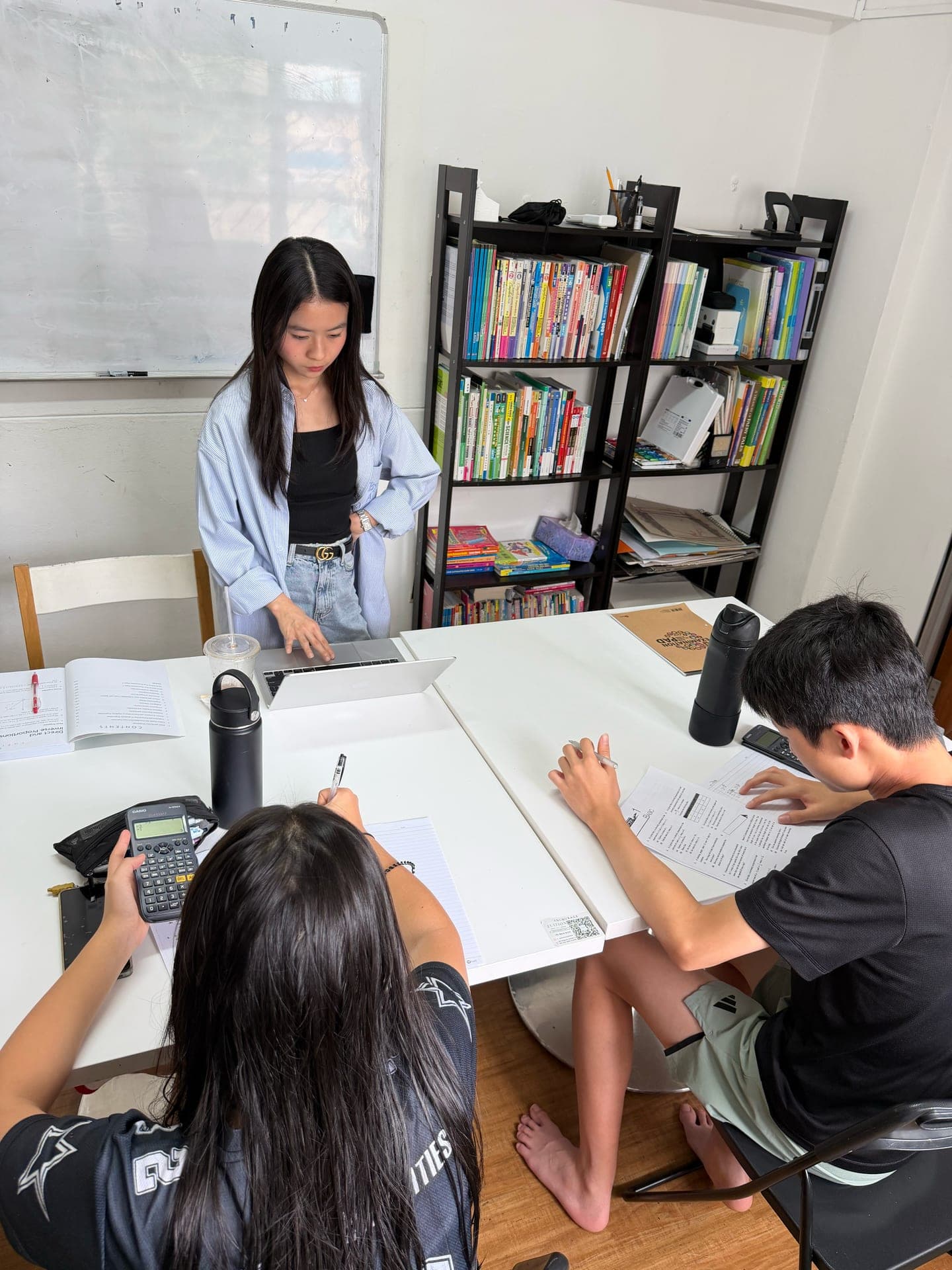
H2 Economics (Syllabus 9570) is examined through two papers — Paper 1 Case Studies (40%) and Paper 2 Essays (60%) — totalling 135 marks. The syllabus covers microeconomics and macroeconomics, taught through a decision-making approach that rewards two-sided analysis and evaluation. This guide is from Ancourage Academy, whose JC Economics tuition programme prepares students for both papers at H1 and H2 level.
Economics is one of the most popular H2 subjects in Singapore JCs, partly because it requires no prior O-Level / SEC background — most students start from scratch in JC1. That fresh start is an advantage only if you build the right habits early: thinking in trade-offs, drawing accurate diagrams, and evaluating both sides of every policy. This guide walks through the 9570 paper structure, the micro and macro content, and how to approach the case study and essay papers.
What Is H2 Economics (Syllabus 9570)?
H2 Economics 9570 is the current Singapore-Cambridge A-Level syllabus, organised around three themes and a decision-making approach. Unlike the H2 sciences, Economics was not part of the recent syllabus-code revision, so 9570 remains the code students prepare for. The full syllabus is published by the Singapore Examinations and Assessment Board.
The three themes are the Central Economic Problem, Markets (microeconomics), and the National and International Economy (macroeconomics). If you are still choosing subjects, our guide to JC subject combinations explains how Economics fits Arts, Science and hybrid combinations, and the L1R4 admission guide covers entry after the O-Level / SEC examinations.
How Is H2 Economics (9570) Structured?
The 9570 examination has two papers: Paper 1 (Case Studies) carries 40% and Paper 2 (Essays) carries 60%, for a total of 135 marks. Both papers test microeconomics and macroeconomics, so you cannot revise one half and ignore the other.
| Paper | Format | Marks | Weighting | Duration |
|---|---|---|---|---|
| Paper 1 | Case Studies — two compulsory (30 marks each) | 60 | 40% | 2 h 30 min |
| Paper 2 | Essays — answer 3 of 6 (≥1 micro, ≥1 macro) | 75 | 60% | 2 h 30 min |
Each essay has two parts: part (a) carries 10 marks and part (b) carries 15 marks, with the higher-order evaluation marks concentrated in part (b). Students wanting structured practice can join our JC1 and JC2 H2 Economics classes, or book a trial class (usually $18) to sit in on a lesson first.
Microeconomics Core (Themes 1 and 2)
Microeconomics is built on the Central Economic Problem and the workings of markets — the price mechanism, firms and decisions, and microeconomic objectives and policies. The foundation is scarcity, choice and opportunity cost, which underpins every later topic.
Theme 2 (Markets) covers how the price mechanism allocates resources, demand and supply and their elasticities, market failure, market structures, and government intervention. These are the building blocks for both case study application and essay evaluation, so a secure grasp of micro diagrams pays off across the whole paper.
The 9570 syllabus needs about fifteen diagrams, from the production possibility curve to the tariff diagram; the H2 Economics diagrams guide shows how to draw and label each one.
Market failure means the free market allocates resources inefficiently; our market failure worked guide shows that gap on a diagram, applies it to case study data and judges the policy that corrects it.
Price elasticity of demand is the percentage change in quantity demanded divided by the percentage change in price, and income, cross and supply elasticities follow the same shape; our H2 Economics elasticity worked calculations guide works all four step by step.
Macroeconomics Core (Theme 3)
Macroeconomics extends the analysis to the whole economy through Theme 3, the National and International Economy. You study the circular flow of income, aggregate demand and aggregate supply, the standard of living, and the major macroeconomic aims.
From there, the syllabus develops fiscal, monetary and supply-side policies, plus international trade and exchange rates. The strongest answers connect policy choices back to specific macro aims and weigh their limitations — exactly the kind of evaluation examiners reward.
Singapore's monetary policy works through the exchange rate, not an interest rate: MAS guides the Singapore dollar against a trade-weighted basket inside a policy band, and our H2 Economics guide to Singapore's exchange-rate macro policy traces that transmission step by step.
H1 or H2 Economics: Which Should You Take?
H1 Economics (8843) covers a narrower content scope and is assessed by case studies only, while H2 Economics adds the essay paper and deeper macroeconomic analysis. Students taking Economics as a contrasting subject or heading toward non-economics courses often take H1, while those aiming for economics, business or social-science degrees usually take H2.
Match the choice to your university pathway and overall load. If you are still mapping your combination, the subject combination guide and the secondary-to-JC transition guide are useful starting points.
How Do You Tackle the Case Study Question (CSQ)?
Paper 1 presents data in text, numbers and graphs, followed by part-questions that move from data response to application and evaluation. The skill is reading the extracts precisely and answering the exact command word, not writing everything you know.
Because CSQ technique deserves dedicated practice, we cover it in depth in our H2 Economics essay and CSQ technique guide — including how marks are split between data-response and higher-order analysis, and how to manage your time across two case studies.
Essay Technique in Brief
Strong essays use a clear thesis, two-sided analysis with accurate diagrams, and genuine evaluation rather than a one-line conclusion. Part (a) typically tests explanation and analysis; part (b) tests judgement, so the evaluation marks live there.
The full method — command words, essay scaffolds, and worked examples — is in the essay and CSQ technique guide, so this overview keeps to the essentials.
What Are the Most Common H2 Economics Mistakes?
The single most common mistake is one-sided analysis — arguing a case without weighing the counter-argument, which caps essay marks well below an A. Examiners reward balanced reasoning and explicit evaluation.
- Drawing diagrams that are not referred to in the written argument.
- Defining concepts but never applying them to the case or essay context.
- Ignoring the command word — "explain", "discuss", "assess" and "evaluate" demand different responses.
- Spending too long on Paper 1 data-response parts and running out of time for the higher-mark evaluation.
Common Questions About H2 Economics
Do I need to have studied Economics before JC to take H2 Economics?
No. H2 Economics (9570) assumes no prior O-Level / SEC Economics, and most JC students begin the subject in JC1. The advantage goes to students who build good habits early — thinking in trade-offs, drawing accurate diagrams, and evaluating both sides of policy questions — rather than to those with a head start in content.
How is H2 Economics assessed?
H2 Economics 9570 has two papers: Paper 1 (Case Studies, 60 marks, 40%, two compulsory case studies) and Paper 2 (Essays, 75 marks, 60%, answer three of six with at least one microeconomics and one macroeconomics essay). Each essay has a 10-mark part (a) and a 15-mark part (b), with the evaluation marks concentrated in part (b).
What is the difference between H1 and H2 Economics?
H1 Economics (8843) has a narrower content scope and is assessed by case studies only, while H2 Economics adds an essay paper and deeper macroeconomic analysis. Take H2 if you are aiming for economics, business or social-science degrees; H1 often suits students taking Economics as a contrasting subject or heading toward unrelated courses.
Is H2 Economics hard to score in?
Economics is demanding because both papers reward evaluation, not memorisation — you must argue two sides and reach a justified judgement. Students who master diagram accuracy, application to the question, and balanced evaluation tend to do well. The biggest barrier is one-sided writing, which is why technique-focused practice on the case study and essay papers matters so much.
Which themes does H2 Economics cover?
H2 Economics 9570 is organised around three themes: the Central Economic Problem (scarcity, choice, opportunity cost), Markets (microeconomics — the price mechanism, firms, market failure, market structures and policy), and the National and International Economy (macroeconomics — aggregate demand and supply, macro aims, fiscal/monetary/supply-side policy, trade and exchange rates).