
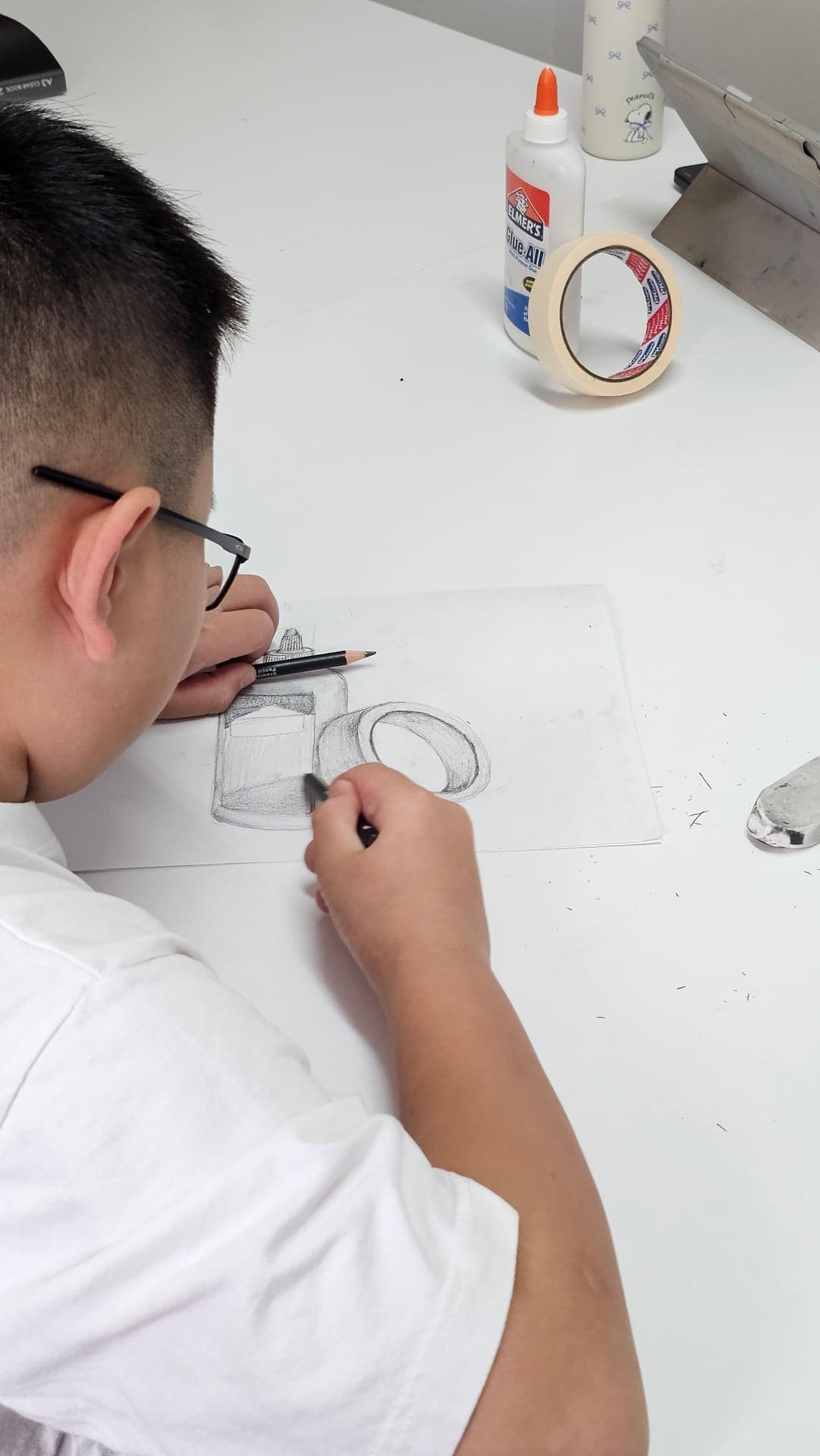
Drawing from a reference photograph is normal, taught studio practice — what the O-Level / SEC Art syllabus penalises is using someone else's image without acknowledging it. That distinction is the whole of the issue, and it is the one most parents have never had explained to them. At Art by Ancourage we teach reference discipline from the first observational drawing lesson, because by the time a student is assembling a DSA portfolio or an O-Level / SEC Art coursework portfolio, the habit is either already there or it is a problem.
I am asked some version of this question almost every term. A child has found an image they love and wants to draw it. A parent worries that copying is cheating. A secondary student has thirty saved images and no record of where any of them came from. None of these are disasters — but the last one becomes one at portfolio stage, and it is entirely preventable.
What Does the O-Level / SEC Art Syllabus Actually Say?
The 6114 Art syllabus states that all work submitted, whether for learning or for assessment, is to be authentic and based on the student's individual and original ideas and efforts — and that students must acknowledge all sources and make known the use of applications or tools in their work. Authenticity and attribution are named requirements, not implied ones.
The syllabus is unusually specific about what counts as a source needing attribution. It lists literature references, parts of a work inspired by others, collaborative tasks with peers, consultations with external parties, the use of readymade materials, and software or AI tools. Where possible it recommends a standard, consistent referencing style such as APA. The published syllabuses are available from the Singapore Examinations and Assessment Board.
The same requirements carry into the Secondary Education Certificate. Under SEC, Art is K347 and Higher Art is K348, and the K347 syllabus keeps the identical paper structure — a 2 hour 15 minute, 50-mark Visual Response paper at 50% and a 30-hour Portfolio at 50%, marked against the same five criteria — alongside the same "Respect for Creative Expressions & Academic Integrity" and "Academic Citation by Students" sections. The wording quoted throughout this guide is from the O-Level 6114 document; students on either code are working to the same expectation. Our O-Level to SEC transition guide covers the wider changeover.
Read that list again and notice what it does not say. It does not say a student may not work from a photograph. It does not say borrowing a composition is forbidden. It says the inclusion of ideas or work by others should be fully attributed, so that it is clear which aspects can be considered the student's own work. The test is clarity of authorship, not purity of invention.
Is Citation Actually Worth Marks?
Yes — attribution sits inside a 10-mark assessment criterion, not in a separate conduct policy. The O-Level / SEC Art Portfolio is marked against five criteria of 10 marks each: Ideas and Influences; Visual Language; Art Forms, Media and Technical Processes; Artistic Intent; and Making Connections.
Making Connections asks candidates to identify and analyse links and influences between their own and others' works of art, and to understand the value of creative works by acknowledging works, expressions and ideas appropriately. The achievement descriptors for that criterion run from "diligent and comprehensive in acknowledging the expressions and works of others, with appropriate citation" at the top, through "some citations provided for works of others with some works not attributed", down to a bottom band that reads: "Little or no citations provided. Difficulty in distinguishing the candidate's works from the works of others."
That bottom descriptor is worth sitting with. It does not describe a student who cheated. It describes a portfolio a marker cannot navigate — where the moodboard, the studies and the final piece blur together and nobody can tell which marks on the page are the candidate's. A student can lose those marks through disorganisation alone.
For the wider picture of how the Portfolio and the Visual Response paper fit together, our O-Level Art coursework and exam guide covers the full 6114 structure.
What Does Higher Art Add?
Both syllabuses list the same objective: 6114 (O-Level Art) and 6124 (Higher Art) each place "attribute sources and record citations" under Knowledge with Understanding. Both also require candidates to include citations and relevant images and to observe academic honesty when referencing the works of others, with in-text citations forming part of the submission requirements alongside file naming, file size and file type. What Higher Art adds is not a stricter citation rule but a second layer of authentication.
The Higher Art Project goes further still. It must be undertaken under normal conditions of classroom study, and each submission must be accompanied by a statement from the subject tutor, endorsed by the school Principal, testifying that it is the authentic work of the candidate. Someone signs their name to the claim that the work is the student's own.
Students on that track have usually been building portfolios for years, which is why we treat reference habits as a long-horizon skill rather than an exam-year fix. See our DSA art portfolio guide for how that pathway is built.
Is Appropriation Allowed in Student Art?
Appropriation is not only allowed, it is named in the syllabus as one of the postmodern principles students are expected to have vocabulary for — alongside juxtaposition, layering, and the interaction of text and image. Borrowing existing imagery is a recognised contemporary art strategy, and the syllabus treats it as one.
The line, then, is not between original and borrowed. It is between appropriation and passing off. Appropriation declares itself: the source is named, the borrowing is deliberate, and the student can explain what the recontextualisation is for. Passing off hides the source and hopes nobody checks. The first is what Ideas and Influences and Making Connections are set up to credit. The second puts those marks at risk.
In practical terms, I ask students one question about any borrowed image: what did you change, and why? If the answer is "nothing, I just liked it", it is a study — a legitimate exercise, but not a portfolio piece. If the answer names a decision about crop, palette, medium or meaning, it is the student's work built on an acknowledged source, and it belongs in the folder with a caption saying so.
Whose Photograph Is It?
Photographs are protected artistic works under Singapore copyright law, and the Intellectual Property Office of Singapore is explicit that the absence of a © symbol does not mean the owner has waived any rights. "It had no watermark" is not the reassurance students think it is.
IPOS describes copyright as protecting the expression of ideas in tangible forms, and lists drawings, paintings, sculptures and photographs among protected artistic works. For artistic works the owner's exclusive rights are to reproduce, publish and communicate the work to the public (the separate adaptation right belongs to literary, dramatic and musical works). A painting worked up from someone else's photograph can therefore engage the reproduction right, even though the medium has changed.
This is background, not legal advice, and for a school portfolio the exam board's rules are the operative constraint rather than the courts. But it explains why the habit matters beyond the mark scheme: a student who leaves school able to say where every image in their folder came from is a student who can work professionally without stumbling into a real dispute. Our art career pathways guide covers where those paths lead.
What Does an Honest Reference Practice Look Like?
The most reliable answer is to take the photograph yourself. A student who shoots their own reference owns it outright, can reshoot when the drawing needs a different angle, and has already made the compositional decisions that a downloaded image makes for them.
I work in videography and photography outside the studio, and the transfer is direct: choosing where to stand, what to include and how the light falls is the same judgement as choosing a crop and a value range on paper. Students who shoot their own references arrive at the drawing with the composition half-solved, because they solved it through the viewfinder.
Where an external image is genuinely needed, three habits cover almost everything:
- Log the source at the moment of saving. Photographer or account name, platform, and date, written into the sketchbook beside the printed thumbnail. Retrieving a source six months later is the step that never happens.
- Keep the trail visible. A sketchbook that shows the reference, the studies, the rejected compositions and the final piece answers the "which parts are yours" question before it is asked. Our sketchbook and visual journal guide covers how to build that record.
- Prefer references you have permission to use. Own photographs first, then family photographs, then images the creator has licensed for reuse — and name the creator regardless.
Credit and permission are two different things, and it is worth keeping them apart. Naming a photographer is what the syllabus asks for, and it is what the Making Connections criterion credits — but it does not by itself give a student the right to reproduce the image, and it does not make a close copy of someone else's photograph into original work. Attribution answers the assessment question; permission and genuine transformation are separate questions.
None of this is bureaucracy for its own sake. It is the same discipline that makes writing an artist statement straightforward instead of agonising, because a student with a source log already knows what their influences were.
What About AI-Generated Images?
The 6114 syllabus names AI directly, listing software and AI tools among the things students must make known when used, and framing recent AI developments as raising questions of authenticity and how authors of creative works are protected. Undisclosed AI use sits in the same category as an unattributed photograph, and is treated the same way.
The syllabus also permits candidates to use a Personal Learning Device to research and experiment with digital tools or time-based works for the Portfolio, so the position is not prohibition — it is disclosure. A student who generates a composition study with an AI tool and says so has made the disclosure the syllabus asks for. A student who does not has a portfolio that cannot demonstrate its own authorship, which is exactly what the bottom achievement band describes.
For families thinking about AI more broadly across schoolwork, our academic integrity and AI guide covers the same question outside the studio.
How Should This Change by Age?
Reference honesty is taught in age-appropriate stages: at ages 3 to 5, only that the work is theirs; at 6 to 8, the difference between "I drew this from a photo" and "I made this up"; in upper primary and DSA preparation, a source page at the front of the sketchbook; and in secondary and O-Level / SEC coursework, consistent written citation in the Commentary. Introduced at portfolio stage it is too late to be a habit. The vocabulary changes; the principle does not.
- Ages 3 to 5 (Crafty Corner): nothing formal. Children copy what they see, and that is how making is learned. The only idea worth planting is that the thing they made is theirs.
- Ages 6 to 8 (Mini Masters): the language of "I drew this from a photo of my cat" versus "I made this up". Both are good answers. Being able to tell them apart is the skill.
- Upper primary and DSA preparation: a source page at the front of the sketchbook. This is also when observational drawing from life should be taking over from drawing from screens, because the DSA drawing test stage can require work produced on the spot, without a folder to lean on.
- Secondary and O-Level / SEC coursework: consistent written citation in the Commentary, and a portfolio a stranger can navigate.
That last point is the quiet argument for observational work throughout. A student who can draw what is in front of them has no structural need to lean on other people's images, and the interview and drawing-test stages of most art pathways are designed to find out whether they can. To work on reference discipline and observational technique with a teacher, book an Art trial class (from $18), or read more in our Art article hub.
Common Questions About Reference Photos and Originality
Is it cheating for my child to draw from a photograph?
No. Working from reference is standard studio practice and is taught at every level of art education. What the O-Level / SEC Art syllabus requires is that the work be authentic and based on the student's own ideas and efforts, and that all sources be acknowledged. A drawing developed from a credited photograph into the student's own work meets that standard; the same drawing with no record of where the image came from does not.
Can my child use an image found on Pinterest or Instagram for their portfolio?
Using a Pinterest or Instagram image for an Art portfolio is possible, but it is the weakest option, for two reasons. First, images on those platforms are frequently reposted without their original credit, so the creator can be hard to identify — which makes proper attribution difficult and leaves the student unable to answer where the image came from. Second, the absence of a copyright symbol or watermark does not mean the photographer has given up any rights; the Intellectual Property Office of Singapore states this explicitly. Where an external reference is needed, use an image whose creator can be named, and name them. A photograph the student took themselves avoids the problem entirely.
Do citations really affect the O-Level / SEC Art mark?
Yes, directly. The Portfolio is assessed against five criteria of 10 marks each, and one of them — Making Connections — explicitly covers acknowledging the works, expressions and ideas of others with appropriate citation. Its top achievement band describes work that is diligent and comprehensive in acknowledgement; its lowest band describes a portfolio with little or no citation where the candidate's own work cannot be distinguished from that of others. Attribution is scored, not merely policed.
Does the syllabus allow appropriation of existing artwork?
Yes — the O-Level / SEC Art syllabus allows appropriation. Appropriation appears in the 6114 syllabus as one of the postmodern principles students are expected to understand, listed alongside juxtaposition, layering, and the interaction of text and image. The requirement is that the borrowing be acknowledged and purposeful — the student should be able to explain what the recontextualisation achieves. Appropriation that names its source is a recognised strategy; borrowing that conceals its source is the problem.
Does my child need to declare AI tools used in their artwork?
Yes. The 6114 syllabus lists software and AI tools among the things students must make known when used in their work, in the same sentence as readymade materials, peer collaboration and outside consultation. Candidates are permitted to use a Personal Learning Device to research and experiment with digital tools for the Portfolio, so the rule is disclosure rather than prohibition. Undisclosed AI use leaves a portfolio unable to evidence its own authorship.
How early should reference habits be taught?
Earlier than most families expect, and gently. Preschoolers need nothing more than the idea that what they made belongs to them. From around ages 6 to 8, children can distinguish "I drew this from a photo" from "I made this up", which is the whole concept in miniature. By upper primary, when DSA portfolio work begins, a simple source page at the front of the sketchbook is enough — and by then the habit costs no effort, which is the point of starting early.