
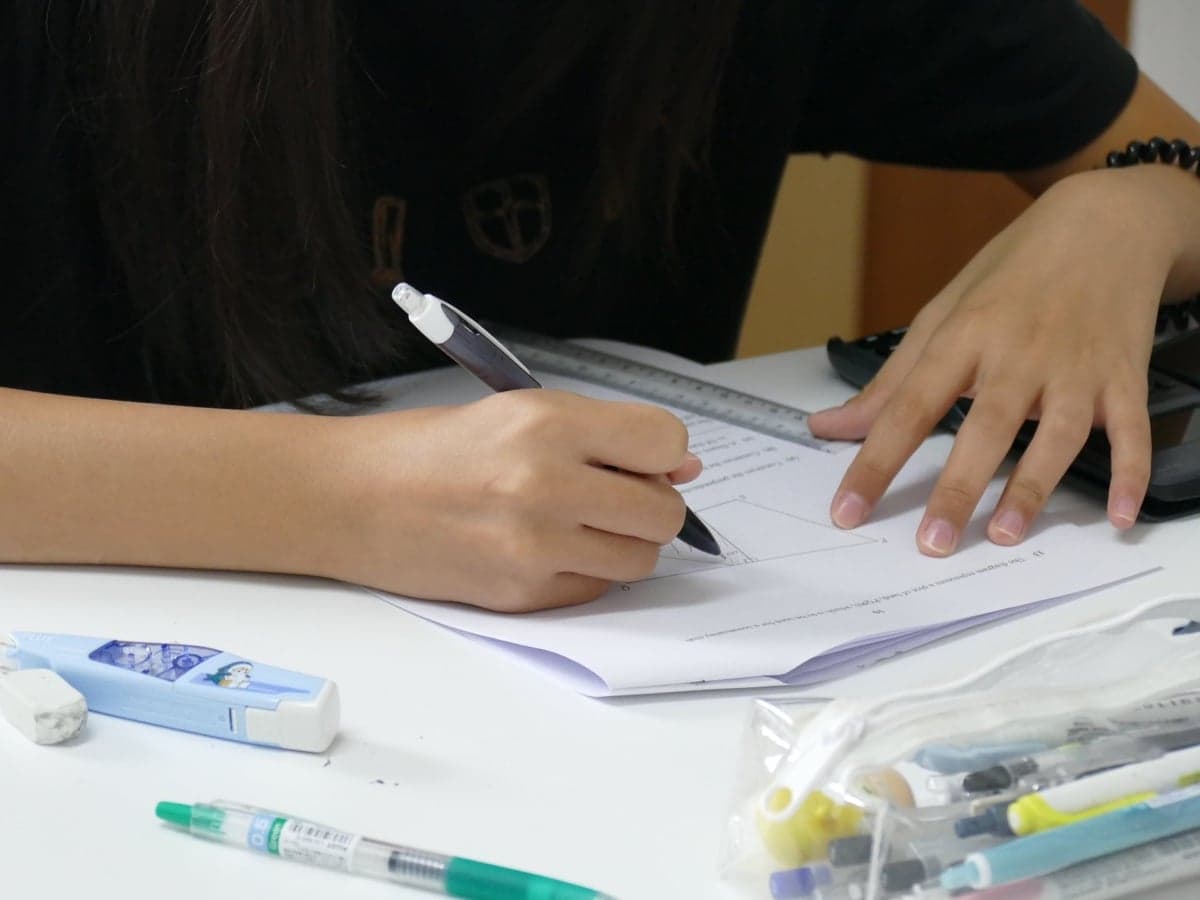
MOE announced on 1 August 2026 that it would launch the AI Essay Marking System (AIMS) on the Singapore Student Learning Space in September 2026, to handle routine marking of secondary school Chinese Language essays so that teachers can concentrate on higher-order feedback. AIMS marks grammar, spelling and sentence structure on both handwritten and typewritten essays; teachers keep authority over the feedback students receive. Ancourage Academy teaches Chinese across the secondary years, and this guide explains what MOE has actually said about AIMS, what it changes for a student's writing practice, and what it does not change. Our secondary Chinese programmes run at both centres.
What MOE Announced
MOE announced AIMS in its press release of 1 August 2026 on mother tongue languages, stating: "In September 2026, the MOE will launch the new AI Essay Marking System (AIMS) on the Singapore Student Learning Space (SLS) platform to enhance the teaching and learning of Chinese Language in secondary schools."
The release is specific about the division of labour. In MOE's words, "AIMS will support Chinese Language teachers by handling routine marking – such as grammar, spelling and sentence structure – for both handwritten and typewritten essays, so that the teachers can focus on providing individualised higher-order feedback on students' creativity, depth of expression, and quality of their ideas."
Two details in that sentence are easy to skim past and worth holding on to. AIMS covers handwritten essays as well as typed ones, which is what makes it usable in a subject still largely examined on paper. And the marking it takes over is explicitly the routine layer — the surface features — not the judgement about whether a piece of writing is any good.
What AIMS Does, and What It Does Not Do
AIMS handles the routine layer of a Chinese essay — grammar, spelling and sentence structure. MOE’s stated purpose is to free teachers for the individualised, higher-order feedback.
| Layer | Handled by | What it covers |
|---|---|---|
| Routine marking | AIMS | Grammar, spelling, sentence structure |
| Higher-order feedback | The teacher | Creativity, depth of expression, quality of ideas |
| Final judgement | The teacher | Review and curation of all feedback given |
MOE states that teachers "retain full authority to review and curate the feedback", and that AIMS parameters can be customised to suit different proficiency levels. That makes the system a teacher's instrument rather than an automatic grader. Note what it does not say: authority to review is not a guarantee that every item of automated feedback is reviewed before a student sees it, and MOE publishes no accuracy figure for AIMS.
For parents, the honest summary is that AIMS changes the speed and consistency of the corrections a student receives on the surface features of their writing. It does not change what a good Chinese essay is, and MOE has not announced any role for it in marking the national examination.
What MOE Has Said About AIMS and the National Examination
MOE has said nothing about AIMS marking national examinations — it describes AIMS only as an SLS tool for Chinese Language teachers in secondary schools. What it has said about AI and the examinations is that they remain proctored, with AI prohibited in the proctored papers — and it names an exception for coursework. Its parliamentary reply of 6 May 2026 states: "National exams continue to be proctored, and use of AI is prohibited", and adds that "In cases where the use of AI is permitted in national exams, such as for coursework, Teacher Supervisors monitor students' work such that AI use meets the objectives of the assessment."
This is worth reading precisely, because it is narrower than it first looks. The prohibition binds candidates, and it applies to the proctored papers: SEC papers are still sat under examination conditions and a student may not use AI in them. Where a component is coursework rather than a proctored paper, MOE says AI use may be permitted under a Teacher Supervisor. MOE has not described AIMS as having any role in national examinations, and this guide makes no claim either way about how national scripts are marked. What matters for a family is that a student's preparation target has not moved. Our SEC 2027 guide covers the examination itself.
The same reply sets out MOE's framework for AI in schools — the Four Learns: the aim is "for every student to learn about AI, learn to use AI, learn with AI and most importantly, learn beyond AI". MOE also notes that students "are taught to be discerning about AI output as it may contain errors or false information", and that where "students pass off AI-generated content as their own, they will have to bear the consequences of academic dishonesty".
Where AIMS Sits Among MOE's Other Language Tools
AIMS is one of several mother tongue tools MOE has built, alongside LangBuddy, an AI chatbot for mother tongue oral interaction — covered in our LangBuddy explainer.
The 1 August 2026 release features LangBuddy as an MOE-developed resource for "engaging and joyful MTL learning experiences for children". Where AIMS addresses written work in secondary schools, LangBuddy addresses spoken practice — the two tools sit on opposite sides of the same subject.
The same announcement expands the Language Elective Programme from 2027: the Chinese LEP-JC extends to a sixth school, Anderson Serangoon Junior College; the Tamil LEP programmes expand through a centre-based approach at the Umar Pulavar Tamil Language Centre; and the Malay Special Programme expands to a fifth centre at National Junior College. Our Language Elective Programmes 2027 guide explains that Malay (Special Programme) is a third-language course, not a Malay Language Elective Programme, and sets out CLEP eligibility and entry routes.
What This Changes for a Secondary Chinese Student
The practical effect is faster, more consistent correction of surface errors — which raises the value of practice and removes the excuse of slow feedback.
- Feedback turnaround should shorten. The bottleneck in essay practice has always been marking time. Where a teacher adopts AIMS, more essays can be marked in the same teacher hours.
- Surface errors should get harder to hide. Automated marking is applied uniformly in a way that hand-marking under time pressure is not — though MOE publishes no accuracy figure, so treat flagged output as a prompt to check rather than a verdict.
- The bar for teacher feedback rises. If routine marking is handled, the comments a student receives from their teacher should be about ideas and expression. That is the feedback worth acting on.
- Handwriting still matters. Because AIMS handles handwritten essays, legibility remains a practical issue rather than becoming irrelevant.
Our Chinese composition guide covers what strong composition actually requires, and the secondary Chinese strategies guide covers the wider subject.
How to Use Faster Feedback Well
More corrections only help if a student acts on them; the risk of automated marking is that a student reads the flags and changes nothing.
- Keep an error log. Record the recurring flagged errors, not every flagged error. Three habits fixed beats thirty corrections read.
- Rewrite, do not just review. Rewriting one paragraph correctly embeds the fix; reading a correction does not.
- Separate the two feedback types. Surface corrections are a checklist; teacher comments on ideas are the actual lesson.
- Write more where marking becomes cheaper. Frequency has been constrained by marking capacity; if AIMS increases your teacher's marking capacity, use the extra feedback for more writing practice.
- Do not outsource the thinking. Our guide to AI study tools for students and parents covers where AI helps and where it quietly substitutes for learning.
Questions Worth Asking the School
Ask the school whether and when your child's class will use AIMS, which proficiency settings apply, whether the frequency of written assignments will change, and how teacher feedback on ideas and expression will reach students — AIMS is a national platform feature, but how it is used sits with each school and each teacher.
- Is AIMS being used for my child's class, and from when?
- What proficiency-level settings are applied, given that MOE allows the parameters to be customised?
- If AIMS reduces routine marking time in this class, will the frequency of written assignments change?
- How will teacher feedback on ideas and expression reach students — in writing, or in conference?
For families where Chinese is not the dominant home language, our guide on teenagers struggling with Chinese in English-dominant families addresses the underlying issue that no marking tool solves. A trial class (usually $18) starts with a written diagnostic.
What Has Not Changed
The syllabus, the papers, the examination conditions and the definition of good writing are all unchanged; only the marking of routine features inside school has moved.
Students preparing for Chinese at any level should continue with the same fundamentals: vocabulary range, sentence variety, structure, and enough reading to have something to say. Our Chinese preparation guide, oral and listening strategies guide and Higher Chinese guide cover those, and our guide to AI in English composition covers the parallel questions on the English side.
Common Questions About AIMS
What is AIMS?
AIMS is the AI Essay Marking System that MOE said it would launch in September 2026 on the Singapore Student Learning Space. It supports secondary school Chinese Language teachers by handling routine marking of essays — grammar, spelling and sentence structure — on both handwritten and typewritten work, so teachers can focus on feedback about creativity, depth of expression and quality of ideas.
Does AIMS give my child their grade?
Not on its own. MOE describes AIMS as handling the routine marking layer and says teachers "retain full authority to review and curate the feedback" and "can review, refine and customise the feedback before sharing it with students", so what a student receives comes through the teacher. MOE has not said whether AIMS produces a score, and publishes no accuracy figure. The system's parameters can also be customised by teachers to suit different proficiency levels.
Does AIMS mark the national Chinese examination?
MOE has not announced any role for AIMS in marking the national Chinese examination: it describes AIMS as a tool on the SLS platform supporting Chinese Language teachers in secondary schools. Separately, MOE's parliamentary reply of 6 May 2026 states that "National exams continue to be proctored, and use of AI is prohibited" — that binds candidates sitting the proctored papers. MOE adds that where AI use is permitted in a national examination, "such as for coursework", a Teacher Supervisor monitors it.
Which subjects and levels does AIMS cover?
MOE's announcement scopes AIMS to Chinese Language in secondary schools. It is not described as covering other mother tongue languages, English, or primary levels at launch. Whether and when it extends further has not been announced.
Does AIMS work on handwritten essays?
Yes. MOE's release specifies that AIMS handles routine marking "for both handwritten and typewritten essays". This matters in practice, because Chinese composition is still largely written by hand for examinations, so handwriting legibility remains relevant rather than becoming a non-issue.
What is LangBuddy?
LangBuddy is an AI chatbot for mother tongue language oral interaction, developed by MOE and featured alongside AIMS in the same August 2026 announcement. Where AIMS addresses written work in secondary schools, LangBuddy supports spoken practice, so the two tools address opposite halves of mother tongue learning.