
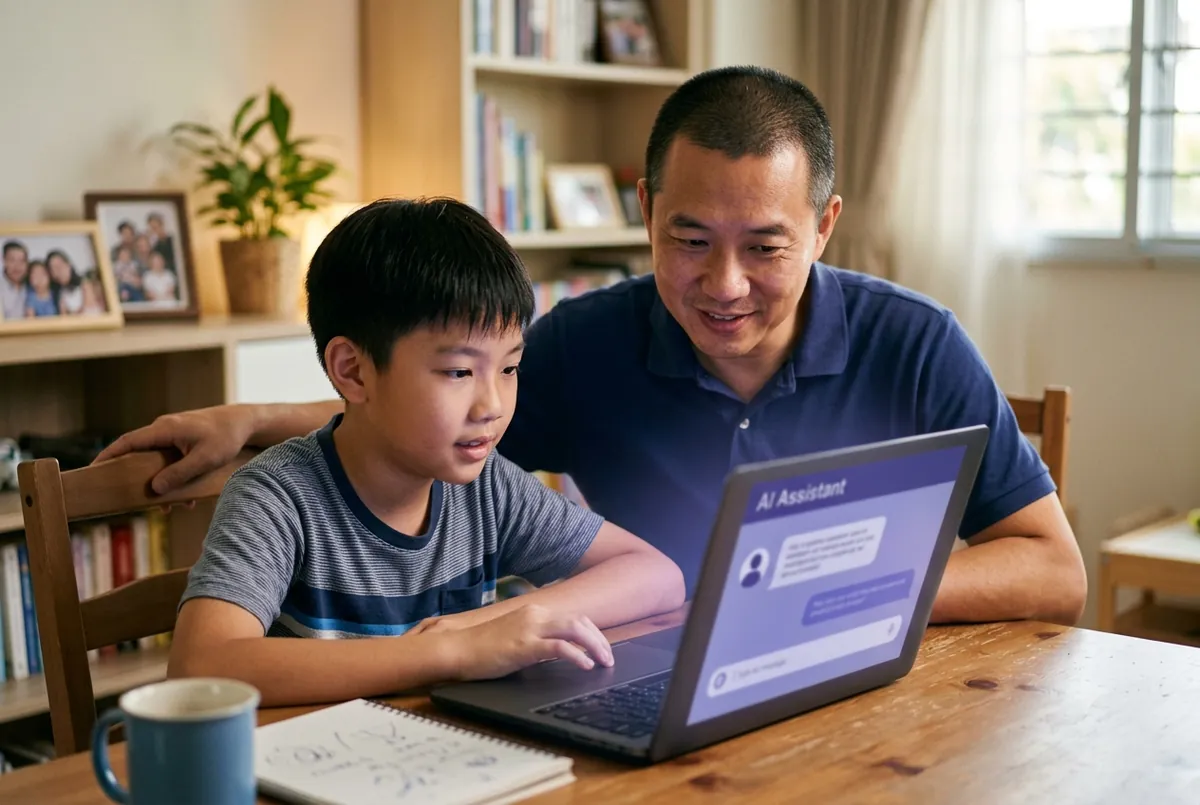
MOE describes its approach to artificial intelligence in schools as the "Four Learns" — for every student to learn about AI, learn to use AI, learn with AI and, most importantly, learn beyond AI. This explainer from Ancourage Academy unpacks each limb using MOE's own words, and sets out what it means for a student in primary or secondary school under the approach described in MOE's 6 May 2026 parliamentary reply. For the specific tools inside the Student Learning Space, see our SLS AI features guide.
The framework was set out in a combined parliamentary reply on 6 May 2026 answering questions from four Members of Parliament about AI use in schools. It is the clearest public statement of where MOE draws its lines, and most of the questions parents actually ask are answered somewhere in it.
What Are the Four Learns?
MOE's stated approach is "simple, but deliberate – for every student to learn about AI, learn to use AI, learn with AI and most importantly, learn beyond AI. These are what we call the 'Four Learns'." The emphasis on the fourth limb is MOE's own.
| Limb | What it covers in practice (our reading of the reply) |
|---|---|
| Learn about AI | How AI works, how to be discerning about its output, and responsibility for the content students create — taught in Cyber Wellness lessons and in the Code for Fun programme |
| Learn to use AI | Supervised hands-on use of educational AI tools, beginning at Primary 4 |
| Learn with AI | AI-enabled tools inside the Singapore Student Learning Space used to support subject learning |
| Learn beyond AI | The capabilities that remain the student's own — MOE names guarding "against risks such as cognitive offloading" |
MOE adds that "theoretical knowledge alone is not sufficient", and that students "need well-designed and supervised hands-on experiences, through the use of educational AI tools guided by teachers". It calls this a spiral approach that prepares students "to harness AI to benefit their learning, critically evaluate AI output, and guard against risks such as cognitive offloading" — the last of which is the risk the fourth limb is best read against.
Why AI Starts at Primary 4, and What Happens Before
From Primary 1 to Primary 3, MOE prioritises physical hands-on learning and states plainly that "schools will not assign any work that requires them to use AI directly" — students learn about AI's presence in daily life without using it for schoolwork. The starting point for use is Primary 4.
The stated reason is developmental rather than technological. By Primary 4, MOE says, students "would have developed foundational literacy, numeracy and basic knowledge of AI in their daily lives", and research shows that around this age they have developed "some executive functioning skills like planning, task initiation, and ability to evaluate their own thinking, to begin to use simple digital tools to support their learning".
| Stage | What MOE says happens |
|---|---|
| Primary 1–3 | Physical hands-on learning prioritised; students learn about the basics of AI; no assigned work requiring direct AI use |
| Primary 4–6 | Only AI tools specifically designed for education, only under teacher supervision; mandatory 10-hour Code for Fun programme begins |
| Secondary | Some schools design tasks that allow AI use; where used, students must state where they used it and cite their sources |
| National examinations | Proctored; use of AI prohibited, except where permitted for coursework under Teacher Supervisor monitoring |
What Primary 4 to 6 Students Actually Use
Students in Primary 4 to 6 use only AI tools that are specifically designed for education, and only under teacher supervision — including AI-enabled tools in the Student Learning Space that carry built-in safety guardrails. MOE gave one worked example.
Primary 4 students in an English Language class can use the AI Learning Assistant in SLS for composition writing, working from prompts provided by their teacher to get ideas on how to "show not tell" — enhancing writing through details on actions and emotions — and refining their drafts on personalised feedback. MOE describes the guardrail directly: the assistant "will redirect students back on track if they veer off-topic and ask irrelevant questions, or if they want to be spoon-fed with direct answers".
Alongside that sits explicit instruction. Before using AI tools in SLS, students complete a "Basic module on AI and AI-enabled Features in SLS". From Primary 4 they also take the mandatory 10-hour Code for Fun programme, covering coding, computational thinking and an introduction to AI. Primary schools may additionally opt for two "AI for Fun" modules of five hours each, going further into generative AI and computer vision respectively.
Academic Integrity and the Secondary Rules
Where secondary schools design tasks that permit AI, MOE states that "students must state where they have used AI and cite the sources of information" — and that passing off AI-generated content as one's own carries the consequences of academic dishonesty. Disclosure, not prohibition, is the classroom rule.
The stated rationale is preparation: this "helps to prepare them for post-secondary education where they will be expected to use AI far more heavily, in anticipation of what their future workplace might look like". Schools also teach students when they should not use AI, "so that they do not take short cuts to get answers without actual learning".
Our academic integrity guide works through where the line falls on ordinary homework, and AI detectors and their accuracy covers what schools can realistically identify.
National Examinations: The Rule Has Not Changed
"National exams continue to be proctored, and use of AI is prohibited" — with one exception MOE names in the same reply: coursework, where permitted AI use is monitored by Teacher Supervisors. MOE stated this in the same reply, and added the reason it matters for daily work.
The warning is worth quoting in full: "If students use AI as a shortcut for their daily work instead of learning deeply, they will not be able to demonstrate the levels of mastery expected during the exams." There is one narrow exception — "in cases where the use of AI is permitted in national exams, such as for coursework, Teacher Supervisors monitor students' work such that AI use meets the objectives of the assessment".
For subjects with coursework components, our guides to O-Level / SEC Art coursework and H2 Art coursework cover how supervised work is structured.
Data, Safeguards and What MOE Is Studying
MOE states that data from students' use of MOE-built AI tools "is anonymised and not used to train external AI models that power these tools", and that schools using commercial off-the-shelf tools must check that input data contains no personally identifiable information. Research on the effects is under way rather than concluded.
- Guardrails — educational AI tools made available by MOE have built-in safeguards for learners' interest, privacy and well-being, in addition to the educational guardrails that keep tools on task.
- Commercial tools — schools are required to check that input data does not contain personally identifiable information and complies with data management guidelines.
- Longitudinal research — MOE funds the Singapore Longitudinal Early Development Study by A*STAR, which "will start to collect data in 2027" to understand children's AI usage patterns and the effects on learning and well-being.
- Short-term research — MOE is also working with schools on shorter studies to inform classroom practice more quickly.
- Teacher preparation — workshops and networked learning communities led by Master Teachers, plus online sharing platforms.
How Singapore Compares, and What It Means at Home
MOE notes that some systems — China, the UAE and the United Kingdom — have introduced AI from Primary 1, while India and states in Australia and the United States start at similar ages to Singapore or slightly later, and describes its own position as "a calibrated approach". It also commits to adjusting as evidence accumulates.
For parents, the practical reading is that the school environment is more constrained than the home one. A Primary 3 student will not be assigned AI-dependent work at school, but has access to general-purpose AI on any device at home — and MOE acknowledges that many parents "are already struggling with their children's excessive screentime". The Four Learns are a useful home framework precisely because the fourth limb names the risk: the capability that has to stay the child's own.
Our should my child learn AI and is AI safe for children guides cover the home decisions, studying with AI without outsourcing the thinking covers study habits, and prompt engineering for students covers using the tools well. More sits on the AI and education hub and in the education glossary. To discuss how your child studies, book a trial class (usually $18).
Common Questions About the Four Learns
What are MOE's Four Learns?
They are MOE's framing of its approach to AI in schools, stated in Parliament on 6 May 2026: "for every student to learn about AI, learn to use AI, learn with AI and most importantly, learn beyond AI. These are what we call the 'Four Learns'." Learning about AI covers how it works and how to judge its output; learning to use and with AI covers supervised hands-on use of educational tools; learning beyond AI covers the capabilities students must retain themselves.
At what age do Singapore students start using AI in school?
Primary 4. From Primary 1 to 3, MOE prioritises physical hands-on learning and states that schools will not assign any work requiring students to use AI directly, though they do learn about its presence in daily life. From Primary 4, students use educational AI tools under teacher supervision. MOE's stated reason is that by then students have foundational literacy and numeracy plus executive functioning skills such as planning, task initiation and the ability to evaluate their own thinking.
What is "cognitive offloading" and why does MOE mention it?
Cognitive offloading is delegating mental work to an external tool instead of doing it yourself. MOE names it explicitly as a risk its spiral approach is designed to guard against, alongside preparing students to harness AI and to critically evaluate its output. It is the natural reading of why the fourth limb — learn beyond AI — is called the most important: the concern is not that students use AI, but that they stop building the capability the tool is standing in for.
Can secondary students use AI for their schoolwork?
Sometimes, with disclosure. MOE states that some secondary schools may design tasks which allow students to use AI, and that in those situations "students must state where they have used AI and cite the sources of information". Passing off AI-generated content as one's own carries the consequences of academic dishonesty. Schools also teach students when they should not use AI, so that they do not take shortcuts to answers without actual learning.
Is student data from these AI tools used to train AI models?
Not for MOE-built tools. MOE states that data from students' use of MOE-built AI tools "is anonymised and not used to train external AI models that power these tools". Where schools use commercial off-the-shelf AI tools, they are required to check that the input data does not contain personally identifiable information and complies with data management guidelines. MOE also funds a longitudinal A*STAR study that will begin collecting data in 2027 on children's AI usage and its effects.