
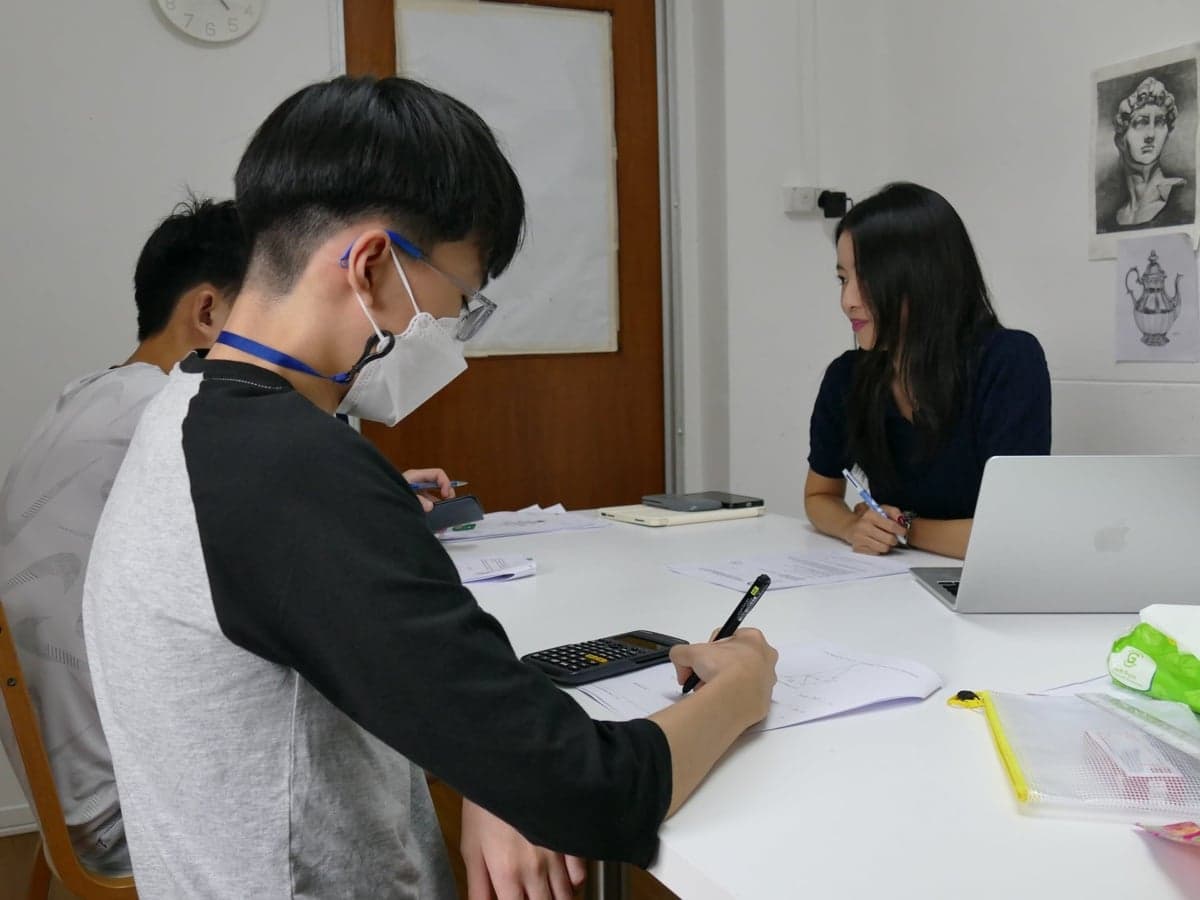
Mother Tongue Language (MTL) exemption in Singapore is granted only in specific circumstances — primarily to returning Singaporean children who had no exposure to an official MTL overseas, and to students with special educational needs that severely affect their ability to cope with overall learning — and this guide from Ancourage Academy explains the full process. Finding Chinese, Malay, or Tamil difficult is not, on its own, sufficient grounds for exemption. The Ministry of Education (MOE) evaluates each application case by case, considering the student's full learning profile.
As Founder of Art by Ancourage and a multilingual educator across Ancourage Academy's programmes, Angie works closely with bilingual families in primary Chinese tuition — including those where English is the dominant home language. This guide covers the exact eligibility criteria, the MTL-in-Lieu alternative, how exemption affects PSLE scoring, and what parents should consider before applying.
Who Qualifies for Mother Tongue Exemption in Singapore?
MOE recognises two broad categories of students for Mother Tongue exemption: returning Singaporeans with no prior MTL exposure, and students with special educational needs (SEN) that severely affect overall learning.
- Returning Singaporeans: Children who lived overseas for an extended period and had no opportunity to learn an official MTL (Chinese, Malay, or Tamil), a Non-Tamil Indian Language (NTIL), or an approved Foreign/Asian Language. The key factors MOE considers are the duration and location of the overseas stay, and whether the child had any formal MTL instruction abroad.
- Students with SEN: Children with diagnosed learning differences — such as dyslexia — that cause severe difficulty coping with overall learning, not just the Mother Tongue subject. MOE assesses the child's overall learning capacity, not just the diagnosis itself. A dyslexia diagnosis alone does not guarantee exemption if the child is otherwise coping with school.
Importantly, a child who struggles with Chinese, Malay, or Tamil but has always lived in Singapore and does not have a diagnosed learning difference is unlikely to qualify. In such cases, the better path is structured Chinese language support — which is what Ancourage Academy specialises in at both Bishan and Woodlands.
Ancourage Academy offers trial classes (usually $18) for Chinese at Bishan and Woodlands — small groups of 3-6 with diagnostic assessment to identify specific language gaps.
MTL-in-Lieu: Studying a Foreign Language Instead
Students who have lived overseas and studied a foreign language formally may take that language in lieu of Mother Tongue — this is the MTL-in-Lieu pathway, distinct from full exemption.
The available languages under MTL-in-Lieu fall into two categories:
| Category | Languages Available | Where Taught |
|---|---|---|
| Foreign Languages (FL) | French, German, Japanese | Private arrangements by parents (MOELC teaches these as Third Languages, not MTL-in-Lieu) |
| Approved Asian Languages (AsL) | Arabic, Burmese, Thai | Private arrangements by parents |
A few important distinctions: Foreign Languages under MTL-in-Lieu require parents to make private study arrangements (note: MOELC teaches French, German, and Japanese as Third Languages, which is a separate pathway from MTL-in-Lieu). Asian Languages in lieu of MTL also require parents to arrange private tuition and ensure the provider can prepare the child for national examinations. NTILs are available specifically for non-Tamil Indian students and are a separate category from MTL-in-Lieu.
Foreign and Asian Languages taken in lieu of MTL are not offered at PSLE level. Students taking one will be assigned an MTL score for secondary school posting purposes, similar to fully exempted students.
Non-Tamil Indian Languages are a different thing entirely. An NTIL is taken as the student's Mother Tongue, not in lieu of one — and all five are examinable PSLE subjects, with SEAB codes 0010–0014 (Standard) and 0020–0024 (Foundation). They are taught at community-based language centres outside school hours, but they are sat at the PSLE like any other Mother Tongue.
How to Apply for Mother Tongue Exemption
Applications for MTL exemption are submitted through the child's school, not directly to MOE, and the process can take up to three months.
The typical process:
- Speak with the school's MTL teacher and HOD: They will assess whether an application is appropriate based on the child's situation.
- Gather supporting documents: For returning Singaporeans, this includes evidence of the overseas stay and the child's schooling history. For SEN students, a psychologist's report is typically required.
- School submits the application: The class teacher writes a report that accompanies the application form and supporting documents to MOE.
- MOE reviews: Each case is evaluated holistically. Decisions are not based on a single criterion but on the full picture of the student's learning profile and circumstances.
MOE strongly encourages parents to let the child attempt MTL for at least one semester before applying. This attempt does not prejudice the application — in fact, it provides evidence of the child's actual capacity to cope with the language, which MOE considers during evaluation.
Applications should be submitted before the first quarter of the year the child will sit national MTL examinations (i.e., before Q1 of the PSLE year for primary students).
How Exemption Affects PSLE Scoring and Secondary School Posting
Students exempted from Mother Tongue are assigned an MTL score of AL 6 to AL 8 for PSLE, determined by referencing the MTL scores of peers with similar English, Mathematics, and Science grades. This means an exempted student's best possible PSLE aggregate is 9 (AL 1 in three subjects plus AL 6 for MTL), compared to 4 for a student who scores AL 1 across all four subjects.
According to a 2019 Parliamentary Reply from MOE, the assigned score falls within the AL 6-8 range, which aligns with the Foundation Mother Tongue scoring band. This ensures parity with students who take Foundation MTL rather than Standard MTL.
The practical implication: exempted students are at a scoring disadvantage for secondary school posting compared to students who score AL 1-5 in MTL. For parents weighing exemption versus persevering with MTL, this is a critical factor. A child who can achieve even AL 5 in Standard MTL or AL 6 in Foundation MTL is no worse off than an exempted student — and may be better off because the AL score reflects actual performance rather than a statistical assignment.
For more on how PSLE scoring works and how each AL band affects secondary school options, see the detailed PSLE 2026 Syllabus Changes guide.
Mother Tongue Exemption at O-Level / SEC and Beyond
MTL exemption granted at primary school automatically carries over to Secondary 1 — parents do not need to re-apply. At O-Level / SEC level, exempted students do not sit the MTL paper, and their L1R5 or L1R4 aggregate for post-secondary admission is calculated without an MTL component.
With the transition to the SEC examination from 2027, Mother Tongue continues to be a required subject at the O-Level / SEC level for non-exempted students. Exemption carries forward into the SEC framework in the same way.
This has downstream implications for post-secondary admission — including one point that is widely misunderstood:
- JC admission: Students who score A1–C6 in both English and Higher Mother Tongue at O-Level earn a 2-point bonus on their L1R5/L1R4 aggregate — exempted students cannot earn this bonus, which can affect admission to competitive JCs.
- University admission: An MOE-approved MTL exemption satisfies the university Mother Tongue requirement in its own right — NUS, NTU and SMU all list an MOE-approved MTL exemption among the accepted routes, and SUTD refers exemption applications to MOE as part of the admissions process. SMU states the requirement plainly — it may be met by "an MOE-approved MTL-in-lieu, or an MTL exemption by MOE" — so an exempted applicant has already satisfied it at the point of application. Applicants who have not satisfied it are a separate case: SMU admits them under Conditional Admission, which defers the requirement to graduation rather than barring entry. Exempted students do not need a separate university-level waiver, though universities ask for the MOE approval letter as evidence. Students who are not exempted meet the requirement through D7 or better in O-Level Higher Mother Tongue, an S grade in H1 MTL, or a pass in MTL 'B' at A-Level.
For students on the secondary Chinese pathway, the long-term academic cost of exemption should be weighed carefully against the short-term relief it provides.
When Exemption Is Not the Right Choice
For most students who find Chinese difficult but have neither special educational needs affecting overall learning nor a sustained period overseas without access to an official MTL, exemption is neither available nor advisable. The better approach is structured support that addresses the specific areas of difficulty.
Common scenarios where parents consider exemption but should pursue support instead:
- "My child hates Chinese and refuses to study." This is a motivation issue, not a learning capacity issue. With the right teaching approach — particularly one that connects the language to the child's interests — engagement can improve significantly. Read the PSLE Chinese strategies guide for practical approaches.
- "My child is an English-dominant speaker and Chinese feels foreign." Many Singapore families are in this situation. Structured tuition that builds vocabulary systematically and uses bilingual scaffolding can bridge the gap. Ancourage Academy's Chinese programme at primary and secondary level is designed for exactly this profile.
- "My child scores well in everything except Chinese." This is the most common scenario. A child who excels in English, Maths, and Science but struggles with Chinese does not meet the SEN exemption criteria because overall learning capacity is not impaired. The 2026 Higher Mother Tongue eligibility changes may actually benefit such students by decoupling HMT eligibility from overall PSLE score.
Alternatives: Building Chinese Proficiency with Structured Support
For the majority of students who do not qualify for exemption, the most effective path forward is targeted, structured Chinese language support that addresses specific weaknesses — vocabulary, composition, oral, or comprehension — rather than generic practice.
At Ancourage Academy, Chinese tuition follows a diagnostic approach: the first step is identifying whether the child's primary challenge is vocabulary breadth, composition structure, reading comprehension, or oral confidence. Each requires a different intervention. A child who understands spoken Chinese but struggles with written composition needs a very different approach from one who lacks basic vocabulary.
Key strategies that Ancourage Academy uses for English-dominant Chinese learners:
- Bilingual scaffolding: Explaining Chinese concepts using English analogies to bridge the comprehension gap
- Systematic vocabulary building: Themed vocabulary clusters with spaced repetition rather than rote memorisation
- Oral confidence first: Building spoken fluency before demanding written accuracy, since oral components carry 20-25% of exam marks
- Composition frameworks: Teaching the four-paragraph structure (开头/经过/高潮/结尾) as a repeatable template
Book a trial class (usually $18) at Bishan or Woodlands to assess your child's specific Chinese language needs — or WhatsApp Ancourage Academy to discuss your child's situation.
Common Questions About Mother Tongue Exemption
Can my child get Mother Tongue exemption because they find Chinese too difficult?
No. Finding a subject difficult is not grounds for exemption. MOE grants exemption only to returning Singaporeans with no prior MTL exposure, or to students with diagnosed special educational needs that severely affect overall learning. If your child finds Chinese difficult but is coping with other subjects, the recommended path is structured language support rather than exemption.
Does Mother Tongue exemption affect university admission in Singapore?
Not as a barrier to admission. An MOE-approved MTL exemption is itself one of the accepted ways to satisfy the university Mother Tongue requirement — NUS, NTU and SMU all list an MOE-approved MTL exemption among the qualifying routes, and SUTD refers exemption applications to MOE as part of the admissions process. SMU additionally offers Conditional Admission to applicants who have not met the requirement, who must then satisfy it before graduating. No separate university waiver is needed, though universities ask for the MOE approval letter as evidence. The real cost of exemption sits earlier: exempted students cannot earn the 2-point JC admission bonus that students who score A1–C6 in both English and Higher Mother Tongue receive.
What foreign languages are available under MTL-in-Lieu?
Foreign Languages include French, German, and Japanese (private study arrangements required; MOELC teaches these as Third Languages, not MTL-in-Lieu). Approved Asian Languages include Arabic, Burmese, and Thai (private arrangements required). Non-Tamil Indian Languages include Bengali, Gujarati, Hindi, Punjabi, and Urdu (available at community language centres for non-Tamil Indian students).
Can my child switch from exemption back to taking Mother Tongue?
In principle, yes — exemption is not irreversible. However, a child who has been exempted for several years will have significant gaps compared to peers who have been studying the language continuously. Re-entry would require substantial catch-up support. It is generally easier to maintain some level of MTL learning from the start rather than to stop and restart.
How does Mother Tongue exemption work for PSLE scoring?
Exempted students are assigned an MTL score of AL 6 to AL 8, determined by referencing the MTL scores of peers with similar English, Maths, and Science grades. This means the best possible PSLE aggregate for an exempted student is 9 (three AL 1s plus assigned AL 6), compared to 4 for a student who scores AL 1 in all four subjects including MTL.
Visit Ancourage Academy at Bishan or Woodlands, check primary Chinese courses or secondary Chinese courses, or WhatsApp us with any questions.
Related: Scoring in Primary Chinese · Is Higher Chinese worth it? · Higher Mother Tongue 2026 Changes · PSLE Chinese Tips · Secondary Chinese Strategies · O-Level Chinese Preparation · a guide to My Child Hates Chinese Tuition · PSLE Chinese Oral guide