
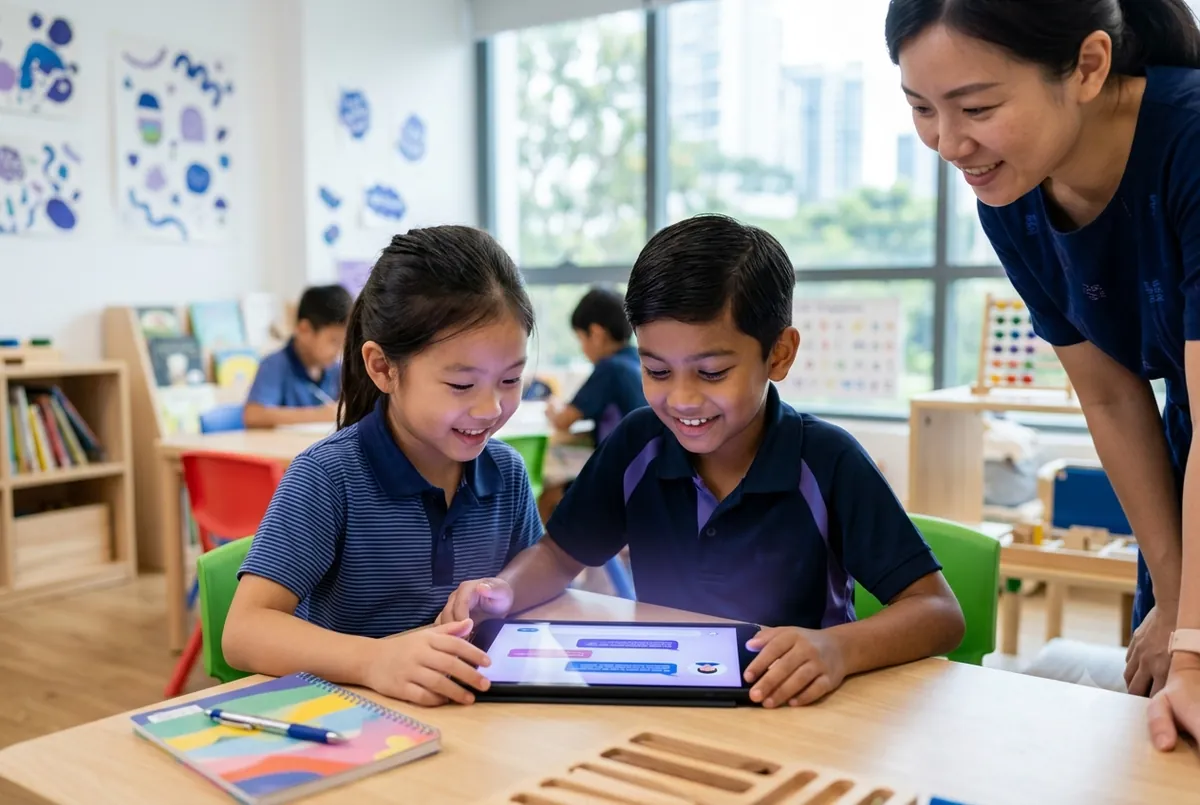
LangBuddy is an AI conversational chatbot MOE uses to let students practise speaking their mother tongue "on topics both within and beyond the curriculum at their own pace" — the phrase "at their own pace" is doing most of the work, because a shortage of low-stakes speaking practice is the real constraint for most students. This explainer from Ancourage Academy covers what was announced and what it means for a student in secondary Chinese tuition. For the wider policy frame, see our Four Learns guide.
Mother tongue oral is unusual among Singapore examination components: the skill is built by talking, and talking is the one thing a self-conscious teenager will avoid. That is the gap a conversational tool is aimed at, and it is worth understanding precisely what it does and does not close.
What Did MOE Announce About LangBuddy?
Speaking at the 14th Mother Tongue Languages Symposium on 1 August 2026, Education Minister Desmond Lee said: "LangBuddy, an AI conversational chatbot, encourages our students to converse in their mother tongue on topics both within and beyond the curriculum at their own pace." He invited attendees to try it in the exhibition hall.
MOE's accompanying press release describes it more plainly still, as "LangBuddy, an AI chatbot for MTL oral interaction", and records that families could try it at the symposium Centrepiece alongside creative mother tongue board games and card games — resources "developed by MOE to offer engaging and joyful MTL learning experiences for children". The reference sat under the heading "Technology in Education" in the published address, alongside the announcement of AIMS, an AI Essay Marking System for secondary school Chinese Language teachers launching that September. The two are complementary rather than similar: AIMS is a teacher-facing marking assistant, covered in our AIMS explainer, while LangBuddy is student-facing and aimed at spoken practice.
Why Speaking Practice Is the Hard Part
Oral carries a substantial share of the mother tongue grade — 25% of O-Level / SEC Chinese (K320) and 20% of Higher Chinese (K355) — and it is the component families find hardest to rehearse at home. Marks are lost to hesitation far more often than to vocabulary.
| Component | O-Level / SEC Chinese (K320) | Higher Chinese (K355) |
|---|---|---|
| Writing | Paper 1 — 60 marks, 30% | Paper 1 — 80 marks, 40% |
| Language use and comprehension | Paper 2 — 70 marks, 35% | Paper 2 — 80 marks, 40% |
| Oral | 50 marks, 25% | 40 marks, 20% |
| Listening | 20 marks, 10% | No listening paper |
The practical problem is that oral improves through repeated, low-stakes attempts, and most students get a handful of high-stakes ones. A conversational partner that is always available and never impatient is a genuine addition to that, even if it is not a substitute for talking to people.
Where LangBuddy Fits in MOE's Wider Mother Tongue Push
LangBuddy is one strand of a broader effort that runs from preschool to pre-university, most of which is not about technology at all. The same speech set out the rest of it.
- Preschool — MOE has been piloting increased mother tongue exposure at six MOE Kindergartens, raising it from one hour to 1.5 hours each day, with teachers observing greater student confidence.
- Primary — the Mother Tongue Languages SOAR reading programme, and a curriculum refreshed in 2024 to emphasise songs, animations, games and interactive experiences. Primary 1 Tamil students use augmented reality to discover animals at the zoo, exploring habitats through a virtual zoo in Primary 2.
- Cross-curricular — a Young Scientist badge in mother tongue, launched with the Science Centre, in which students explore the world through the lens of their language and culture.
- Pre-university and secondary — the Language Elective Programme expands from 2027, with the Chinese Language Elective Programme at JC level adding a sixth school, Anderson Serangoon Junior College, and the Tamil Language Elective Programme, at both secondary and junior college levels, expanding through a centre-based approach at the Umar Pulavar Tamil Language Centre. See our Language Elective Programmes 2027 guide for who qualifies and how to apply.
- Third language — Malay (Special Programme) expands to a fifth centre at National Junior College.
What an AI Speaking Partner Is Good At
The strengths of a conversational chatbot map neatly onto the specific weaknesses that hold back mother tongue oral: exposure volume, willingness to make mistakes, and topic range. These are the areas where more repetition genuinely helps.
Volume is the obvious one. A student who speaks Mandarin for two minutes a week in class and none at home is not going to become fluent, and the barrier is usually opportunity rather than ability. Willingness matters just as much: adolescents avoid speaking a language in front of peers precisely when they most need the practice, and a private practice partner removes the audience. Topic range is the third — MOE's framing explicitly includes topics "beyond the curriculum", which is where genuine interest lives and where vocabulary sticks.
What it will not do is supply the reason to care. MOE's own framing of home language use is candid: home exposure "has become more challenging as fewer families use mother tongue predominantly as the main language at home". Our guide on what to do when a child dislikes Chinese deals with that half of the problem, which no tool solves.
What It Does Not Replace
LangBuddy does not replace three things: assessment against the examination format (O-Level / SEC Chinese oral is reading aloud plus a video-stimulus conversation; Higher Chinese is an oral presentation and discussion), rehearsal under graded conditions, and the student's own sentence production. MOE's position across its AI announcements is consistent: educational AI tools are supervised supplements, and national examinations remain proctored with AI prohibited in the proctored papers — the narrow exception being coursework, where permitted use is monitored by Teacher Supervisors.
Three limits are worth stating plainly. First, a chatbot does not assess you the way an examiner does — the O-Level / SEC oral includes reading aloud and a video-stimulus conversation, and Higher Chinese uses an oral presentation and discussion, formats that reward specific preparation. Second, fluency built in a forgiving conversation does not automatically transfer to a graded one; some rehearsal under exam conditions is still necessary. Third, MOE calls the fourth limb of its Four Learns — learning beyond AI — the most important, and names cognitive offloading among the risks its approach guards against — a student who lets a tool generate their sentences is practising selection, not production.
Our guide to studying with AI without outsourcing the thinking covers how to keep the effort on the student's side, and is AI safe for children covers the supervision questions.
How Families Can Use the Same Idea at Home
At home, practise mother tongue through short daily conversations about the child's own interests and shared reading aloud, letting mistakes pass rather than correcting every one — consistency matters more than perfect speech. The Minister's own advice was not technological: "we do not need to be perfect speakers. Don't let perfection be the enemy of good. What matters is effort and consistency." That is the principle a speaking tool is imitating.
- Short and daily beats long and occasional. Talking about the day in mother tongue is worth more than a weekly hour of drilling.
- Read aloud together. MOE cites findings that early book reading contributes to long-term oracy and reading comprehension, and that adult interaction during reading further promotes literacy.
- Use interests, not textbooks. The "beyond the curriculum" framing exists because vocabulary attaches to things a student actually wants to discuss.
- Let mistakes pass. Correcting every error is the fastest way to end the conversation.
- Add a listener. Some schools run parent volunteer reading — MOE named Paya Lebar Methodist Girls' School (Primary) and St Joseph's Institution Junior as examples.
MOE also cites research that bilingual children have greater mental agility and are better able to switch between tasks, adding that there are "even findings suggesting it may delay the onset of dementia in older people" — a hedged claim in MOE's own words, and worth repeating with the hedge intact.
Getting Oral Practice That Counts
The highest-return oral preparation combines volume — which a tool can supply — with format-specific rehearsal and feedback, which it cannot. Both halves are needed.
For the examination formats and preparation sequence, see our O-Level / SEC Chinese preparation guide, the Higher Chinese guide, and the Higher Chinese versus Standard Chinese decision guide. Classical Chinese is covered in our 文言文 study guide. More AI explainers sit on the AI and education hub, the Chinese language hub collects the rest, and terms are defined in our education glossary. To practise oral with a bilingual teacher, book a trial class (usually $18) or see our Higher Chinese programme.
Common Questions About LangBuddy
What is LangBuddy?
LangBuddy is an AI conversational chatbot named by Education Minister Desmond Lee at the Mother Tongue Languages Symposium on 1 August 2026. In MOE's words, it "encourages our students to converse in their mother tongue on topics both within and beyond the curriculum at their own pace". MOE's press release of the same date describes it as "an AI chatbot for MTL oral interaction", developed by MOE and showcased to families at the symposium. It is student-facing and aimed at spoken practice, unlike AIMS — announced in the same speech — which is a teacher-facing essay marking system for secondary school Chinese Language teachers.
Can LangBuddy replace mother tongue oral practice with a teacher?
No, and it is not presented as doing so. A conversational tool supplies volume and a low-stakes setting, which are real constraints for most students. It does not replicate the examination formats — O-Level / SEC Chinese oral includes reading aloud and a video-stimulus conversation, and Higher Chinese uses an oral presentation and discussion — and it does not assess against those criteria. Format-specific rehearsal with feedback remains necessary.
How much is oral worth in the Chinese examination?
Oral carries 50 marks, or 25%, in O-Level / SEC Chinese (K320), alongside a 20-mark listening component worth 10%. In Higher Chinese (K355) the oral is 40 marks, or 20%, and there is no separate listening paper. In both cases oral is a larger share of the grade than most families assume, and it is the component where a lack of everyday speaking practice shows up most directly. At G2 (K220), oral and listening are examined together for a combined 80 marks, or 40%.
Is using an AI chatbot for language practice allowed?
For practice, yes — MOE has built one itself. In national examinations, no: MOE told Parliament on 6 May 2026 that they continue to be proctored and that use of AI is prohibited — the narrow exception being coursework, where permitted AI use is monitored by Teacher Supervisors. Oral examinations are sat with human examiners. In classroom tasks where secondary schools permit AI, students must state where they used it and cite their sources. The distinction MOE draws is between using AI to build capability and using it as a shortcut that leaves the capability unbuilt.
What else did MOE announce for mother tongue learning?
Several things beyond technology: a pilot raising mother tongue exposure at six MOE Kindergartens from one hour to 1.5 hours daily; the primary Mother Tongue Languages SOAR reading programme; a 2024 curriculum refresh emphasising songs, animations and games; a Young Scientist badge in mother tongue with the Science Centre; and, from 2027, an expanded Language Elective Programme adding Anderson Serangoon Junior College for Chinese and a centre-based Tamil programme at the Umar Pulavar Tamil Language Centre.