
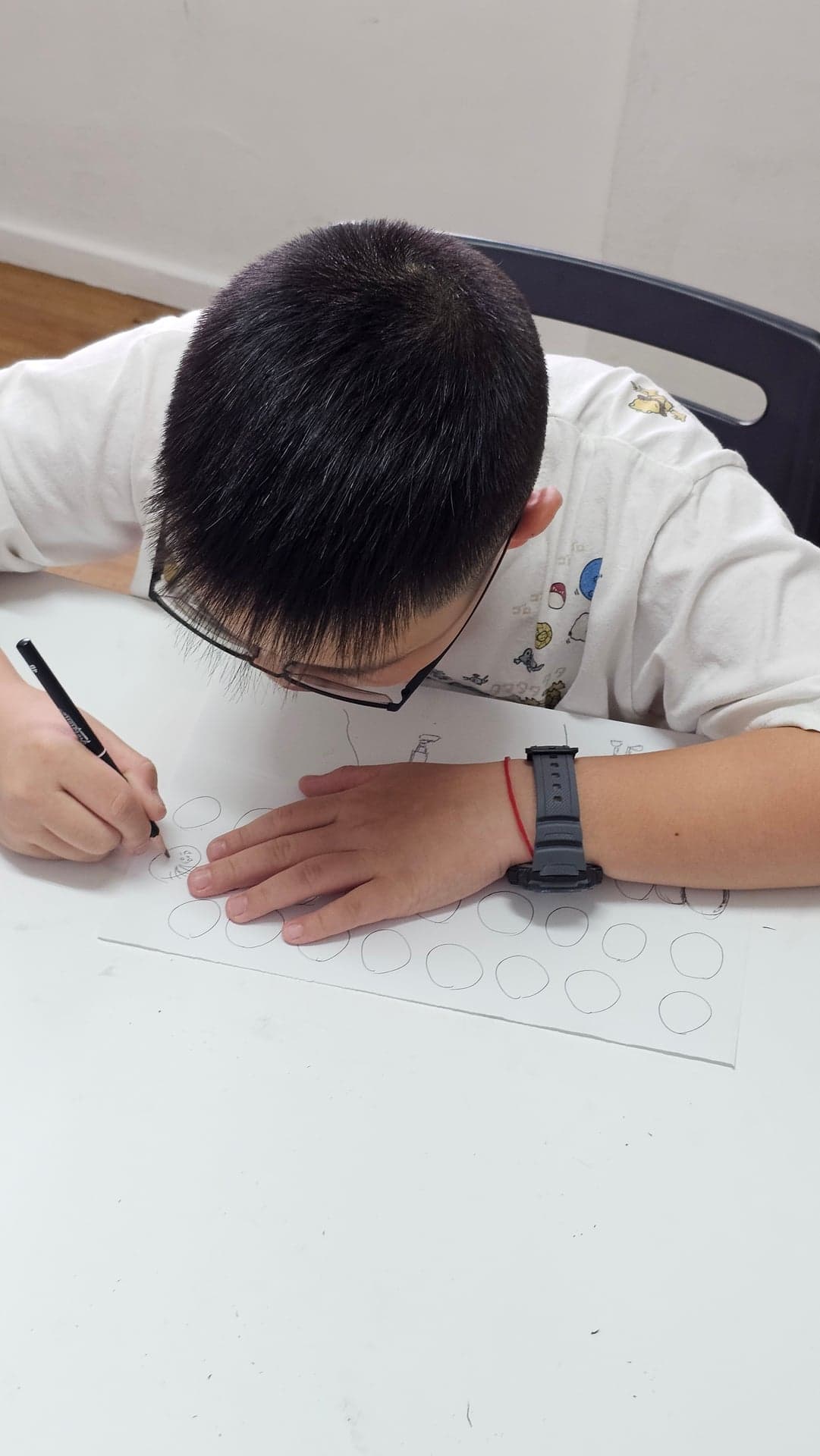
The core art techniques every student should learn are observational drawing (drawing accurately from life), value and shading (the illusion of 3D form), proportion, perspective (depth) and composition, with colour theory layered in once your drawing is reliable — built up through deliberate practice, not innate talent. Each is a learnable skill, and together they form the foundation of strong representational art. Art by Ancourage teaches this progression to students at Bishan and Woodlands.
This guide is the hub for our technique cluster. It gives you the big picture — what each skill does and the order to learn it — then points you to a focused deep-dive for every pillar, from colour theory to value and shading. It pairs naturally with our guides to drawing classes for beginners and analysing and critiquing artwork.
In our experience, the students who improve fastest are almost never the ones who arrived "gifted" — they are the ones who treat each technique as a problem to be practised. When we teach a beginner who insists they "can't draw", the breakthrough comes the moment they stop chasing a pretty picture and start measuring, observing and repeating. Talent is a head start; technique is the engine.
Are Art Techniques Learned or Innate?
Art techniques are learned skills, not fixed talents — every core technique on this page can be taught, measured and improved through structured practice. The myth that you either "have it" or you don't discourages far more students than a lack of ability ever does.
Drawing accurately, mixing colour, building tone and arranging a composition are all trainable competencies, much like learning a sport or an instrument. What looks like raw talent in an experienced artist is usually thousands of hours of observation and repetition. The right question is not "am I talented?" but "what is the next technique I should practise, and how?"
Why Does Observational Drawing Come First?
Observational drawing — drawing what you actually see from life rather than from memory or symbols — comes first because it trains the single skill every other technique depends on: looking carefully and translating three dimensions onto a flat surface. Without accurate seeing, colour and composition have nothing reliable to build on.
Most beginners draw their idea of an object — a symbol for an eye, a symbol for a hand — instead of the shapes, angles and proportions in front of them. Observational practice replaces those symbols with genuine looking. The classic training subjects are still life (controllable, unmoving objects) and the human face and its proportions, because both reward precise measurement and patient observation.
What Are the Core Art Techniques to Learn?
Beyond observational drawing, the core art techniques to learn are five practical pillars — colour theory, composition, value and shading, perspective, and proportion — each handling a different part of how a convincing image is made. Think of them as separate tools rather than a single talent, each with its own deep-dive guide below.
| Technique pillar | What it does | Guide to read |
|---|---|---|
| Observational drawing | Trains accurate seeing — translating real, 3D subjects onto a flat surface | Drawing still life |
| Colour theory | Governs how colours relate, mix and create mood, harmony and contrast | Colour theory guide |
| Composition | Arranges elements so the eye moves through the work and lands on the focal point | Composition guide |
| Value and shading | Uses light and dark to create the illusion of 3D form and volume | Shading and value guide |
| Perspective | Creates the illusion of depth and space on a flat page | Perspective drawing guide |
| Proportion | Keeps the relative sizes of parts accurate — vital for faces and figures | Faces and proportions guide |
How Do the Formal Elements Fit In?
The formal elements of art — line, shape, form, value, colour, texture and space — are the shared vocabulary that underpins every technique, the words you use to name what a technique is doing. They are the building blocks; the technique pillars are how you put those blocks to work.
You do not need to re-learn the elements from scratch here — we cover them in depth in our guide to analysing and critiquing artwork, alongside the principles of design. For reference definitions, museums keep useful glossaries such as the Tate art terms. The key point is that understanding the elements makes every technique below easier to learn, because you can describe precisely what you are trying to do.
What Order Should You Learn Them In?
A sensible learning order is observational drawing first, then value and proportion, then perspective, then composition, with colour layered in once your drawing is reliable — though the pillars reinforce each other and rarely advance in a strict line. The sequence matters because each skill leans on the ones before it.
- Observational drawing: accurate seeing and line, the foundation everything rests on.
- Value and proportion: value turns flat shapes into form, while proportion keeps the parts correctly sized.
- Perspective: perspective places your accurate forms convincingly in space.
- Composition: composition arranges everything into a deliberate, readable whole.
- Colour: add colour theory once your drawing is sound, so colour enhances form rather than hiding weak drawing.
How Do You Build Technique Through Practice?
Technique is built through deliberate practice — short, focused, repeated studies of one skill at a time, recorded in a sketchbook — rather than occasional ambitious "masterpieces". Quantity of focused reps, not the perfection of any single drawing, is what moves a student forward.
The most reliable habit is a working sketchbook or visual journal used daily for small studies — a hand, a nine-step value scale from white to black, a five-minute gesture. An A5 (148 × 210 mm) or A4 (210 × 297 mm) sketchbook is small enough to carry every day. Pair that with deliberate repetition (draw the same difficult subject several times), self-critique against a clear reference, and the discipline of finishing imperfect work. A few useful practice habits:
- Study one thing at a time: a value page today, a perspective box tomorrow — isolate the skill so you can see it improve.
- Use references honestly: compare your drawing to the real subject and fix what is actually wrong, not what is easy.
- Repeat the hard subjects: the second and third attempt at a face or a still life teaches more than a new subject would.
- Keep the pencil kit simple: a hard 2H for light construction lines, an HB for general drawing, and soft 2B to 6B grades for the darkest values are enough for every study on this page.
- Critique your own work: applying the language of art critique to your studies turns practice into progress.
How Does Art by Ancourage Build Strong Technique?
Art by Ancourage teaches technique as a structured progression, so students build observational drawing, value, perspective, proportion, composition and colour step by step rather than hoping talent appears.
This happens in small-group Professional Fine Art Classes and one-to-one private lessons, where each session targets the next skill in a student's journey and feeds back into deliberate practice between classes. Book a trial class (from $18) at Bishan or Woodlands.
Frequently Asked Questions
Quick answers about the core art techniques and how to learn them.
What are the most important art techniques for beginners?
For beginners, the most important techniques are observational drawing (drawing accurately from life), value and shading to create form, and proportion to keep sizes correct. These three give you a reliable foundation. Perspective, composition and colour theory build on top of them. Starting with accurate seeing, rather than colour or style, is what makes the fastest progress.
Can you learn art techniques without natural talent?
Yes. Every core art technique is a learnable skill that improves with structured, deliberate practice, much like a sport or an instrument. What looks like talent is usually years of observation and repetition. Students who treat drawing as a set of trainable problems, and practise them one at a time, routinely outperform those who simply wait to feel inspired.
What order should I learn drawing and painting skills in?
A practical order is observational drawing first, then value and proportion, then perspective, then composition, adding colour theory once your drawing is reliable. This sequence matters because each skill builds on the previous one — colour applied over weak drawing only hides the problem. In practice the pillars reinforce one another, so expect to revisit earlier skills often.
How long does it take to get good at art?
There is no fixed timeline, but consistent short practice beats occasional long sessions. Students who sketch most days and complete focused studies usually see clear improvement within a few months, and noticeable skill within a year or two. Progress depends far more on the quality and regularity of deliberate practice than on starting ability or how many hours you cram at once.
Do I need to learn the elements of art first?
You do not need to memorise the formal elements before you start drawing, but understanding them — line, shape, form, value, colour, texture and space — makes every technique easier to learn, because you can name exactly what you are trying to do. We cover the elements and principles in depth in our guide to analysing and critiquing artwork, which pairs well with technique practice.