
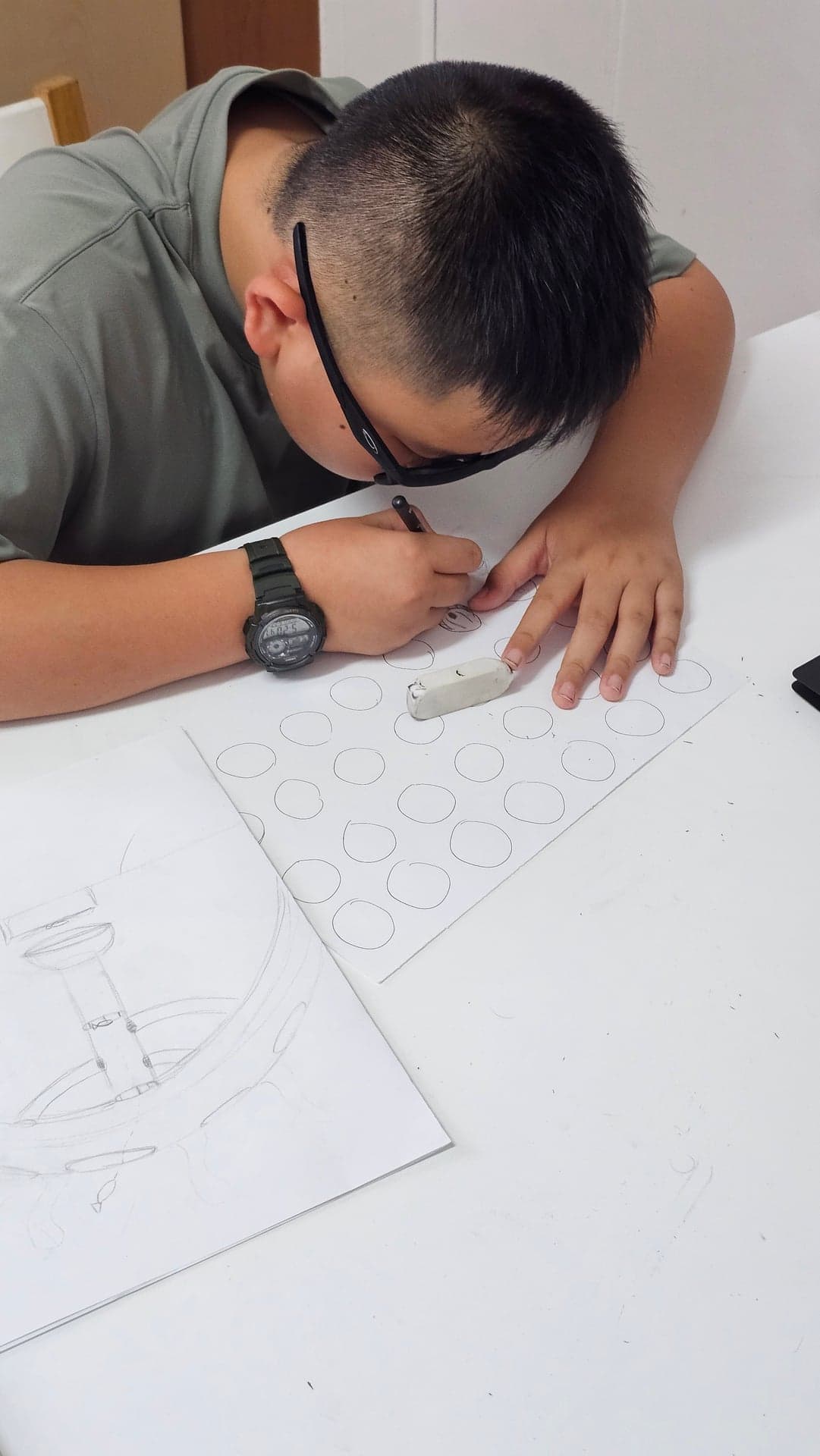
Shading is about value — controlling how light or dark each area is — to create the illusion of three-dimensional form on a flat page. Value, more than colour or line, makes a drawing read as solid and real, even in pure greyscale. Art by Ancourage teaches structured shading to students at Bishan and Woodlands.
This guide explains what value is, the standard pattern of light and shadow on a form, how to build a value scale, which pencils to use, and the core shading techniques. It pairs with our art techniques and fundamentals guide and our walkthrough of drawing classes in Singapore for beginners.
When we teach beginners to shade, the breakthrough almost always comes the moment a student stops shading "flat grey" and starts mapping a clear pattern of light, midtone, core shadow and cast shadow — suddenly a circle becomes a sphere.
What Is Value in Art?
Value, also called tone, is the lightness or darkness of an area, and it does more than colour or line to create the illusion of three-dimensional form and depth. A drawing made only in shades of grey can read convincingly as 3D when its values are right, which is why value is the single most important skill in shading.
The Tate art terms glossary defines tone as "the lightness or darkness of something." Training your eye to judge value accurately — to see how dark a shadow really is, not how dark you assume it is — is the foundation everything else in this guide builds on, and it carries straight into still-life drawing.
What Are the Elements of Light and Shadow?
On a simple form lit by one light source — say a sphere — light falls in a predictable pattern of five named parts: highlight, light (midtone), core shadow, reflected light, and cast shadow. Learning these names lets you read and recreate light on any object, from an apple to a face.
| Part | What it is |
|---|---|
| Highlight | The brightest point, where the light hits the form most directly |
| Light (midtone) | The general lit side of the form, between highlight and shadow |
| Core shadow | The darkest band of the form shadow, lying along the terminator — the line where the form turns away from the light |
| Reflected light | A slightly lighter area inside the shadow, from light bounced off nearby surfaces |
| Cast shadow | The shadow the object throws onto the surface — usually the darkest value, hardest-edged and darkest closest to the object |
Two terms are easy to confuse: a form shadow sits on the object itself and has a soft edge, while a cast shadow is thrown onto another surface and has a harder edge. Always begin with a single light source so this whole pattern stays clear — multiple lights flatten and complicate it.
How Do You Build a Value Scale?
A value scale is a strip of evenly stepped greys running from white to black, commonly drawn in 5, 9 or 10 steps, and making one trains both your eye and your hand. It is the single most useful warm-up exercise in shading, and we ask every new student to draw one.
- Draw a row of equal boxes — start with five, then progress to nine or ten.
- Leave the first box white (the paper) and make the last box as dark as your pencil allows.
- Fill the boxes in between so each step is an even jump in darkness, with no sudden leaps.
- Squint at your finished scale: the steps should look like a smooth staircase, not random patches.
Once you can produce even steps, you can match the values you see in real life to your scale — which is the bridge between an exercise and a finished portrait or face drawing.
Which Pencils Should You Use?
Graphite pencils are graded by an H-to-B scale: H grades are Harder and lighter (4H, 2H), B grades are softer and Blacker (2B, 6B), with HB and F sitting in the middle. Knowing the scale lets you reach for the right pencil instead of pressing harder and damaging the paper.
- H grades (4H, 2H): hard and light — ideal for faint guidelines and the lightest values.
- HB and F: the middle ground — good for general midtones and everyday sketching.
- B grades (2B, 4B, 6B): soft and dark — used to build up midtones quickly and place your darkest accents in core and cast shadows.
A practical beginner kit is just three pencils — say 2H, HB and 4B — which already covers your full value range. Build value up gradually in light layers rather than trying to hit the darkest tone in one heavy pass.
What Are the Main Shading Techniques?
The core shading techniques are hatching (parallel lines), cross-hatching (overlapping sets of lines), blending or smudging, stippling (dots), and scumbling (small scribbled circles). Each builds value in a different texture, and most finished drawings combine two or three.
- Hatching: closely spaced parallel lines; the closer together, the darker the value reads.
- Cross-hatching: a second set of lines crossing the first, layered to deepen tone and suggest texture.
- Blending: smudging graphite with a tortillon, tissue or finger for smooth gradients — useful for soft form shadows.
- Stippling: building value with dots; dense clusters read as dark, sparse dots as light.
- Scumbling: overlapping small scribbled circles to fill an area with an even, slightly textured tone.
Why Does Squinting Help You Shade?
Squinting at your subject blurs away fine detail and simplifies the scene into a few big shapes of light and dark, which is the key skill that lets beginners see value clearly. Without it, beginners get lost in details and shade everything mid-grey.
The Getty's Understanding Formal Analysis resource lists value among the core elements of art, and squinting is the practical way to read it. When you squint, ask one question: which shapes are light, which are dark, and where is the darkest dark? Map those big shapes first, then refine — a habit that pays off in every still-life setup.
How Does Art by Ancourage Teach Shading?
Art by Ancourage teaches shading as a structured skill — value scales, the light-and-shadow pattern, and pencil control — rather than leaving students to guess.
This happens in our Professional Fine Art Classes and one-to-one private lessons, and is introduced from the start in drawing basics. Book a trial class (from $18) at Bishan or Woodlands.
Frequently Asked Questions
Quick answers about shading, value and pencils.
What is value in shading?
Value, also called tone, is the lightness or darkness of an area in a drawing. It is the most important factor in shading because value — more than colour or line — creates the illusion of three-dimensional form. A drawing made only in shades of grey can look convincingly solid and 3D when its values are accurate, which is why value training comes first.
How do I make my shading look three-dimensional?
Use a single light source and map the standard pattern: highlight, light, core shadow, reflected light and cast shadow. Keep the lit side light, place the darkest band where the form turns away from the light, and add a dark cast shadow on the surface. Building these distinct values, rather than shading everything flat grey, is what makes a form read as 3D.
Which pencils are best for shading?
Use H-grade pencils (such as 2H) for light guidelines, HB or F for general midtones, and B grades (2B to 6B) for dark accents in shadows. A simple starter kit of 2H, HB and 4B covers the full value range. Build value gradually in light layers rather than pressing hard, which damages the paper and is difficult to correct.
What is the difference between a form shadow and a cast shadow?
A form shadow sits on the object itself, where its surface turns away from the light, and has a soft edge. A cast shadow is thrown by the object onto another surface — like a table — and has a harder edge that is darkest closest to the object. Cast shadows are usually the darkest value in the whole drawing.
How does squinting help with shading?
Squinting blurs out fine detail and simplifies your subject into a few large shapes of light and dark. This makes it far easier to judge value accurately and to find the darkest dark and the brightest highlight. It is the single most useful habit for beginners, because it stops you getting lost in details and shading everything mid-grey.