
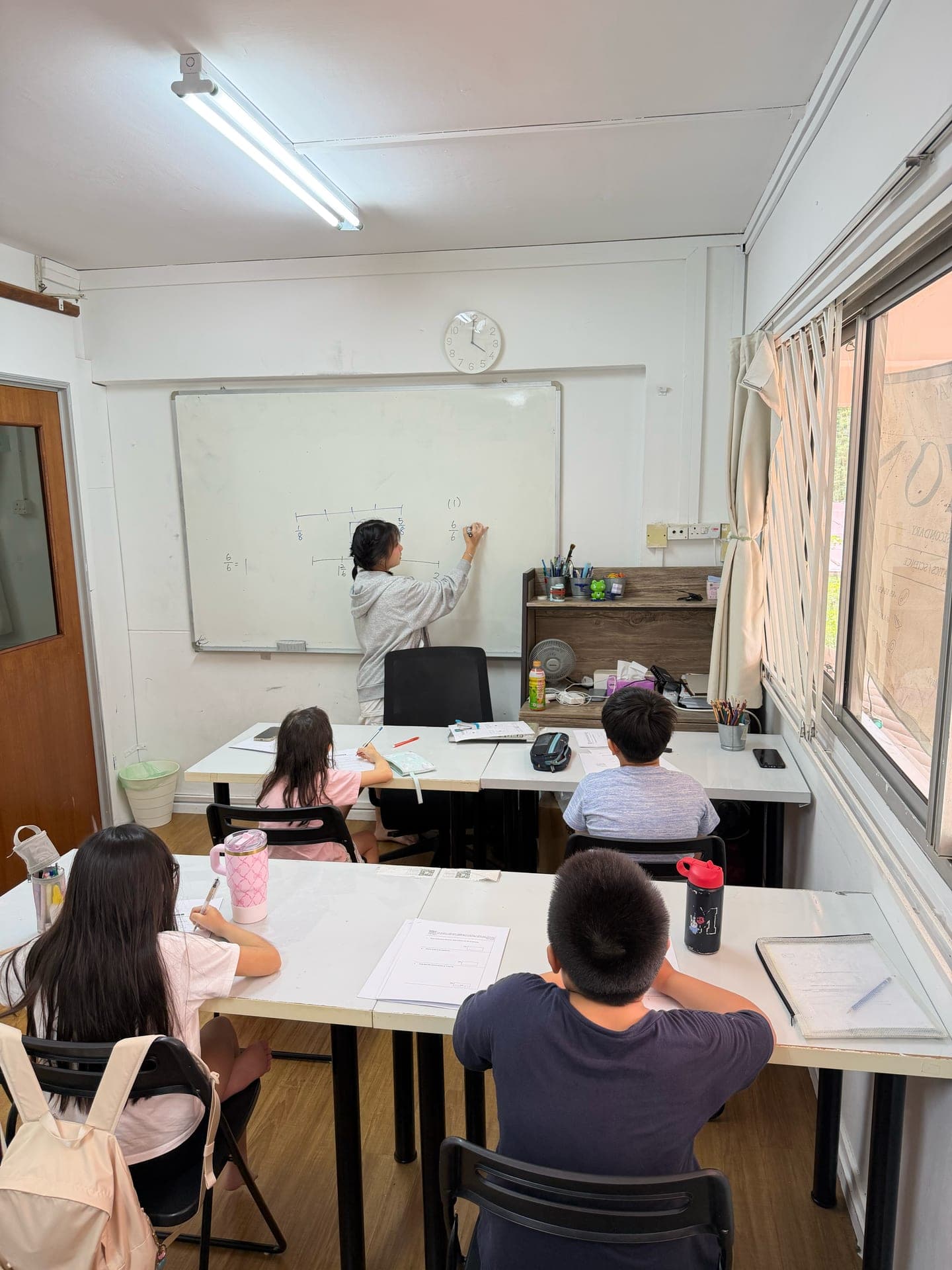
The O-Level / SEC Pure Physics examination (SEC code K323, formerly GCE O-Level 6091) is assessed across three papers — Paper 1 Multiple Choice, Paper 2 Structured and Free Response, and Paper 3 Practical — totalling 160 marks, with around 55% of the theory marks rewarding the handling of information and problem-solving over straight recall. This guide is from Ancourage Academy, whose secondary Physics tuition prepares Sec 3 and Sec 4 students for every topic and paper in the syllabus.
This is a single-subject map of O-Level / SEC Physics, not a general study-tips piece — what the 20 topics are, which ones decide grades, and the specific errors that cost marks. If your child is still choosing between Pure and Combined Science, start with our Combined vs Pure Science guide; this article assumes Pure Physics.
If Physics feels abstract or the calculations are slipping, Ancourage Academy's Sec 4 Pure Physics programme builds topic understanding and answering technique in small groups of 3–6 — book a trial class (usually $18) for a diagnostic assessment.
How Is O-Level / SEC Physics (K323) Structured?
O-Level / SEC Physics has three papers — a 40-question multiple-choice paper, a structured and free-response theory paper, and a practical examination — with the assessment objectives placing around 45% of the theory marks on Knowledge with Understanding and around 55% on Handling Information and Solving Problems.
| Paper | Component | Duration | Marks | Weighting |
|---|---|---|---|---|
| Paper 1 | Multiple Choice (40 MCQ) | 1 hour | 40 | 30% |
| Paper 2 | Structured and Free Response | 1 h 45 min | 80 | 50% |
| Paper 3 | Practical | 1 h 50 min | 40 | 20% |
Paper 2 splits into Section A (70 marks of compulsory structured questions, including a data-based question of 8–12 marks) and Section B (10 marks, where students answer one of two free-response questions). The full syllabus is on the SEAB SEC G3 syllabuses page, with the current O-Level edition (6091) on the SEAB O-Level page.
The Full O-Level Physics Syllabus (6091) / SEC K323: 20 Topics, 6 Sections
The Physics syllabus is organised into 20 topics across six sections — Measurement, Newtonian Mechanics, Thermal Physics, Waves, Electricity and Magnetism, and Radioactivity — and the structure is the same for the current O-Level (6091) and the new SEC G3 (K323).
| Section | Topics |
|---|---|
| I. Measurement | 1. Physical Quantities, Units and Measurement (including scalars and vectors) |
| II. Newtonian Mechanics | 2. Kinematics · 3. Dynamics · 4. Turning Effect of Forces · 5. Pressure · 6. Energy (work, power, efficiency) |
| III. Thermal Physics | 7. Kinetic Particle Model of Matter · 8. Thermal Processes (conduction, convection, radiation) · 9. Thermal Properties of Matter (specific heat capacity, latent heat) |
| IV. Waves | 10. General Properties of Waves (including sound) · 11. Electromagnetic Spectrum · 12. Light (reflection, refraction, lenses) |
| V. Electricity and Magnetism | 13. Static Electricity · 14. Current of Electricity · 15. D.C. Circuits · 16. Practical Electricity · 17. Magnetism · 18. Electromagnetism · 19. Electromagnetic Induction |
| VI. Radioactivity | 20. Radioactivity (atomic model, alpha/beta/gamma, half-life, fission and fusion) |
Two points worth flagging for students using older notes: there is no standalone "Sound" topic — sound is covered within Topic 10 (General Properties of Waves) — and Radioactivity is a full syllabus section that is easy to neglect because it sits at the very end. Within the Waves section, the Electromagnetic Spectrum (Topic 11) is taught before Light (Topic 12).
Where Are the Marks Won and Lost in O-Level / SEC Physics?
The electricity cluster and Newtonian mechanics decide most O-Level / SEC Physics grades, with electromagnetism and the practical paper acting as the common dividing lines between B and A students.
- Kinematics and Dynamics (Topics 2–3): foundational and heavily MCQ-tested. Velocity–time graph interpretation (gradient is acceleration, area is displacement) and free-body, resultant-force reasoning underpin many later questions.
- Energy, Work and Power (Topic 6): conservation-of-energy problem chains — gravitational potential energy to kinetic energy, efficiency, power — recur every cohort and combine with kinematics.
- Turning Effect of Forces (Topic 4): principle-of-moments calculations are frequent structured-question fodder and a classic mark-loser when the pivot or perpendicular distance is set up wrongly.
- The electricity cluster (Topics 14–16): the single densest, most heavily weighted block. Series and parallel resistance, potential dividers, P = VI and E = VIt, and current–voltage characteristics dominate Paper 2.
- Electromagnetism and EM Induction (Topics 18–19): Fleming's left-hand and right-hand rules, the d.c. motor, the a.c. generator, and the transformer turns ratio — commonly failed because the three-dimensional field, current, and force directions are hard to visualise.
- Practical skills (Paper 3 and the Paper 2 data-based question): graph plotting, gradient extraction, reading instruments to the correct precision, and evaluating method are disproportionately decisive for the final grade.
How Do You Answer Physics Questions for Full Marks?
O-Level / SEC Physics rewards explicit reasoning and disciplined working — most marks are lost not on wrong physics but on incomplete explanations, missing units, and graph misreadings. The cross-subject habits are in our secondary Science answering-technique guide; the Physics-specific ones are below.
- State the principle before applying it: name the law (conservation of energy, Ohm's law, principle of moments) and then substitute. Definition and recall marks reward exact wording.
- Show formula, substitution, then answer: each step earns marks, and the working survives an arithmetic slip. Always include units — a correct number without units loses the mark.
- Read the graph axis carefully: on a velocity–time graph the gradient is acceleration and the area is displacement; on a distance–time graph the gradient is speed. Confusing the two is one of the most common errors.
- Draw free-body diagrams: show every force, do not duplicate forces, and remember that a moving object at constant velocity has balanced forces (Newton's first law).
- Apply Fleming's rules deliberately: left hand for the motor effect (force), right hand for induced current — getting the hand wrong reverses the answer.
What Is in the O-Level / SEC Physics Practical Paper?
Paper 3 is worth 20% and rewards careful measurement and analysis, not theory recall — it tests reading instruments to the correct precision, plotting graphs with sensible scales and large gradient triangles, and evaluating sources of error. Planning carries about 15% of the practical marks, with the rest on manipulation, measurement, presentation of data, analysis, and conclusions.
Common practical mark-losers are quoting raw readings to inconsistent decimal places, drawing gradient triangles that are too small, omitting axis units, and giving vague "human error" answers instead of specific, improvable sources of error. Our guide to secondary Science practical and lab exam preparation covers these skills across all three sciences.
What Changes for O-Level Physics Under SEC in 2027?
From 2027, the GCE O-Level becomes the Singapore-Cambridge Secondary Education Certificate (SEC), and Pure Physics moves from code 6091 to G3 code K323 — but the standard, three-paper structure, and 20-topic content are unchanged. SEAB has confirmed SEC G3 mirrors the O-Level standard, so revision resources and preparation methods carry over directly.
Under Full Subject-Based Banding, science is taken at G1, G2, or G3 level, and Pure Physics is a G3 subject. At G2, Physics is not a standalone subject but half of a two-subject pairing — K223 with Chemistry or K224 with Biology. For the wider transition, see our guide to the 2027 SEC examination.
How Do You Build Physics From Sec 3 to Sec 4?
O-Level / SEC Physics builds in layers — the Sec 3 mechanics and measurement foundations are assumed knowledge for the Sec 4 electricity and electromagnetism topics, so gaps left early compound quickly.
The same compounding continues into JC, where fields and circuits reappear at a higher level; our small-group Physics classes for JC students take the syllabus on from there.
- Sec 3 — secure measurement and mechanics: units and vectors, kinematics, dynamics, moments, pressure, and energy form the problem-solving toolkit for the whole subject. See our Sec 3 Pure Physics programme.
- Sec 3 — start graph and practical work early: velocity–time graphs and measurement precision are skills that take time to become automatic.
- Sec 4 — master the electricity block and electromagnetism: circuits, practical electricity, magnetism, electromagnetism, EM induction, and radioactivity build on the Sec 3 toolkit and carry heavy weighting.
- Sec 4 — drill exam technique: practise under timed conditions, write definitions in exact syllabus wording, and review every wrong answer by cause — concept, working, or carelessness.
At Ancourage Academy, our secondary Physics classes at Bishan and Woodlands teach topic mastery and answering technique together in small groups of 3–6. Book a trial class (usually $18) for an honest assessment, or WhatsApp us with any questions.
For students who want to go beyond the syllabus, the Singapore Junior Physics Olympiad (SJPO) is run by the Institute of Physics Singapore, is a two-hour paper, and is entered through the school. Our SJPO and SJBO guide sets out what the organiser publishes.
Common Questions About O-Level / SEC Physics
How many topics are in the O-Level / SEC Physics syllabus?
There are 20 topics across six sections: Measurement, Newtonian Mechanics (kinematics, dynamics, moments, pressure, energy), Thermal Physics, Waves (general properties and sound, electromagnetic spectrum, light), Electricity and Magnetism (the largest section), and Radioactivity. The structure is identical for the current O-Level (6091) and the SEC G3 (K323) from 2027.
What is the hardest topic in O-Level / SEC Physics?
Most students find the electromagnetism topics (electromagnetism and electromagnetic induction) the hardest, because the three-dimensional relationships between field, current, and force are difficult to visualise and Fleming's rules are easy to misapply. The electricity cluster (circuits and practical electricity) is the most heavily weighted and where many marks are won or lost. Kinematics graph interpretation is the most common early stumbling block.
Does O-Level / SEC Physics include radioactivity?
Yes. Radioactivity is a full section of the syllabus (Topic 20), covering the nuclear model of the atom, alpha, beta, and gamma radiation and their properties, balancing nuclear equations, half-life, and a descriptive treatment of fission and fusion. It sits at the end of the syllabus and is often under-revised, which makes it a reliable source of marks for students who prepare it properly.
How is O-Level Physics changing under SEC in 2027?
From 2027 the GCE O-Level becomes the Singapore-Cambridge SEC, and Pure Physics changes from code 6091 to G3 code K323. The standard, the three-paper structure (160 marks), and the 20-topic content are unchanged — SEAB has confirmed SEC G3 mirrors the O-Level standard. Students prepare exactly as before.
Is Pure Physics harder than Combined Science Physics?
Yes. Pure Physics covers the full syllabus with greater depth and a standalone practical paper, while Combined Science Physics covers selected topics at reduced depth as part of a shared grade and omits areas such as electromagnetic induction. Pure Physics is the stronger foundation for JC H2 Physics and engineering pathways. Our Combined vs Pure Science guide covers the trade-offs.
Related: Choosing Combined vs Pure Science · Secondary science exam techniques · Science Practical Preparation · H2 Physics JC Guide · SEC 2027 Examination · Forces, Energy & Kinematics · Electricity & Magnetism · Waves, Light & Sound · Thermal Physics · a guide to O-Level / SEC Biology · Sec 1-2 Science guide