
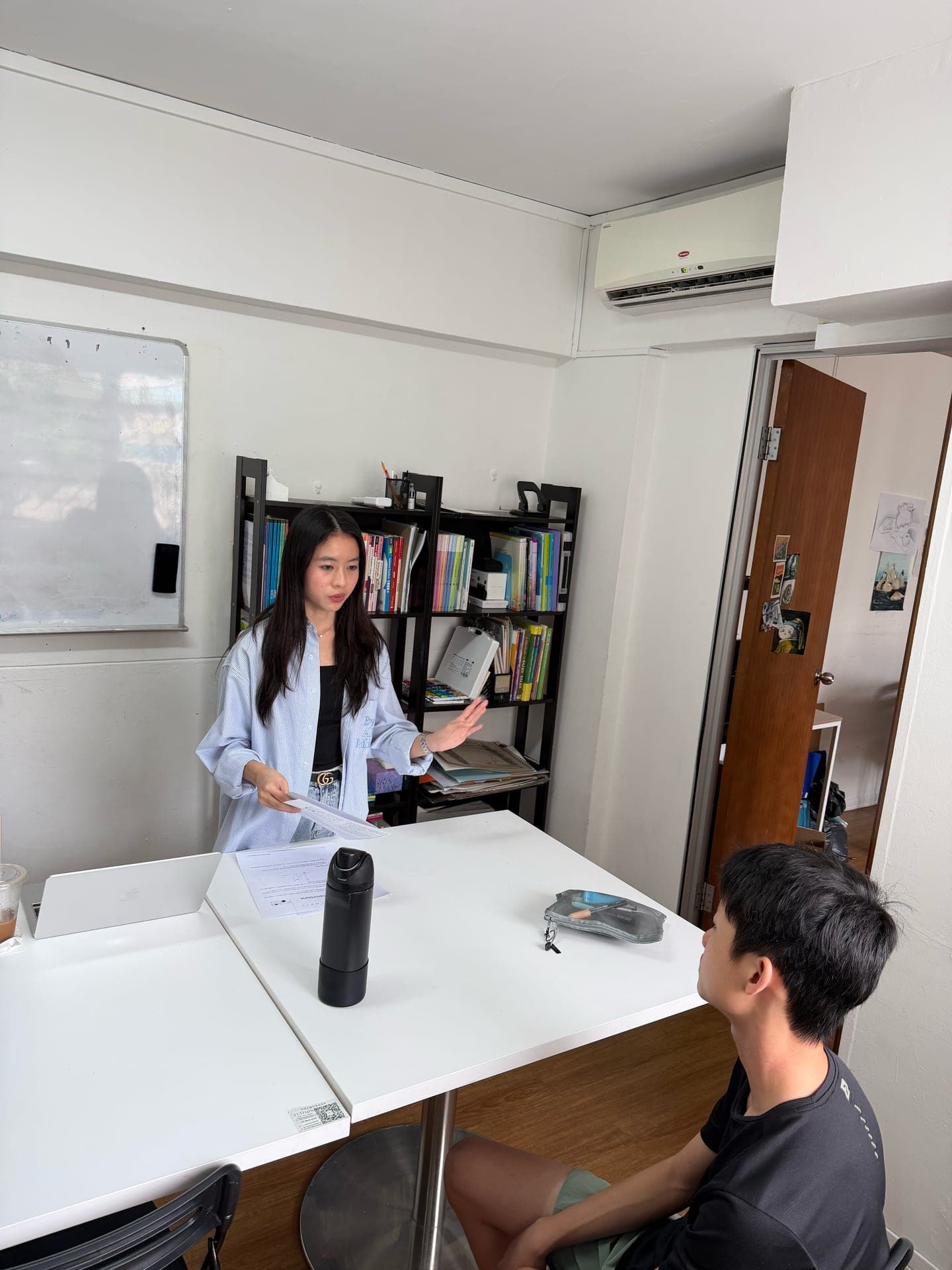
The O-Level / SEC Pure Chemistry examination (SEC code K324, formerly GCE O-Level 6092) is assessed across three papers — Paper 1 Multiple Choice, Paper 2 Structured and Free Response, and Paper 3 Practical — totalling 160 marks, with the assessment weighted toward understanding and applying chemistry rather than rote recall. This guide is from Ancourage Academy, whose secondary Chemistry tuition prepares Sec 3 and Sec 4 students for every topic and paper in the syllabus.
Unlike a general "science study tips" article, this is a single-subject map of O-Level / SEC Chemistry — what the 12 topics actually are, which ones decide grades, and the exact mistakes that cost marks in each paper. If you are still choosing between Pure and Combined Science, start with our Combined vs Pure Science guide; this article assumes your child is taking Pure Chemistry.
If your child is finding Chemistry demanding, Ancourage Academy's Sec 4 Pure Chemistry programme builds topic mastery and answering technique in small groups of 3–6 — book a trial class (usually $18) for a diagnostic assessment of where the gaps are.
What Is the O-Level / SEC Chemistry Exam Structure (K324)?
O-Level / SEC Chemistry has three papers — a 40-question multiple-choice paper, a structured and free-response theory paper, and a practical examination — and the assessment objectives place around 55% of the theory marks on Handling Information and Solving Problems and around 45% on Knowledge with Understanding. Knowing how each paper is built helps students allocate revision time to where the marks actually are.
| Paper | Component | Duration | Marks | Weighting |
|---|---|---|---|---|
| Paper 1 | Multiple Choice (40 MCQ) | 1 hour | 40 | 30% |
| Paper 2 | Structured and Free Response | 1 h 45 min | 80 | 50% |
| Paper 3 | Practical | 1 h 50 min | 40 | 20% |
Paper 2 carries the heaviest weighting and splits into Section A (70 marks of compulsory structured questions, including a data-based question worth 8–12 marks) and Section B (10 marks, where students answer one of two free-response questions — often a cross-topic problem). The full syllabus is published on the SEAB SEC G3 syllabuses page, and the current O-Level edition (6092) is on the SEAB O-Level page.
What Is in the O-Level / SEC Pure Chemistry Syllabus (6092 / K324)?
The Chemistry syllabus is organised into 12 topics across three sections — Matter (structure and properties), Chemical Reactions, and Chemistry in a Sustainable World — and the structure is identical between the current O-Level (6092) and the new SEC G3 (K324), which were refreshed together by MOE and Cambridge.
| Section | Topics |
|---|---|
| I. Matter: Structures and Properties | 1. Experimental Chemistry · 2. The Particulate Nature of Matter (kinetic particle theory, atomic structure) · 3. Chemical Bonding and Structure (ionic, covalent, metallic; structure–property links) |
| II. Chemical Reactions | 4. Chemical Calculations (formulae, the mole and stoichiometry) · 5. Acid–Base Chemistry (acids, bases, salts, ammonia) · 6. Qualitative Analysis · 7. Redox Chemistry (oxidation–reduction; electrochemistry, including electrolysis) · 8. Patterns in the Periodic Table · 9. Chemical Energetics · 10. Rate of Reactions |
| III. Chemistry in a Sustainable World | 11. Organic Chemistry (fuels, hydrocarbons, alcohols, carboxylic acids, esters, polymers) · 12. Maintaining Air Quality |
A few naming points trip up students using older notes: electrolysis is not a standalone topic — it sits inside Topic 7 (Redox Chemistry); "macromolecules" is now covered as Polymers within Organic Chemistry; and the old "Air / Atmosphere" topic is now "Maintaining Air Quality," which folds in greenhouse gases and the carbon cycle under a sustainability framing.
Which Topics Decide Your O-Level / SEC Chemistry Grade?
Six topics decide most O-Level / SEC Chemistry grades — Chemical Calculations (the mole), Qualitative Analysis, Redox and Electrolysis, Acid–Base Chemistry and Salts, Organic Chemistry, and Chemical Bonding — because they are heavily tested and consistently mis-answered.
- Chemical Calculations / the mole (Topic 4): the single highest-yield, highest-failure area — it recurs across Paper 2 because almost every other topic is quantified through it. (SEAB publishes paper weightings for K324 — Paper 1 40 marks 30%, Paper 2 80 marks 50%, Paper 3 40 marks 20% — but no topic breakdown, so any per-topic share is Ancourage Academy's own estimate from past papers.) Limiting reagent, percentage yield, and multi-step mole–mass–volume conversions separate the grades. Students who memorise formulae without the conceptual chain break down the moment a question has two reactants.
- Qualitative Analysis (Topic 6): a dedicated 6–8 mark question appears almost every year, plus the Paper 3 practical. The cation, anion, and gas test table is the rare topic where memorisation pays off directly — but the marks are lost on choosing the wrong confirmatory test or mis-stating whether a precipitate is soluble in excess.
- Redox and Electrolysis (Topic 7): oxidation numbers, half-equations, and electrolysis (predicting cathode and anode products for molten versus aqueous, dilute versus concentrated electrolytes) are perennial heavy hitters. Forgetting that concentration changes the product — dilute versus concentrated sodium chloride solution give different products at the anode — is a classic error.
- Acid–Base Chemistry and Salts (Topic 5): salt preparation routes (titration for soluble salts, excess-then-filter, or precipitation for insoluble salts) and ionic equations are tested in both theory and the practical.
- Organic Chemistry (Topic 11): homologous series, isomerism, alkene reactions, alcohol oxidation, esterification, and drawing an addition polymer from a given monomer. High marks, but compressed under time pressure at the end of the paper.
- Chemical Bonding and Structure (Topic 3): linking structure (ionic, giant covalent, simple molecular, metallic) to physical properties such as melting point, conductivity, and solubility through deductive reasoning — exactly the kind of "handling information" question the syllabus weights most.
How Do You Answer Chemistry Questions for Full Marks?
O-Level / SEC Chemistry rewards precise scientific language and complete reasoning — conceptually correct answers routinely lose one or two marks because the exact mark-scheme vocabulary is missing. Building these habits from Sec 3 is what converts understanding into marks. Our secondary Science answering-technique guide covers the cross-subject habits; the Chemistry-specific ones are below.
- Use exact bonding language: "shared pair of electrons," "strong electrostatic forces of attraction," and "giant covalent structure" earn marks where "the atoms join together" does not.
- Write ionic equations correctly: balance charge as well as atoms, include state symbols, and use ionic (not molecular) equations for precipitation and electrolysis half-equations.
- Show every step in mole calculations: write the balanced equation, the mole ratio, then the substitution. Method marks are awarded even when the final arithmetic slips.
- Separate observation from conclusion in QA: "white precipitate, insoluble in excess aqueous sodium hydroxide" is the observation; the cation conclusion follows from it. Both are needed.
- Explain rate changes with collision theory: describe the frequency or energy of effective collisions, not just that a reaction is "faster."
What Does the Chemistry Practical (Paper 3) Test?
Paper 3 is worth 20% and is the most under-prepared paper, because it cannot be revised from a textbook — it tests qualitative analysis, titration technique, salt preparation, and the planning and evaluation of experiments. Within the practical, planning carries about 15% of the marks, with the rest on manipulation, observation, presentation of data, analysis, and evaluation.
Students who only practise practical skills during school lab sessions are underprepared. Systematic observation recording, drawing results tables before starting, and writing precise colour-change and gas-test observations are skills that need deliberate rehearsal. Our guide to secondary Science practical and lab exam preparation goes deeper on the cross-subject practical skills that Paper 3 assesses.
What Changes for Chemistry When O-Level Becomes SEC in 2027?
From 2027, the GCE O-Level is replaced by the Singapore-Cambridge Secondary Education Certificate (SEC), and Pure Chemistry moves from code 6092 to G3 code K324 — but the standard, paper structure, and 12-topic content are unchanged. SEAB has confirmed that SEC G3 mirrors the O-Level standard, and the published K324 (2027) and 6092 (2026) syllabus documents contain identical content and assessment tables.
In practice this means current revision resources remain valid, and students sitting under either system prepare the same way. The change that matters more for most families is Full Subject-Based Banding, under which science is taken at G1, G2, or G3 level — Pure Chemistry is a G3 subject. At G2, Chemistry is not a standalone subject but half of a two-subject pairing — K223 with Physics or K225 with Biology. For the wider picture, see our guide to the 2027 SEC examination.
How Should Students Build Chemistry From Sec 3 to Sec 4?
O-Level / SEC Chemistry is cumulative — Sec 3 foundations in the mole, bonding, and acids and bases directly determine Sec 4 performance, because the harder Sec 4 topics assume those tools are already automatic.
The same is true of the jump to H2, where mole calculations and bonding are assumed from the first week; our Chemistry tuition for JC1 and JC2 starts from that assumption.
- Sec 3 — build the calculation and bonding core: the mole concept, formulae and equations, bonding and structure, and acids, bases and salts are the foundation for everything that follows. A student who is still hesitant with mole calculations entering Sec 4 will struggle with energetics, electrolysis, and titration questions that build on them. See our Sec 3 Pure Chemistry programme.
- Sec 3 — start qualitative analysis and practical skills early: the QA test table and salt-preparation routes reward early, repeated exposure rather than last-minute cramming.
- Sec 4 — integrate and apply: redox and electrolysis, the reactivity series, organic chemistry, and rate of reaction build on the Sec 3 core. Cross-topic Section B questions, which combine (for example) energetics with bonding, are where grade bands separate.
- Sec 4 — drill exam technique: practise under timed conditions, write to the mark scheme's keyword expectations, and review every wrong answer by cause — concept gap, keyword error, or careless slip.
At Ancourage Academy, our secondary Chemistry classes at Bishan and Woodlands teach topic mastery and answering technique together in small groups of 3–6. Book a trial class (usually $18) for an honest assessment of your child's Chemistry, or WhatsApp us with any questions.
For revision and answering-technique guides across every O-Level / SEC subject, browse our O-Level / SEC subject hub.
Common Questions About O-Level / SEC Chemistry
How many topics are in the O-Level Chemistry syllabus?
There are 12 topics organised into three sections: Matter (Experimental Chemistry, Particulate Nature of Matter, Chemical Bonding), Chemical Reactions (Chemical Calculations, Acid–Base Chemistry, Qualitative Analysis, Redox, Periodic Table, Energetics, Rate of Reactions), and Chemistry in a Sustainable World (Organic Chemistry, Maintaining Air Quality). The structure is identical for the current O-Level (6092) and the SEC G3 (K324) from 2027.
What is the hardest topic in O-Level Chemistry?
Most students find Chemical Calculations (the mole) the hardest, because it runs through most of Paper 2 — almost every other topic is quantified through it. Limiting reagent and percentage yield questions are the most common grade-determining gap. Organic Chemistry is the second most challenging by volume, and electrolysis (within Redox) is the topic most often mis-answered under time pressure.
How is O-Level Chemistry changing under SEC in 2027?
From 2027 the GCE O-Level becomes the Singapore-Cambridge SEC, and Pure Chemistry changes from code 6092 to G3 code K324. The standard, the three-paper structure (160 marks), and the 12-topic content are unchanged — SEAB has confirmed SEC G3 mirrors the O-Level standard. Students prepare exactly as before, and existing revision resources remain valid.
How is the Chemistry practical (Paper 3) marked?
Paper 3 is worth 40 marks (20% of the grade) over 1 hour 50 minutes. It tests qualitative analysis, titration and salt-preparation technique, and experimental planning. Planning carries about 15% of the practical marks, with the remainder split across manipulation, observation, data presentation, analysis, and evaluation. It requires hands-on practice — reading about experiments is not enough to score well.
How can my child improve from a C to an A in Chemistry?
Most C-grade students understand the content but lose marks on precision and incomplete reasoning. The fastest gains come from mastering mole calculations until they are automatic, learning the qualitative-analysis test table, and writing answers in the exact mark-scheme language (state symbols, bonding keywords, full ionic equations). Practising past papers and classifying every error — concept, keyword, or carelessness — turns understanding into marks more efficiently than additional content study.
Is Pure Chemistry harder than Combined Science Chemistry?
Yes. Pure Chemistry covers the full syllabus with greater depth and an additional standalone practical paper, while Combined Science covers selected topics at reduced depth as part of a shared grade. Pure Chemistry is the stronger foundation for JC H2 Chemistry and science-related pathways. Our Combined vs Pure Science guide explains the trade-offs for L1R5 / L1R4 and JC eligibility.
Related: Combined or Pure Science? · Secondary Science Strategies · Science Practical Preparation · H2 Chemistry JC Guide · SEC 2027 Examination · Mole Concept & Stoichiometry · Atomic Structure & Bonding · Acids, Bases & Salts · Metals & Electrolysis · Organic Chemistry · Answering open-ended science questions · a guide to O-Level / SEC Biology · a guide to O-Level Science Preparation for Bishan Secondary Schools