
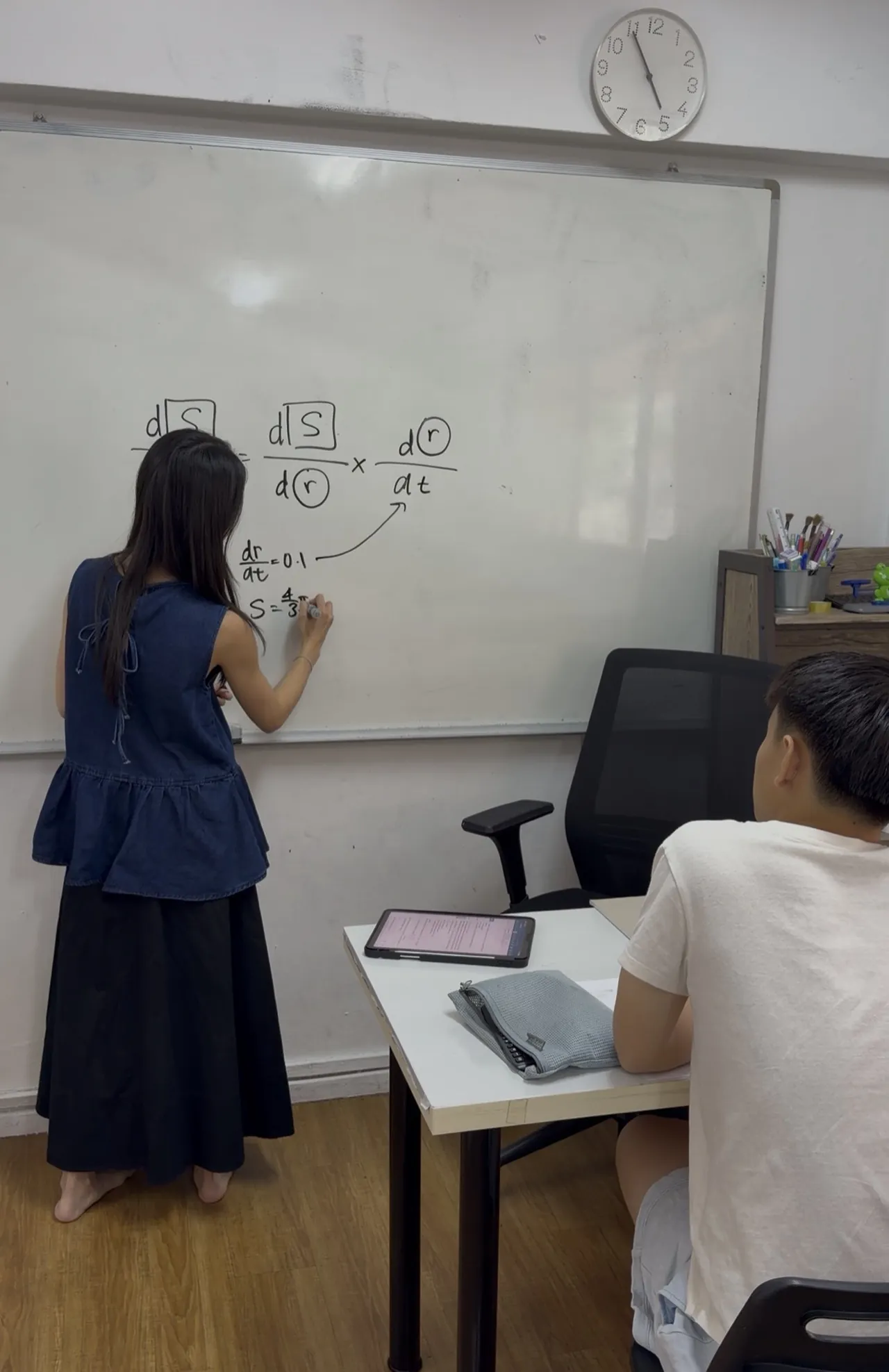
The A-Level H2 Physics examination (Syllabus 9478) consists of four papers — Multiple Choice, Structured Questions, Longer Structured Questions, and Practical — totalling 230 marks, with the new syllabus introducing Capacitance and Wavefunctions as major additions from 2026. The 9478 code is first examined in 2026 (with the older 9749 having its final examination in the same year), and students entering JC1 from 2025 should ensure all study materials reference the current syllabus. This guide is from Ancourage Academy, whose JC Physics tutor-led tuition programme prepares students for H2 Physics from JC1 through Prelims.
After teaching JC Physics at Ancourage Academy, one pattern recurs every year: students who excelled in O-Level Physics by memorising definitions and formulas hit a wall in JC. H2 Physics requires mathematical reasoning — applying calculus, vectors, and trigonometry to physical scenarios — and the ability to synthesise concepts across topics that were taught separately. A question on electromagnetic induction might require mechanics, field theory, and energy conservation all in one solution. This guide covers what the exam actually tests and how to prepare effectively.
What the H2 Physics Exam Tests (Syllabus 9478)
The A-Level H2 Physics examination (Syllabus 9478) tests four papers — Paper 1 Multiple Choice (30 marks, 15%), Paper 2 Structured Questions (75 marks, 30%), Paper 3 Longer Structured Questions (75 marks, 35%) and Paper 4 Practical (50 marks, 20%) — 230 marks in total, all compulsory.
Syllabus 9478 is first examined in 2026 alongside the older 9749 (which has its final examination in the same year), introducing new content in electricity and modern physics while restructuring the practical assessment to include mandatory spreadsheet skills.
| Paper | Component | Duration | Marks | Weighting |
|---|---|---|---|---|
| Paper 1 | Multiple Choice (30 MCQs) | 1 hour | 30 | 15% |
| Paper 2 | Structured Questions | 2 hours | 75 | 30% |
| Paper 3 | Longer Structured Questions | 2 hours | 75 | 35% |
| Paper 4 | Practical | 2 h 30 min | 50 | 20% |
Paper 3 carries the heaviest weighting at 35%, split into Section A (55 marks of compulsory structured questions) and Section B (20 marks — a choice of one from two 20-mark questions). Section B questions often require integrating concepts from multiple topics. The full syllabus document is available from SEAB's A-Level syllabuses page, and MOE outlines the A-Level curriculum framework.
If your child needs H2 Physics support, Ancourage Academy's JC programme builds both conceptual understanding and exam technique in small groups of 3–6 — book a trial class (usually $18) for a diagnostic assessment.
"The A-Level curriculum and subject syllabuses are designed to develop the values, skills and dispositions that students would need to take them through life as responsible adults and active citizens."
— Ministry of Education, Singapore, A-Level Curriculum and Subject Syllabuses
The Six Content Sections
H2 Physics content spans six sections — Foundations of Physics, Mechanics, Waves, Thermal Physics, Electricity and Magnetism, and Modern Physics — with each section building on concepts from the previous ones, making gaps in early topics particularly costly.
- Foundations of Physics: Quantities and measurement, kinematics, forces and dynamics, work, energy and power. These form the mathematical and conceptual bedrock for everything that follows
- Mechanics: Circular motion, gravitational fields, oscillations (SHM), projectiles, and collisions. Gravitational fields introduce the concept of field theory that extends to electric and magnetic fields later
- Waves: Wave motion, superposition, interference, and diffraction. Understanding path difference and phase relationships is essential for later quantum physics topics
- Thermal Physics: Temperature, ideal gases (pV = nRT), kinetic theory, and the first law of thermodynamics. Requires connecting microscopic particle behaviour to macroscopic measurements
- Electricity and Magnetism: Electric fields, capacitance (new content), current electricity with drift velocity, DC circuits, electromagnetic forces, electromagnetic induction, and alternating current. This is the largest section by content volume
- Modern Physics: Quantum physics (photoelectric effect, wave-particle duality), wavefunctions (new content — probability density, 1D infinite potential well), nuclear physics (radioactive decay, mass-energy equivalence, binding energy)
Key Changes From the Old Syllabus (9749 to 9478)
The 9478 syllabus represents a significant revision with two entirely new areas of content — capacitance and wavefunctions, each folded into an existing topic rather than added as one — and a new practical requirement for digital spreadsheet skills that has no precedent in previous Physics exams.
| Aspect | Old Syllabus (9749) | New Syllabus (9478) |
|---|---|---|
| Capacitance | Not in syllabus | New topic (charge, energy, RC circuits, time constant) |
| Wavefunctions | Not in syllabus | New topic (probability density, 1D infinite potential well) |
| X-ray physics | Included | Removed |
| Current electricity | Drift velocity and I = nAvq already examinable (Current of Electricity, outcome (b)) | Same outcome retained word for word; what is new is explaining the temperature dependence of resistivity in metals and semiconductors in terms of drift velocity and carrier number density (Circuits, outcome (f)) |
| Practical assessment | Traditional lab skills | Mandatory spreadsheet processing (import/enter data; plot a labelled line graph; adjust the scale of both axes; add a linear trendline and display its equation; area under a curve; gradient at a point on a curve) |
| Paper 3 marks | 80 (Section A: 60, Section B: 20) | 75 (Section A: 55, Section B: 20) |
The addition of Capacitance is substantial — it covers charge storage, energy in capacitors, charging and discharging through resistors, and RC time constants. Since this topic has no past exam papers for reference, students will need to rely on specimen papers and first-principles understanding. The Wavefunctions topic introduces probability-based thinking that is conceptually demanding but narrow in scope.
Where Students Lose the Most Marks
The most common mark losses in H2 Physics come from weak field theory understanding, insufficient mathematical application, and poor practical skills — not from lack of content knowledge.
- Electromagnetic induction: Applying Faraday's Law and Lenz's Law correctly in complex geometries is the single most-failed topic area. Students confuse the direction of induced current and EMF, especially in rotating coil scenarios
- Gravitational and electric fields: Students struggle to connect field strength, potential, and potential energy — particularly the significance of negative gravitational potential and escape velocity derivations
- Oscillations (SHM): Phase relationships between displacement, velocity, and acceleration confuse many students. The energy interchange between kinetic and potential energy in SHM requires both graphical and mathematical fluency
- Multi-concept problems: Paper 3 questions frequently combine mechanics with fields, or waves with quantum physics. Students who study topics in isolation cannot make these connections under exam pressure
- Practical skills and spreadsheets: SEAB syllabus 9478 requires candidates to process practical data in a spreadsheet — importing xlsx data files and entering experimental data, using and duplicating formulae and formatting across cells, then plotting a labelled line graph and, on it, adjusting the scale of both axes, adding a linear trendline with the built-in function, displaying the trendline equation, determining the area under a curve, and determining the gradient at a point on a curve. Rigorous statistical treatment of uncertainty is not required. Paper 4 is worth 20% and is often undertrained
- Mathematical application: H2 Physics requires confident use of graphical calculus (gradients and areas under curves in kinematics, fields), vectors (resolving forces, field superposition), and trigonometry. Students with weaker H2 Mathematics foundations consistently underperform
H1 vs H2 Physics: Choosing the Right Level
H2 Physics covers roughly twice the content of H1 with an additional practical examination — students should choose based on university requirements, mathematical confidence, and genuine interest in the subject.
- H2 Physics (9478): 4 papers including a practical exam. Covers all six sections including thermal physics, oscillations, waves, capacitance, electromagnetic induction, and quantum physics. Required or strongly recommended for Engineering, Physics, and Computing university courses
- H1 Physics (8867): 2 papers only (MCQ + Structured), no practical. Covers measurement, Newtonian mechanics, electricity and magnetism, and nuclear physics only. Does not include thermal physics, oscillations, waves, or quantum physics
University Courses That Require H2 Physics
H2 Physics is the most direct preparation for Engineering at NUS and NTU — though neither lists it as a stand-alone prerequisite, and NTU's Mechanical, Electrical and Aerospace degrees accept H2 Biology or Chemistry in its place — as well as Physics and several interdisciplinary science courses.
- NUS and NTU Engineering (Aerospace, Mechanical, Electrical, Civil, Bioengineering): H2 Physics is strongly recommended — some programmes accept other H2 science subjects, but students without H2 Physics may need to take bridging modules
- NUS Computer Science: H2 pass in Computing, Mathematics, Further Mathematics, or Physics accepted (or a good pass in H1 Mathematics) — see NUS A-Level programme prerequisites
- NUS Computer Engineering: H2 Mathematics (or Further Mathematics) required; students admitted without H2 Physics must read a Physics bridging course (jointly conducted by Faculty of Engineering and School of Computing)
- NTU Physics and Applied Physics: H2 Physics and H2 Mathematics required (see NTU Physics admissions)
- SUTD programmes: Engineering-focused courses prefer H2 Physics and H2 Mathematics
Under the new 70-point University Admission Score (from AY2026 admissions), H2 Physics contributes up to 20 points as one of the three best H2 subjects. The UAS is subject-neutral — any three H2 subjects score the same — so students without H2 Physics who later decide on Engineering are not marked down on rank points; the cost is the Physics bridging course NUS Computer Engineering requires of them, and a steeper start in Year 1 physics modules.
Building Physics Skills From JC1
H2 Physics follows a cumulative structure where later topics assume mastery of earlier ones — gaps in JC1 mechanics and fields directly undermine JC2 performance in electromagnetism and quantum physics.
A year-by-year approach based on what Ancourage Academy covers in our JC programme:
- JC1 — Lock in mechanics: Kinematics, forces, energy, and momentum must be second nature before moving to fields. Practise resolving forces, applying work-energy theorem, and solving projectile problems with full mathematical rigour. Circular motion connects directly to gravitational fields — teach them together
- JC1 — Build field intuition: Gravitational fields introduce concepts (field strength, potential, potential energy) that repeat exactly in electric fields and magnetism. Master the gravitational field template thoroughly — electric and magnetic fields follow the same logic
- JC2 — Electromagnetism and quantum: Electromagnetic induction, capacitance (new), and quantum physics build on all previous work. The mathematical demands intensify — ensure calculus skills from H2 Maths are keeping pace
- JC2 — Practical and exam technique: Start Paper 4 preparation early. Practise the 9478 spreadsheet tasks (labelled line graph with both axes rescaled, linear trendline and its equation, area under a curve, gradient at a point on a curve), experimental design, and error analysis. For theory papers, build the habit of showing all working — method marks are awarded even when the final answer is wrong
At Ancourage Academy, our JC1 and JC2 H2 Physics classes use the ESB methodology in small groups of 3-6 students. Physics benefits particularly from the Socratic approach — working through problems via guided questioning helps students develop the systematic problem-solving methods that examiners reward. Book a trial class (usually $18) if you want an honest assessment, or WhatsApp us with any questions.
Common Questions About H2 Physics
Is H2 Physics harder than O-Level Physics?
Substantially. H2 Physics introduces abstract concepts (fields, quantum mechanics, wavefunctions) that have no O-Level equivalent, requires confident mathematical application including calculus, and its practical paper is longer (2 hours 30 minutes) and now includes mandatory spreadsheet tasks. The jump is larger than most students expect — early preparation through strong O-Level foundations (or the equivalent SEC examination from 2027) and A-Maths helps significantly.
Is H2 Physics necessary for Engineering?
Not as an entry requirement. NUS Engineering admits on an H2 pass in Mathematics or Further Mathematics, and NTU's Aerospace, Electrical and Electronic, and Mechanical Engineering degrees accept H2 Biology, Chemistry or Physics (Aerospace also Computing) alongside H2 Mathematics. Only NUS Computer Engineering makes students without H2 Physics read a Physics bridging course. H2 Physics is still the most direct preparation for the Year 1 physics modules, which is why we recommend it for engineering-bound students.
What are the new topics in the 2026 syllabus?
Syllabus 9478 adds two areas of new content rather than two new topics: capacitance (charge storage, RC circuits, time constant), which sits inside Topic 14 Electric Fields with RC circuits in Topic 16 Circuits, and wavefunctions (probability density, 1D infinite potential well) within quantum physics. X-ray physics has been removed. The practical exam now requires mandatory spreadsheet skills for data processing. These changes take effect from the 2026 examination. Details are on the SEAB website.
How important is H2 Maths for H2 Physics?
Very important. H2 Physics routinely requires gradients and areas under curves (the syllabus uses dy/dx notation for rates of change), vector resolution, and trigonometric manipulation. Students who struggle with H2 Mathematics consistently underperform in Physics, particularly in mechanics, fields, and electromagnetic induction questions. The two subjects should be studied in parallel.
How should my child prepare for the new practical format?
Paper 4 now requires digital spreadsheet skills alongside traditional lab techniques. Students should practise the tasks SEAB syllabus 9478 lists — importing xlsx data files and entering experimental data, duplicating formulae and formatting across cells, plotting a labelled line graph, adjusting the scale of both axes, adding a linear trendline with a built-in function and displaying its equation, determining the area under a curve, and determining the gradient at a point on a curve — in Excel or Google Sheets. Rigorous statistical treatment of uncertainty is not required. Hands-on experimental practice remains essential — reading about experiments is not a substitute for performing them.
What is the difference between Capacitance and the other electricity topics?
Capacitance is new content in 9478 rather than a topic of its own. Capacitors — how they store charge and energy — are introduced as a strand of Topic 14 Electric Fields, while RC circuits with a d.c. source, charging, discharging and the time constant τ = RC sit in Topic 16 Circuits. It builds on existing electricity content (current, voltage, resistance) but introduces exponential relationships and circuit-analysis techniques with no precedent in previous exam papers.
Related: H2 Maths topic overview · H2 Chemistry JC Guide · General Paper Guide · Mechanics & Kinematics · Waves & Superposition · Electricity & Magnetism · Thermal Physics & Ideal Gases · Quantum & Nuclear Physics · P3 Science guide · Respiration & photosynthesis (H2 Bio) · Evolution & natural selection (H2 Bio)