
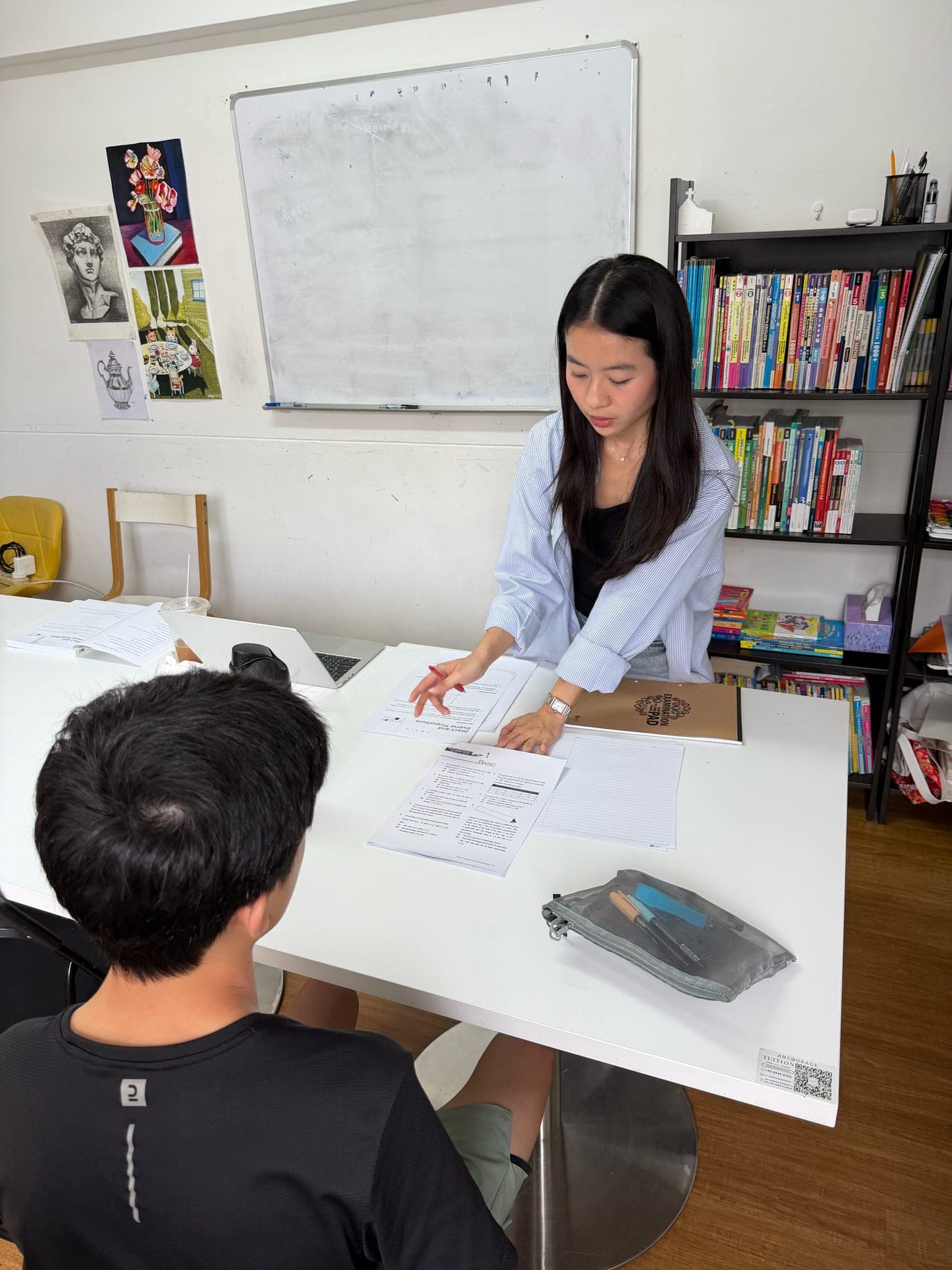
Most O-Level / SEC English comprehension marks are lost not because students fail to understand the passage, but because they answer the wrong way for the question type — a "use your own words" question answered with a lift, or an inference answered too literally. Comprehension is a set of distinct question types, each with its own answer shape. This guide is from Ancourage Academy, whose secondary English tuition trains students to recognise and answer each type in small groups of 3–6.
This is a single-component deep-dive on answering Paper 2 comprehension question by question type. For the full four-paper overview, see our O-Level English preparation guide; for the summary task specifically, see our Paper 2 summary writing guide.
If your child understands the passage but keeps losing comprehension marks, Ancourage Academy's Sec 4 English programme drills answering technique by question type — book a trial class (usually $18) for a diagnostic assessment.
How Is O-Level / SEC English Paper 2 Comprehension Structured?
Paper 2 (Comprehension) is worth 50 marks (35% of the subject) over 1 hour 50 minutes, across three sections based on four texts — two in Section A (one a visual text), a narrative or recount in Section B, and a non-narrative passage in Section C.
| Section | Text | Marks | Tests |
|---|---|---|---|
| Section A | Visual text (Texts 1–2, one with visuals) | 5 | Comprehension, use of visuals, language for effect |
| Section B | Narrative text (Text 3) | 20 | Comprehension, vocabulary in context, language for effect |
| Section C | Non-narrative text (Text 4) | 25 | As above, plus the ~80-word summary |
Texts 3 and 4 together run to about 1200 words. Three question skills recur across the sections — comprehension, vocabulary in context, and use of language for effect — with Section A adding the use of visuals. The SEAB 1184 syllabus defines the format, and from 2027 it carries over to SEC G3 English (K300) unchanged.
How Do You Answer Each O-Level / SEC Comprehension Question Type?
O-Level / SEC English comprehension has six recognisable question types — visual-text, literal, "in your own words", inference, vocabulary-in-context and language-for-effect — and matching your answer shape to the type is the highest-leverage skill in the paper.
Visual text questions (Section A)
Treat the visual — a graph, caption, advertisement, or infographic — as testable text, not decoration. Read the specific data point, headline, or image detail the question asks about, and answer from it directly. Section A is only 5 marks and usually the quickest to answer, so do not over-write.
Literal comprehension questions
These ask for information stated in the passage. Locate the relevant line, and lift the exact answer unless the question says "in your own words." Precision and relevance matter more than length — answer exactly what is asked.
"In your own words" questions
These require you to reword a phrase from the passage to show understanding. Identify the key words to be replaced, substitute accurate synonyms, and keep the meaning intact. Copying the original phrase is not credited even if it is the right phrase — the whole point is to demonstrate that you understand it.
Inference questions
Inference asks what the text implies rather than states. The trap is answering too literally. Read the surrounding context, work out what the writer suggests (about a character's feelings, a situation, or an attitude), and support it with evidence from the text. "How do you know..." and "What does this suggest..." are inference cues.
Vocabulary-in-context questions
These ask for the meaning of a word or phrase as used in the passage, not its dictionary definition in isolation. Substitute your proposed meaning back into the sentence to check it fits the context. A word like "sharp" means something different describing a knife, a mind, and a tone of voice.
Use-of-language and language-for-effect questions
These ask why the writer chose a particular word, phrase, or device. A complete answer quotes the language, names the effect, and explains the impact on the reader — quote, effect, impact. Naming a device ("a metaphor") without explaining its effect rarely earns the mark.
How Do You Read Comprehension Command Words Correctly?
Four command words decide the shape of a comprehension answer — "With reference to…" (cite the lines), "In your own words" (reword, never lift), "Explain" (give the reasoning) and "Suggest" / "How do you know" (infer beyond the literal) — and misreading them is a frequent, avoidable error.
- "With reference to..." means you must quote or cite the specific lines indicated — a general answer will not do.
- "In your own words" forbids lifting; reword the relevant phrase.
- "Explain" requires reasoning, not just a statement; show the cause-and-effect.
- "Suggest" / "How do you know" signals inference; go beyond the literal.
The marks allocated also signal the answer's scale: a 2-mark question usually calls for two distinct points, or a point with its evidence, while a 1-mark question needs a single precise response.
At A-Level the rule tightens: the General Paper specimen paper asks for answers written in your own words as far as possible on every question, as our GP Paper 2 short-answer and comparison guide explains.
What Are the Most Common Comprehension Mistakes in Paper 2?
Most Paper 2 comprehension mistakes come from answering the wrong question type, not from misunderstanding the passage.
| Mistake | Why It Costs Marks | The Fix |
|---|---|---|
| Lifting on "own words" questions | Copying shows no understanding | Reword the key phrase with accurate synonyms |
| Answering inference literally | Misses the implied meaning | Ask what the writer suggests, then support with evidence |
| Dictionary meaning, not in-context | Ignores how the word is used | Substitute your meaning back into the sentence |
| Naming a device without effect | Half an answer | Quote, name the effect, explain the impact on the reader |
| Under-answering for the marks | One point for a 2-mark question | Let the mark allocation set the number of points |
How Should You Practise Comprehension Answering?
Comprehension improves when practice targets question types, not just passages — sorting questions by type reveals exactly which answer shape a student has not yet mastered.
- Classify before answering: label each question (literal, own-words, inference, vocabulary, language-for-effect) so the answer shape is chosen deliberately.
- Review by type: when reviewing a marked paper, group the lost marks by question type to find the pattern.
- Drill the weakest type: if inference is the gap, do ten inference questions in a row rather than another full paper.
At Ancourage Academy, our Sec 3 and Sec 4 English classes teach comprehension by question type in small groups of 3–6 at Bishan and Woodlands, alongside the wider secondary English exam strategies. The comprehension skills here build on those developed at primary level — see our PSLE comprehension guide for the foundation. Book a trial class (usually $18) for a diagnostic, or WhatsApp us with any questions.
How Should You Manage Time Across Paper 2's Three Sections?
Paper 2 allows 1 hour 50 minutes for all three sections plus the summary, so time discipline protects marks as much as answering technique does. Section A (the visual text) is only 5 marks and is usually the quickest section to answer, so do not linger on it. Reserve the most time for Section C, which is worth 25 marks and includes the summary, where points are easiest to lose under time pressure. Read each passage once for overall meaning before answering its questions, and move on from a stubborn question rather than draining the time the summary needs.
Common Questions About O-Level / SEC English Comprehension
How is Paper 2 comprehension structured?
O-Level / SEC English Paper 2 (Comprehension) is worth 50 marks (35% of the subject) over 1 hour 50 minutes, in three sections: Section A on a visual text (5 marks), Section B on a narrative text (20 marks), and Section C on a non-narrative text (25 marks, which also includes the ~80-word summary). The same three skills — comprehension, vocabulary in context, and use of language for effect — are tested across the sections, with Section A also testing use of visuals.
How do I answer "in your own words" questions?
Identify the key words in the original phrase and replace them with accurate synonyms while keeping the meaning intact. The question is testing whether you understand the phrase, so copying it directly — even if it is the correct phrase — is not credited. Reword the substance, not just one or two words, and check that your version still makes sense in the sentence.
Why do students lose marks on inference questions?
Because they answer literally. An inference question asks what the text implies — a character's hidden feeling, an unstated reason, an attitude — rather than what it directly states. Students who repeat a literal detail miss the implied meaning. The fix is to ask "what is the writer suggesting here?" and then support the inference with evidence from the surrounding text.
What does a language-for-effect answer need?
Three parts: quote the specific word or phrase, name the effect the writer is creating (tension, vividness, contrast), and explain its impact on the reader. Naming a device such as "a metaphor" without explaining what it achieves is only half an answer. The marks reward the explanation of effect, not the spotting of the device.
Related: O-Level English Preparation Guide · Paper 2 Summary Writing Guide · Secondary English Strategies · PSLE Comprehension Guide · Continuous writing (O-Level English) · Oral & listening (O-Level English) · O-Level / SEC Physics guide · Sec 1 English