
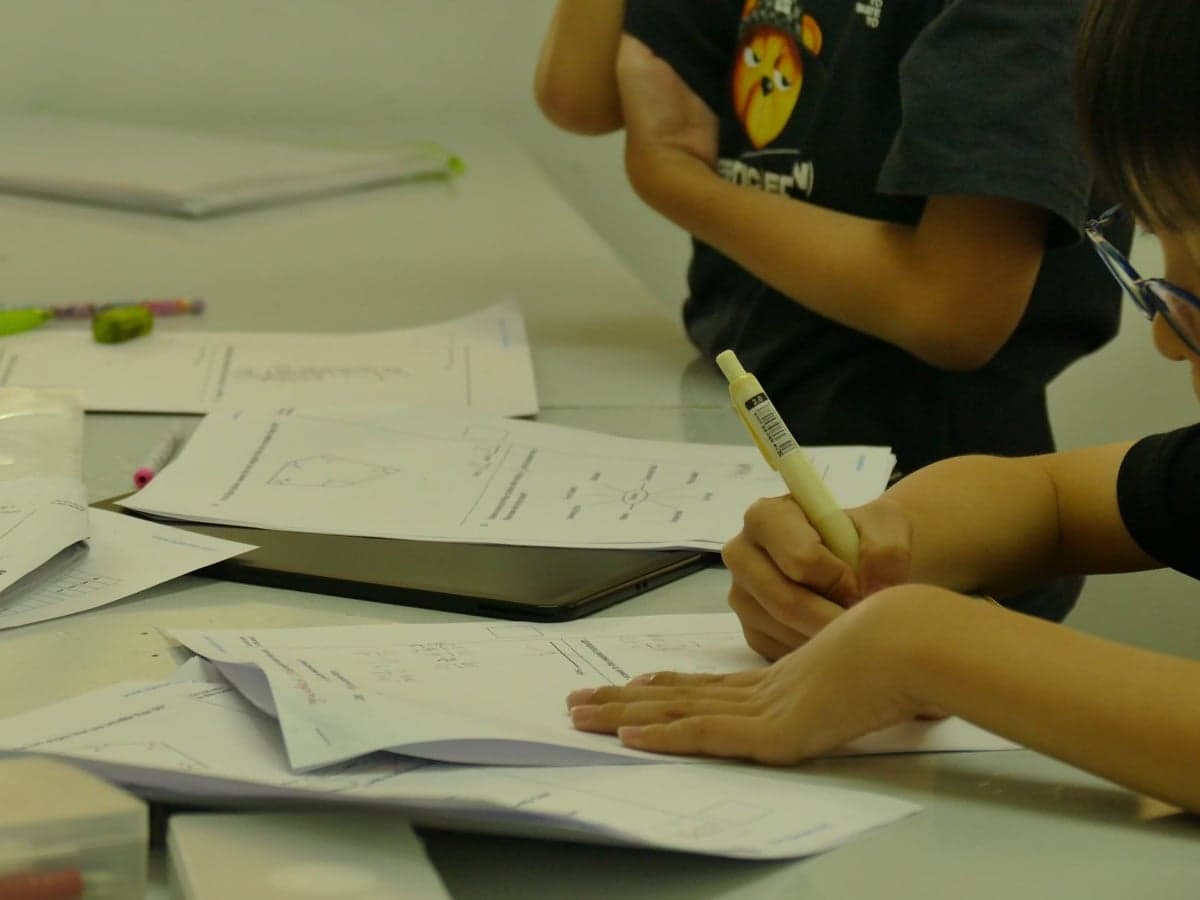
PSLE English Paper 2 comprehension is where most students lose the largest number of marks — not because they cannot read the passage, but because they do not answer in the way the marking scheme requires — a gap Ancourage Academy closes with specific answering frameworks. The comprehension section tests five distinct skills: literal understanding, inference, vocabulary in context, visual text interpretation, and open-ended response. Each question type has its own answering technique, and students who learn these techniques consistently outscore those who rely on general reading ability alone.
As Early Childhood & Primary Education Specialist at Ancourage Academy, Charmaine has guided P5-P6 students through PSLE English Paper 2 preparation across multiple cohorts. The pattern is clear: students who understand what each question type demands — and practise the specific technique for that type — see the largest improvements. This guide from Ancourage Academy breaks down each comprehension question type and provides the answering frameworks that examiners expect.
What PSLE English Paper 2 Tests
Paper 2 is worth 45% of the total PSLE English mark (from 2025 onwards) and contains multiple components: grammar cloze, editing, comprehension cloze, and the comprehension section with open-ended questions. The comprehension section alone typically carries 20 marks — the single largest mark allocation in Paper 2.
The SEAB PSLE English syllabus (0001) specifies that comprehension assesses students' ability to understand explicit and implicit meaning, make inferences, deduce word meaning from context, and respond to visual and multimodal texts. These are not the same skill — a student who is strong at literal comprehension may still struggle with inference.
The MOE STELLAR curriculum builds these skills progressively from P1, but the PSLE exam tests them at a level that requires deliberate practice in P5-P6.
How Do You Tell Literal and Inferential Questions Apart?
Literal questions ask what the text explicitly states; inferential questions ask what the text implies — and the answering technique for each is fundamentally different.
Literal questions use phrases like "According to the passage," "State one reason," or "What did [character] do?" The answer is directly stated in the text. Students should locate the relevant sentence and rephrase it in their own words (not copy word-for-word, which may lose marks for "lifting").
Inferential questions use phrases like "Why do you think," "What does this suggest," or "How do you know that..." The answer is NOT directly stated — students must combine evidence from the text with their own reasoning. The formula for inference answers is: evidence from text + logical conclusion = full-mark answer.
Common mistake: students who answer inferential questions with only the conclusion ("She was angry") without the evidence ("because the text says she slammed the door and walked away without speaking") lose half the marks. Always include both parts.
Inference is the question type most students lose marks on — and one of the fastest to fix with guided practice. A trial class (usually $18) at Bishan or Woodlands begins with a diagnostic of exactly which question types are costing your child marks.
How to Answer Open-Ended Questions (OEQ)
Open-ended questions are the highest-mark items in the comprehension section and require structured, evidence-based answers that go beyond simple recall.
The OEQ answering framework:
- Read the question twice: Identify exactly what is being asked. Is it asking for a reason, an opinion, a comparison, or an evaluation?
- Locate the relevant paragraph(s): Most OEQs point to a specific section of the passage. Underline the key information.
- Answer in full sentences: Do not use point form unless the question specifically asks for it.
- Include evidence + explanation: Quote or paraphrase the relevant text, then explain how it supports your answer.
- Check the mark allocation: A 2-mark question expects 2 distinct points. A 3-mark question expects 3 points or a more developed response.
Example: "Why did the boy decide not to tell his mother about the broken vase? [2 marks]"
Weak answer: "He was scared." (1/2 marks — no evidence)
Full-mark answer: "He decided not to tell his mother because the passage states that she had warned him not to play ball indoors, and he knew she would be disappointed that he had disobeyed her." (2/2 marks — evidence + reasoning)
Ancourage Academy's P5 and P6 English programmes teach the OEQ framework through worked examples and guided practice — book a trial class (usually $18) at Bishan or Woodlands in small groups of 3-6.
How Should You Read PSLE Visual Texts?
Visual text questions test students' ability to extract information from advertisements, posters, brochures, and infographics — a skill that requires reading images, layout, and text together.
Key techniques for visual text:
- Read ALL text on the visual: Headers, fine print, dates, conditions, and disclaimers. Many answers are found in the small text that students overlook.
- Identify the purpose: Is the visual trying to inform, persuade, or instruct? This context helps interpret the message correctly.
- Look for implicit messages: An advertisement showing a family smiling implies happiness and togetherness — examiners may ask what message the image conveys.
- Eliminate, then verify: Visual text is answered as 5 MCQ items worth 5 marks in Booklet A, so rule out every option the visual does not actually state, then check the surviving option against the exact line, caption or figure that supports it.
Visual text is often the most straightforward section if students read carefully. The most common mistake is rushing through and missing details in the fine print or image.
Vocabulary in Context Questions
Vocabulary questions in the comprehension section do not test whether students have memorised word definitions — they test whether students can deduce meaning from the surrounding context.
The technique: read the sentence containing the target word, then read the sentences before and after it. Look for:
- Synonyms or explanations nearby: Authors often explain unusual words in the surrounding text
- Contrast clues: Words like "but," "however," "unlike" signal that the target word means the opposite of something already stated
- Cause-and-effect clues: If the passage says "She was livid because they had broken her favourite vase," the cause (broken vase) helps define "livid" as very angry
When answering, replace the target word with your answer in the original sentence and check if it still makes sense. If it does, your answer is likely correct.
Common Comprehension Mistakes That Lose Marks
The five most common mark-losing mistakes in PSLE comprehension are: lifting answers directly from the passage, answering with only half the required information, misreading what the question asks, using vague language, and poor time management.
- Lifting: Copying sentences word-for-word from the passage instead of rephrasing. The marking scheme often penalises this because it does not demonstrate understanding.
- Incomplete answers: A 2-mark question that receives only one point of evidence. Always match the number of points to the mark allocation.
- Misreading the question: Answering "Why did..." when the question asks "How did..." These are different questions requiring different answers.
- Vague language: "He felt bad" instead of "He felt guilty because he realised his actions had hurt his friend." Specificity earns marks.
- Time mismanagement: Spending too long on early questions and rushing the higher-mark OEQs at the end. Allocate time proportionally to marks.
Practice Strategies for Paper 2 Comprehension
The most effective comprehension practice combines regular passage reading with focused question-type drills — not just doing full papers.
- Daily reading (15-20 minutes): Reading builds the background knowledge and vocabulary that comprehension depends on. Fiction, non-fiction, and news articles all contribute. See the primary English tips for reading recommendations by level.
- Question-type isolation: Rather than always doing full comprehension sections, practise one question type at a time. Spend a week on inference questions, then a week on OEQs, then visual text.
- Marking scheme review: After each practice, compare your answers to the marking scheme word-for-word. Note what the scheme expected that you did not include.
- Timed practice from P6 Term 2: Begin doing comprehension sections under exam time constraints. This builds the pacing skills needed for PSLE day.
Ancourage Academy's PSLE English preparation integrates all these strategies into weekly sessions. Students work through comprehension passages with tutor guidance, learning to identify question types and apply the matching technique for each. For a detailed guide on PSLE composition and PSLE oral (2026 format), see the companion articles.
Book a trial class (usually $18) at Bishan or Woodlands — or WhatsApp Ancourage Academy to discuss your child's PSLE English preparation.
Common Questions About PSLE English Comprehension
How many marks is the comprehension section worth in PSLE English?
The comprehension section with open-ended questions typically carries 20 marks within Paper 2. Paper 2 overall is worth 45% of the total PSLE English mark (from 2025 onwards). This makes comprehension the single highest-mark component in Paper 2, making it critical for students aiming for AL 1-3.
My child reads a lot but still scores poorly in comprehension. Why?
Reading builds vocabulary and background knowledge, but comprehension exam performance also requires answering technique. A student who understands the passage but answers vaguely, incompletely, or without evidence will lose marks. The issue is usually not reading ability but answer construction — specifically, providing evidence from the text and matching the response to what the question asks. Practising with marking schemes helps close this gap.
Should my child underline or highlight the passage while reading?
Yes. Active annotation helps students locate relevant information quickly when answering questions. Teach your child to underline key phrases, circle character names, and mark paragraph numbers. This is especially useful for OEQs where the answer spans multiple paragraphs.
How can my child improve inference skills specifically?
Inference improves with practice that explicitly connects text evidence to conclusions. Start with simple exercises: read a passage together and ask "What do you think the character is feeling? What in the text tells you that?" Gradually increase difficulty. The formula — evidence + logical conclusion — should become automatic through repeated practice.
Is comprehension the hardest part of PSLE English?
For many students, yes — because comprehension cannot be memorised and requires real-time analysis of unfamiliar texts. However, it is also one of the most responsive to technique-based preparation. Students who learn the specific frameworks for each question type (literal, inferential, OEQ, visual text, vocabulary) often see the fastest improvement in this component.
Visit Ancourage Academy at Bishan or Woodlands, check primary English courses, or WhatsApp us with any questions.
Related: PSLE English strategies · PSLE English Editing Guide · PSLE Composition Guide · PSLE Oral 2026 Guide · PSLE Cloze Passage Strategies · Primary English Tips · How to Score Well in PSLE · The 2026 PSLE syllabus updates · PSLE Synthesis and Transformation Guide · P5-P6 English Tuition in Bishan guide · P5-P6 English Tuition in Woodlands guide