
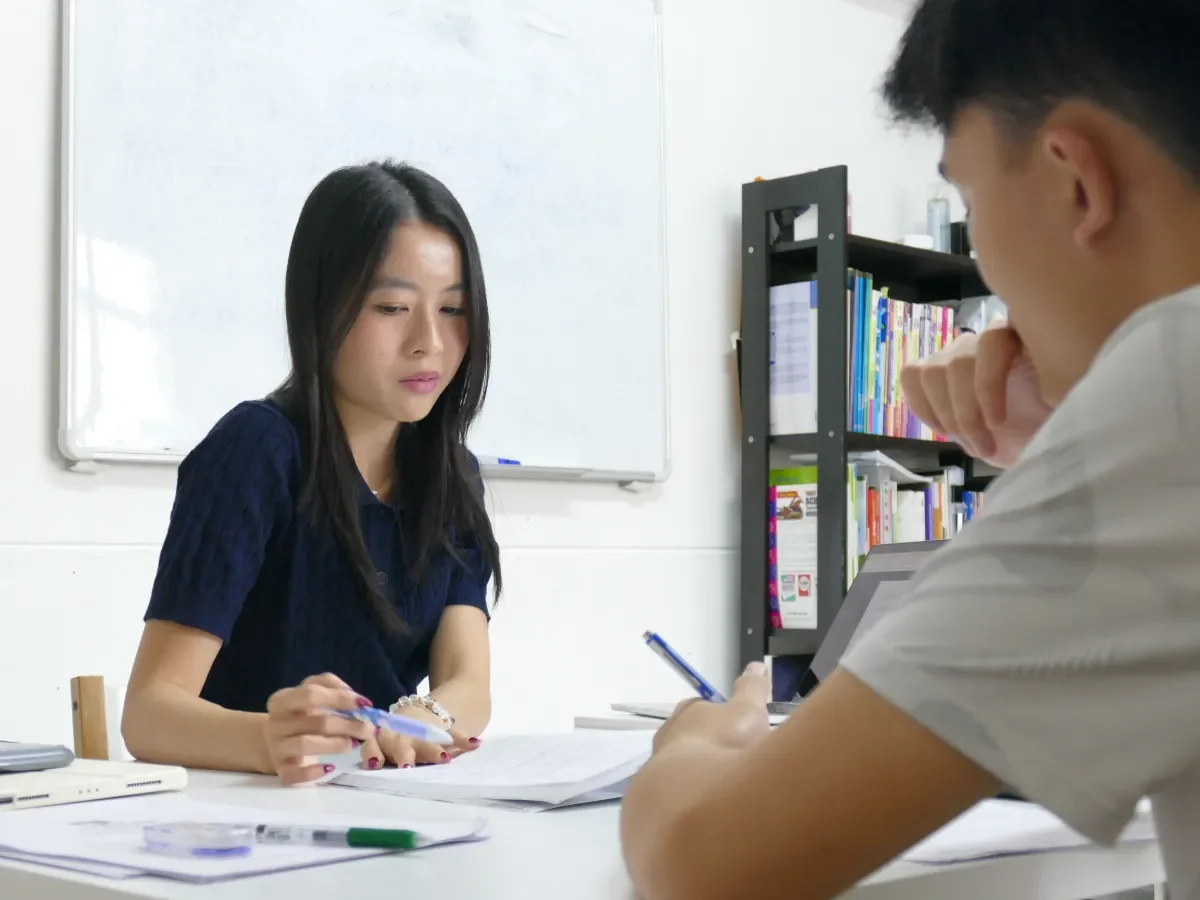
Secondary English in Singapore demands far more than good grammar. Students must master comprehension inference, situational writing, continuous writing, oral communication, and listening skills across four O-Level papers worth a combined 180 marks. For parents in Bishan and Woodlands looking for secondary English tuition — including at Ancourage Academy — understanding what the syllabus actually requires is the first step toward choosing the right support.
Ancourage Academy teaches secondary English at both the Bishan and Woodlands centres in small groups of 3 to 6 students. This guide draws on Ancourage Academy's experience helping Sec 1 to Sec 4 students improve their English language skills across both locations.
What Does the Secondary English Syllabus Cover?
The MOE secondary English Language syllabus is assessed through four O-Level papers that test different language competencies. The syllabus code is 1184 (K300 from 2027), and the total examination is worth 180 marks.
If your child needs English support, Ancourage Academy offers targeted Secondary English tuition in small groups of 3–6 at Bishan and Woodlands — book a trial class (usually $18) for a diagnostic assessment.
The table below shows the breakdown of each O-Level English paper as specified by SEAB:
| Paper | Component | Marks | Duration | What It Tests |
|---|---|---|---|---|
| Paper 1 | Writing | 70 | 1h 50min | Editing (10 marks), Situational Writing (30 marks), Continuous Writing (30 marks) |
| Paper 2 | Comprehension | 50 | 1h 50min | Visual text, narrative/non-narrative comprehension, summary writing |
| Paper 3 | Listening Comprehension | 30 | ~45min | Multiple-choice and short-answer questions on spoken passages |
| Paper 4 | Oral Communication | 30 | ~20min | Planned Response (15 marks) and Spoken Interaction (15 marks) based on a video clip |
Paper 1 carries the most raw marks at 70 (weighted 35%, the same as Paper 2), which is why writing skills are central to secondary English performance. The continuous writing section alone requires students to produce a well-organised essay of 350 to 500 words within a tight timeframe, demonstrating vocabulary range, grammatical accuracy, and coherent argumentation.
Under Full Subject-Based Banding, English can be taken at G1, G2, or G3 levels. G3 follows the O-Level standard shown above, while G2 follows the former N(A)-Level standard with a different syllabus code and adapted question complexity. The core skills tested remain the same across levels.
Why Do Students Struggle with Secondary English?
Many students who performed well in PSLE English find themselves struggling at secondary level because the assessment shifts from surface-level comprehension and structured composition to deeper inference, critical analysis, and sophisticated expression. According to MOE, the secondary English curriculum develops higher-order thinking through language.
The most common struggles Ancourage Academy tutors see in students at the Bishan and Woodlands centres:
Comprehension Inference
At PSLE level, many comprehension questions have answers that can be lifted directly from the passage. Secondary comprehension demands inference, where students must read between the lines to identify implied meaning, authorial intent, and the effect of literary devices. Students who relied on keyword-matching strategies at primary level find this transition particularly difficult, and inference questions are where that habit costs the most marks.
Essay Writing Quality
Secondary continuous writing requires a maturity of expression that goes beyond storytelling. Students must demonstrate varied sentence structures, precise vocabulary, coherent paragraph transitions, and the ability to sustain an argument or narrative across 350 to 500 words. Many students produce essays that are technically correct but lack depth, voice, or analytical thinking. The distinction between a B3 and an A1 essay often lies in sophistication of expression rather than grammatical accuracy alone.
Situational Writing
This component tests students' ability to write for a specific purpose, audience, and context, such as a formal letter, report, speech, or proposal. Students frequently lose marks by using the wrong tone, missing task requirements, or failing to organise their response with appropriate format conventions. Unlike continuous writing, situational writing rewards precision and task fulfilment over creative flair.
Summary Writing
The summary question in Paper 2 requires students to identify relevant points across a passage and synthesise them into a coherent paragraph of no more than 80 words. This is a deceptively difficult skill that combines comprehension, selection, and concise expression. Students who write too much, include irrelevant details, or fail to paraphrase lose significant marks.
Oral Communication
Paper 4 has two parts: Planned Response, where students watch a video clip and deliver a structured 2-minute response, and Spoken Interaction, where students discuss a related topic with the examiner. Both parts carry 15 marks each. Students who are strong writers sometimes underperform in oral because they lack practice in spontaneous verbal articulation or struggle with pronunciation and fluency under pressure.
What Makes Good English Tuition for Secondary Students?
Effective secondary English tuition addresses both the structural weaknesses and the higher-order thinking gaps that hold students back. Unlike maths tuition where errors are immediately visible, English improvement requires sustained, qualitative feedback on writing and comprehension strategies.
"The students who improve fastest in English are not the ones who do the most papers — they are the ones who rewrite their compositions after receiving detailed feedback. One round of revision teaches more than three new essays." — Gabriel, Economics & Mathematics Educator, Ancourage Academy
Personalised Writing Feedback
The single most important factor in English tuition quality is the depth of writing feedback. In large classes, tutors can only mark with broad comments like "good" or "needs improvement." In small groups, every student's essay can be annotated line by line with specific suggestions for vocabulary enhancement, sentence restructuring, and argument development. Ancourage Academy's ESB methodology emphasises guided discovery, where tutors ask students why a particular word choice is weak before suggesting alternatives, building their critical awareness rather than dependence on model answers. Ancourage Academy tutors find that the single most effective strategy for improving Paper 1 Writing scores is systematic vocabulary building paired with essay structure drills — students who adopt this approach typically see measurable improvement within one to two terms.
Comprehension Strategy Training
Good tuition teaches students a systematic approach to comprehension: how to identify question types, how to locate evidence in the passage, how to formulate inference-based answers, and how to structure summary responses. These are transferable skills that improve performance across all text types and question formats, not just the specific passages practised in class.
Vocabulary Building in Context
Memorising vocabulary lists is ineffective. Students need to encounter words in authentic contexts and practise using them in their own writing. Effective tuition exposes students to a wide range of text types, from opinion editorials to academic articles, and explicitly teaches them how to incorporate new vocabulary naturally into compositions and comprehension answers.
Regular Oral Practice
Many tuition centres neglect oral preparation because it is harder to teach in a group setting. However, the Spoken Interaction component is worth 15 marks and is one of the easiest areas to improve with practice. Small-group tuition allows regular oral practice sessions where students receive immediate feedback on articulation, content development, and engagement with the stimulus material.
Exam Technique and Time Management
Students must learn to allocate time effectively across papers. A common mistake is spending too long on continuous writing and rushing through situational writing, or dwelling on one comprehension question at the expense of others. Good tuition explicitly teaches pacing strategies for each paper and provides timed practice under exam conditions.
How Does English Tuition Differ at Bishan vs Woodlands?
The English syllabus is nationally standardised, but student profiles differ between Bishan and Woodlands due to the schools surrounding each centre. A tuition centre that understands these school-specific patterns can provide more targeted support.
Schools Near the Bishan Centre
| School | Type | English Context |
|---|---|---|
| Raffles Institution | Secondary (IP only) | High English standards; students seek enrichment and competitive edge |
| Catholic High School | Secondary (SAP/IP) | SAP school; strong bilingual programme, some students need targeted English support |
| Kuo Chuan Presbyterian Secondary | Secondary | Good English programme; students aim for strong O-Level results |
| Peirce Secondary | Secondary | Solid academic results; students benefit from comprehension and writing support |
| Whitley Secondary | Secondary | Applied Learning focus; practical English communication skills |
| Eunoia Junior College | JC | At Sin Ming Place; reference for post-secondary English standards |
A notable pattern at the Bishan centre: students from SAP schools like Catholic High often have excellent Chinese language ability but need targeted English vocabulary and essay writing support. Their bilingual background is an asset, but the English O-Level demands a depth of expression that requires deliberate practice. Meanwhile, students from Raffles Institution and Kuo Chuan Presbyterian typically have strong reading foundations and seek advanced comprehension strategies and higher-level writing techniques to push from B3/B4 to A1/A2.
Schools Near the Woodlands Centre
| School | Type | English Context |
|---|---|---|
| Woodlands Ring Secondary | Secondary | Strong community focus; students benefit from structured writing practice |
| Riverside Secondary | Secondary | Applied Learning focus; practical communication skills development |
| Marsiling Secondary | Secondary | Accessible from Marsiling MRT; students seek foundational English support |
| Christ Church Secondary | Secondary | Established O-Level track; consistent English teaching |
| Innova Junior College (merged) | Reference | Now Yishun Innova JC; post-secondary benchmark for north students |
At the Woodlands centre, many students benefit from foundational English support that builds reading habits, vocabulary range, and confidence in written expression. Students from the north often have fewer informal exposure opportunities to academic English compared to students in central Singapore, which means tuition plays a more significant role in bridging the language exposure gap. Ancourage Academy's Sec 1 English programme is designed to establish strong habits early.
Key Differences Between the Two Locations
The student profiles at the two centres reflect distinct needs. At Bishan, a larger proportion of students already have solid English foundations and seek targeted improvement to push from B3-B4 to A1-A2. Tuition at this location frequently emphasises advanced comprehension inference, vocabulary precision in compositions, and exam technique refinement. At Woodlands, more students need sustained support to strengthen foundational skills such as grammar accuracy, paragraph structure, and basic comprehension strategies. Both profiles benefit from small-group instruction, but the starting points and pacing differ. Ancourage Academy tutors at each centre tailor their approach accordingly, drawing on familiarity with the schools and assessment patterns in each area.
The Shift from PSLE to Secondary English
Parents who are satisfied with their child's PSLE English results are sometimes surprised by declining grades in Sec 1. The shift from primary to secondary English is substantial and often underestimated.
Key differences between PSLE and secondary English include:
- Comprehension depth: PSLE comprehension often allows students to locate answers directly in the passage. Secondary comprehension requires inference, evaluation, and understanding of authorial technique. A student who scored AL 2 for PSLE English may struggle with Sec 1 comprehension if they lack inference skills
- Writing maturity: PSLE compositions reward vivid descriptions and clear narratives. O-Level continuous writing demands argumentative and discursive writing, which requires logical structure, evidence use, and balanced perspectives
- Vocabulary expectations: Secondary English expects a wider and more precise vocabulary range. Students must move beyond common words and demonstrate awareness of nuance, register, and contextual appropriateness
- Oral format: The O-Level Spoken Interaction component is significantly more demanding than PSLE Stimulus-Based Conversation, requiring students to sustain a discussion, express opinions with elaboration, and respond to probing questions from the examiner
Students who receive English support during the Sec 1-2 transition develop these skills progressively and avoid the common pattern of steady decline from Sec 1 through Sec 4. For a comprehensive overview of what lower secondary students face across all subjects, see the lower secondary tuition guide.
When Should Parents Consider English Tuition?
Sec 1 is the ideal start, when secondary English adds inference-based comprehension and new text types; Sec 2 is still effective, particularly if English assessments sit consistently below 60%; Sec 3 turns to O-Level / SEC standard writing and comprehension; and Sec 4 is exam-focused past-paper work. English is cumulative — unlike a maths topic gap that can be closed in weeks, fluency and writing sophistication build over months of practice and feedback.
- Sec 1 (ideal start): The transition from PSLE English to secondary English introduces inference-based comprehension, more complex writing expectations, and new text types. Students who build these skills from Sec 1 develop a natural command of the language that serves them through O-Levels
- Sec 2 (still effective): By Sec 2, writing expectations increase and comprehension passages become more challenging. Students who are consistently scoring below 60% for English assessments should begin Sec 2 English tuition to prevent gaps from compounding
- Sec 3 (important for exam prep): The Upper Secondary English syllabus focuses on exam preparation. Students taking English at G3 need to demonstrate O-Level standard writing and comprehension. Ancourage Academy's Sec 3 English programme emphasises exam technique alongside continued skill development
- Sec 4 (exam-focused): By Sec 4, tuition focuses on past paper practice, timed writing under exam conditions, and targeted improvement of the weakest paper component. Students preparing for the O-Level or SEC examinations from 2027 need a structured revision plan
Sec 1 to Sec 4 English Tuition at Bishan and Woodlands: How Ancourage Academy Teaches It
Ancourage Academy teaches Sec 1-2 English and Sec 3-4 English in dedicated small-group sessions of 3 to 6 students, with lessons structured around the four O-Level paper components and adapted to each student's G-level.
What distinguishes Ancourage Academy's approach:
- ESB Methodology: Ancourage Academy uses Ebbinghaus spaced repetition for vocabulary retention, Socratic guided questioning for comprehension strategy development, and Bruner's progressive complexity for writing skill advancement
- Paper-specific training: Each lesson cycle covers all four papers systematically. Students practise continuous writing, situational writing, comprehension, and oral communication on a structured rotation to avoid neglecting any component
- Detailed writing feedback: Every composition is annotated with specific, actionable comments. Students revise and rewrite based on feedback, which is more effective than simply moving on to a new essay topic each week
- Comprehension frameworks: Tutors teach explicit strategies for inference questions, language-use questions, and summary writing that students can apply independently across any text type
- Oral practice: Regular spoken interaction practice with immediate feedback on pronunciation, fluency, content development, and engagement quality
- Two locations: The Bishan centre and Woodlands centre each serve the schools in their surrounding area with school-aware pacing and exam alignment
View pricing or book a trial class (usually $18) to experience Ancourage Academy's teaching approach with a diagnostic English assessment and personalised feedback. You can also WhatsApp us if you have any questions. For preparation guides across every subject, explore our O-Level / SEC guides hub.
Common Questions About Secondary English Tuition
What is the most important component of O-Level English?
Paper 1 (Writing) carries the most raw marks at 70 out of 180 (weighted 35%, level with Paper 2), with Continuous Writing (30 marks) showing the largest performance gaps between students. However, a balanced approach across all four papers produces the best overall grade — neglecting Paper 3 (Listening) and Paper 4 (Oral), worth 60 marks combined, is a common strategic mistake.
How can my child improve their English comprehension skills?
Comprehension improvement requires reading widely and learning explicit answering strategies. At Ancourage Academy, tutors use a structured framework that breaks down each question type — inference, language use, summary — and teaches a reliable approach for each. Regular timed practice under exam conditions builds both speed and confidence.
Is English tuition worth it for students already scoring B3 or above?
Yes, if the goal is A1 or A2. The gap between B3 and A1 is usually about writing sophistication, vocabulary precision, and higher-order comprehension — exactly the areas where small-group tuition with detailed feedback makes the biggest difference. These refinements are difficult to achieve through self-study alone.
How is English tuition different from just reading more books?
Reading builds passive vocabulary but does not teach exam technique, writing structure, or comprehension answering strategies. A student who reads extensively but cannot structure an argument or identify inference in a passage needs direct instruction on these specific skills — that is what tuition provides through structured practice with targeted feedback.
Does Ancourage Academy offer English tuition at both Bishan and Woodlands?
Yes. Ancourage Academy offers Sec 1-2 English and Sec 3-4 English at both the Bishan and Woodlands centres. Classes are held in small groups of 3 to 6 students using the ESB methodology. Each centre is familiar with the English teaching patterns and exam schedules of nearby schools. Book a trial class (usually $18) at either location to get started.
What grade improvement can I expect from English tuition?
English improvement is more gradual than mathematics because language skills are cumulative. 100% of students who complete at least one term show grade improvement.
Can my child combine secondary English with another subject at Ancourage Academy?
Yes. Many Bishan and Woodlands families pair English (O-Level / SEC code K300) with a second subject so weekly sessions reinforce one another rather than competing for study time, which can ease the pressure of juggling separate schedules. In Bishan, this often means SAP-school students adding focused English support alongside their existing strengths; in Woodlands, students frequently build foundations across several subjects together. The right combination depends on your child's G-levels under Full Subject-Based Banding and their weakest paper. Rather than decide blind, browse the full Secondary programme for available subject pairings at both the Bishan and Woodlands centres, then book a trial class (usually $18) for a diagnostic that recommends a tailored plan.
Related: PSLE English Prep for Bishan Students · G2 vs G3 Guide · Lower Secondary Tuition Guide · O-Level English Woodlands · Bishan schools & tuition logistics · O-Level English in Bishan · a guide to O-Level / SEC English