
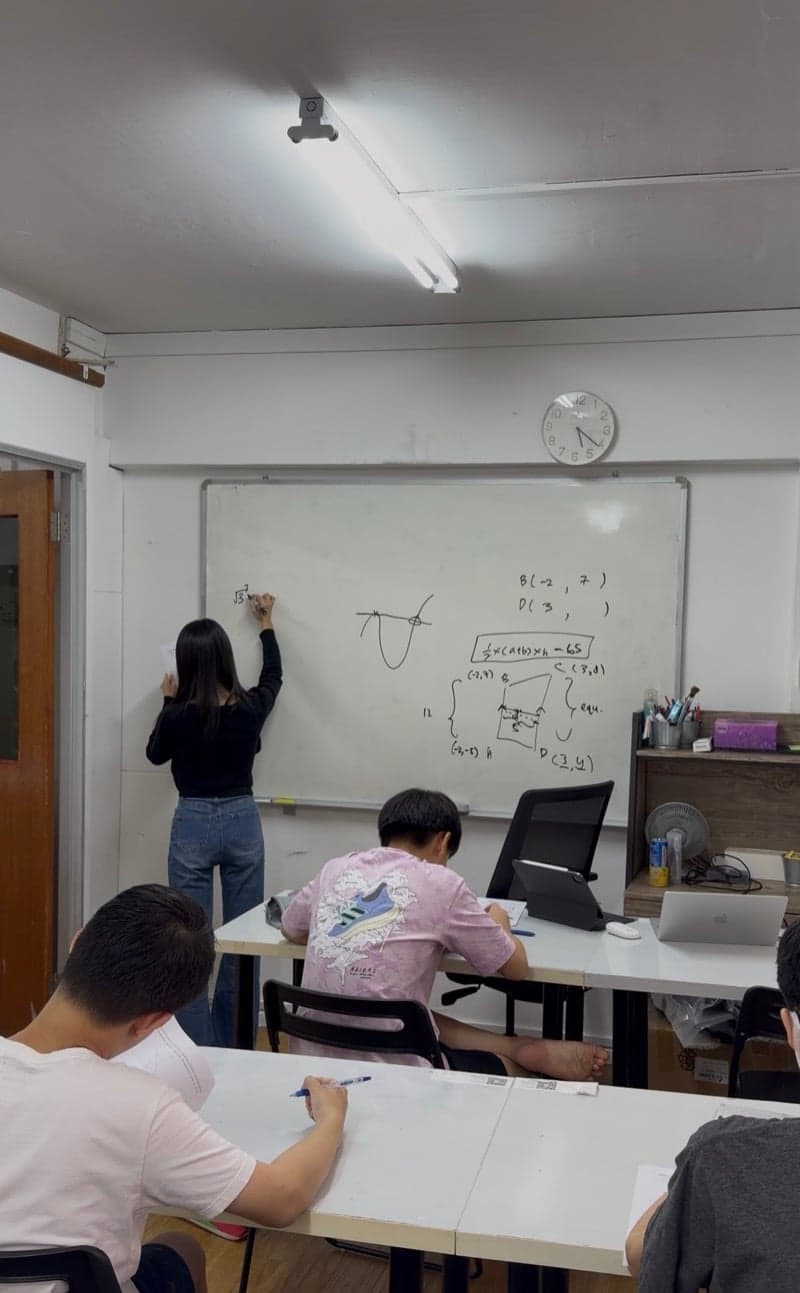
Sec 4 students face 3-4 years of accumulated mathematics content for the O-Level / SEC examination — and without a structured revision plan, most default to re-studying familiar topics while avoiding the ones that actually cost marks. At Ancourage Academy, the pattern is consistent: students who follow a month-by-month plan outperform those who cram, regardless of starting grade. The difference is not more hours — it is better-directed hours.
As Founder and Academic Director at Ancourage Academy, Min Hui has guided hundreds of Sec 4 students through Sec 4 E-Maths tuition and O-Level mathematics preparation across multiple cohorts. This revision plan covers April to October with specific monthly targets for both E-Maths and A-Maths students.
Why a Structured Revision Plan Beats Cramming
Mathematics is cumulative — every topic builds on earlier ones, and cramming the night before an exam cannot replicate months of layered understanding. A Sec 4 student revising for O-Level / SEC maths needs to cover content from Sec 1 (basic algebra) through Sec 4 (vectors, matrices, advanced calculus). Without a plan, students gravitate toward topics they already know and avoid the ones causing the most mark loss.
A structured plan solves three problems:
- Coverage gaps: Ensures every topic receives attention, not just comfortable ones
- Practice progression: Moves from topical worksheets to full timed papers at the right pace
- Confidence building: Milestone markers show measurable progress, reducing exam anxiety
The plan below assumes 6-8 hours per week of mathematics study (including tuition sessions). Students who can dedicate more time will progress faster; those with less time should prioritise the high-weightage topics identified in each phase.
April-May: Foundation Audit and Gap Filling
The first step is not revision — it is diagnosis. Identify the 3-5 weakest topics before studying anything, because targeted gap-filling produces faster improvement than blanket revision.
If your child is starting Sec 4 revision and needs a clear starting point, book a trial class (usually $18) at Ancourage Academy for a diagnostic maths assessment — small groups of 3-6 at Bishan and Woodlands.
How to run a self-diagnostic:
- Take one recent school exam paper under timed conditions
- Mark it honestly using the marking scheme
- Categorise every error as conceptual (did not know the method), procedural (knew the method but made an error), or exam technique (ran out of time, misread question)
- Identify the 3-5 topics where you lost the most marks
| Week | Focus | Activity |
|---|---|---|
| Week 1-2 | Diagnostic | Complete 1 past paper, categorise errors, identify weak topics |
| Week 3-4 | Weakest topic #1 | Topical worksheets, worked solutions review, re-test |
| Week 5-6 | Weakest topic #2 | Topical worksheets, worked solutions review, re-test |
| Week 7-8 | Weakest topic #3 | Topical worksheets, worked solutions review, re-test |
Do not attempt full papers during this phase. Focus entirely on closing specific gaps. A student who masters 3 weak topics in April-May gains more marks than one who does 10 full papers without fixing underlying issues.
June: Intensive Topical Revision
The June school holidays are the most valuable revision window of the year — four weeks of uninterrupted study time to systematically cover every E-Maths and A-Maths topic at least once.
Use this topic checklist to track coverage. Tick each topic only after completing at least one worksheet and reviewing worked solutions:
| E-Maths (Syllabus 4052) | A-Maths (Syllabus 4049) |
|---|---|
| Algebra (equations, inequalities, manipulation) | Surds, indices, logarithms |
| Quadratic equations and graphs | Polynomials, factor/remainder theorems |
| Coordinate geometry (gradient, length of a line segment, y = mx + c) | Coordinate geometry (midpoint, parallel/perpendicular conditions, circles, tangents) |
| Trigonometry (ratios, sine/cosine rule) | Trigonometric identities and equations |
| Geometry (circle properties, congruence, similarity) | Differentiation (rules and applications) |
| Mensuration (area, volume, surface area) | Integration (rules and applications) |
| Statistics (histograms, cumulative frequency, box plots) | Kinematics |
| Probability and set notation | Binomial expansion |
| Matrices (display, scalar multiple, sum and product) | |
| Vectors in 2D |
Aim to cover 2-3 topics per week. For topics already strong, one worksheet is sufficient as maintenance. For weak topics, do 2-3 worksheets with solution review between each.
July: Transition to Mixed Practice
July marks the shift from topical revision to mixed practice — the ability to identify which topic a question tests, without being told, is a separate skill that must be practised deliberately.
- Week 1-2: Paper 1-style mixed short questions (15-20 questions from different topics). Time limit: 45 minutes. This builds topic-identification speed
- Week 3: First full past paper — untimed. The goal is completion and accuracy, not speed. Review every error
- Week 4: Second full past paper — with generous time (add 30 minutes to official duration). Start building time awareness
Begin an error journal this month. After every practice paper, record: question number, topic tested, error type (conceptual/procedural/technique), and what you should have done. Review the journal before each new paper. This single habit is the most effective exam preparation strategy Ancourage Academy recommends.
August: Prelim Preparation
August is prelim month — the most important practice exam before O-Levels / SEC. Treat prelims as a dress rehearsal, not just another test.
Prelim papers from other schools are the best practice resource at this stage. They test the full syllabus and are typically harder than the actual O-Level / SEC paper. Our guide to prelim vs O-Level score gaps breaks that difference down subject by subject, so you can read a disappointing prelim grade in context instead of panicking over it.
- Do one full timed paper per week (both Paper 1 and Paper 2)
- Mark immediately and categorise every error in your error journal
- Review the marking scheme — understand how marks are allocated, not just what the answer is
- Identify recurring mistakes — if the same error type appears across papers, that topic needs urgent attention
After your school prelim results, reassess priorities. If you scored well in trigonometry but poorly in statistics, redirect August revision time accordingly.
September: O-Level / SEC Sprint
September is the final intensive revision month — shift from school prelim papers to the Ten Year Series (TYS) for O-Level pattern familiarity.
- Daily maths practice: 1-2 hours per day, every day. This is non-negotiable for A1-B3 targets
- TYS papers: Do the three most recent years first. These reflect the current syllabus emphasis most accurately
- Focus on the topics you lose most marks on: algebra, coordinate geometry and trigonometry recur across both papers, so weak foundations there cost marks everywhere
- Timed conditions: Every paper under strict exam timing. No pausing, no checking notes mid-paper
| Aspect | School Prelim Papers | O-Level TYS Papers |
|---|---|---|
| Difficulty | Typically harder than O-Level | Reflects actual O-Level standard |
| Best for | Building stamina and identifying gaps | Familiarising with O-Level question patterns |
| When to use | July-August | September-October |
| Source | Cross-school prelim compilations | Official SEAB Ten Year Series |
October: Final Two Weeks
The last two weeks before the O-Level / SEC maths exam should focus on consolidation, not new learning — review what you know rather than panic-studying what you do not.
- Week 1: Review your error journal. Identify the 5 most common mistakes and practise those specific question types. Do one final timed paper
- Week 2: Light practice only — 30-45 minutes per day. Review formulas, key methods, and calculator functions. Prepare logistics: calculator batteries, stationery, exam venue familiarity
Common mistakes in the final two weeks:
- Cramming new topics: If you have not learned matrices by October, it is better to secure marks in topics you know than to half-learn a new one
- Excessive practice: Burnout in the final week reduces performance. Rest is part of preparation
- Ignoring exam logistics: Calculator mode — match it to the angle units in the question rather than setting it once and forgetting it. E-Maths trigonometry works in degrees, while A-Maths (4049 / SEC K341) examines the six trigonometric functions “in degrees or radians” and its calculus of sin, cos and tan assumes radians. Also confirm the approved calculator model and travel time to the exam venue: these matter
E-Maths vs A-Maths: Adjusting the Plan
Students taking both E-Maths and A-Maths need to allocate revision time deliberately — the default instinct is to spend more time on the harder subject, but E-Maths foundations support A-Maths performance. Ancourage Academy's O-Level / SEC A-Maths tuition programme structures revision around this transfer effect rather than treating the two papers in isolation.
| Scenario | Recommended Split | Reasoning |
|---|---|---|
| Both subjects weak | 60% E-Maths, 40% A-Maths | E-Maths algebra supports A-Maths; securing E-Maths is the priority |
| E-Maths strong, A-Maths weak | 30% E-Maths, 70% A-Maths | Maintain E-Maths with light practice; invest in A-Maths recovery |
| Both subjects strong | 50% E-Maths, 50% A-Maths | Balanced practice with focus on exam technique for both |
| A-Maths strong, E-Maths weak | 70% E-Maths, 30% A-Maths | E-Maths is compulsory and affects L1R5 / L1R4; prioritise it |
E-Maths improvement typically benefits A-Maths indirectly. Algebraic manipulation, coordinate geometry, and trigonometric ratio skills transfer directly between the two subjects. At Ancourage Academy's Sec 4 E-Maths and A-Maths programmes, tutors coordinate across both subjects to maximise this transfer effect.
How to Use the Ten Year Series Effectively
The Ten Year Series (TYS) is the single most valuable resource for O-Level / SEC maths — but using it too early or incorrectly wastes its potential.
Common TYS mistakes:
- Starting too early: Doing TYS papers in April-June wastes them. You need them fresh for September when exam-pattern familiarity matters most
- Using topically without timing: Topical TYS practice is useful in June, but by August-September, do full papers under timed conditions only
- Not reviewing the marking scheme: The marking scheme shows how marks are allocated — this is more valuable than the model answer itself
- Repeating papers without reviewing errors: Doing five papers without analysing mistakes is less effective than doing two papers with thorough review
For a detailed guide on maximising practice paper value, see how to use past year papers effectively.
Ancourage Academy's secondary maths programme integrates TYS practice with diagnostic feedback in small groups of 3-6 — book a trial class (usually $18) at Bishan or Woodlands.
Common Questions About Sec 4 Maths Revision
How do I revise four years of secondary maths content for O-Levels / SEC?
Start with a diagnostic to identify the 3-5 weakest topics. Focus on those first (April-May), then systematically cover remaining topics (June), then transition to mixed practice and full papers (July-October). A structured 6-month plan prevents overwhelm and ensures coverage.
How should I use the Ten Year Series for O-Level maths?
Use TYS topically during June revision, then switch to full timed papers from August onwards. Always review the marking scheme after each paper — it shows how marks are allocated, which is more valuable than just knowing the answer. Save the most recent years for September practice.
What new topics are covered in Sec 4 E-Maths?
Sec 4 E-Maths adds matrices, vectors in two dimensions, set language with Venn diagrams, and combined-event probability — plus exam-level integration of all Sec 1-3 topics. SEAB publishes no topic weightings for the paper — only the assessment-objective split (AO1 45%, AO2 40%, AO3 15%) and the two equal 90-mark papers — so treat these Sec 4 topics as a guaranteed presence, not a fixed share of marks.
Is it too late to start revising for O-Level maths in June?
June is a reasonable starting point for structured revision if foundations from Sec 1-3 are intact. Students starting in June should use the school holidays intensively and may need to compress the diagnostic phase. Starting before June gives more time for foundation repair.
How many hours per week should a Sec 4 student study maths?
A realistic target is 6-8 hours per week across both E-Maths and A-Maths, including tuition sessions, self-practice, and paper review. During September, increase to 8-10 hours. Quality matters more than quantity — 2 hours of focused, diagnostic-based practice is more effective than 4 hours of unfocused repetition.
Related: Scoring in secondary maths · Comparing E-Maths and A-Maths · Prelim vs O-Level Results · Supporting a stressed student · Recovering from a Sec 3 maths drop · A-Maths Linear Law · a guide to E-Maths Topic Weightage