
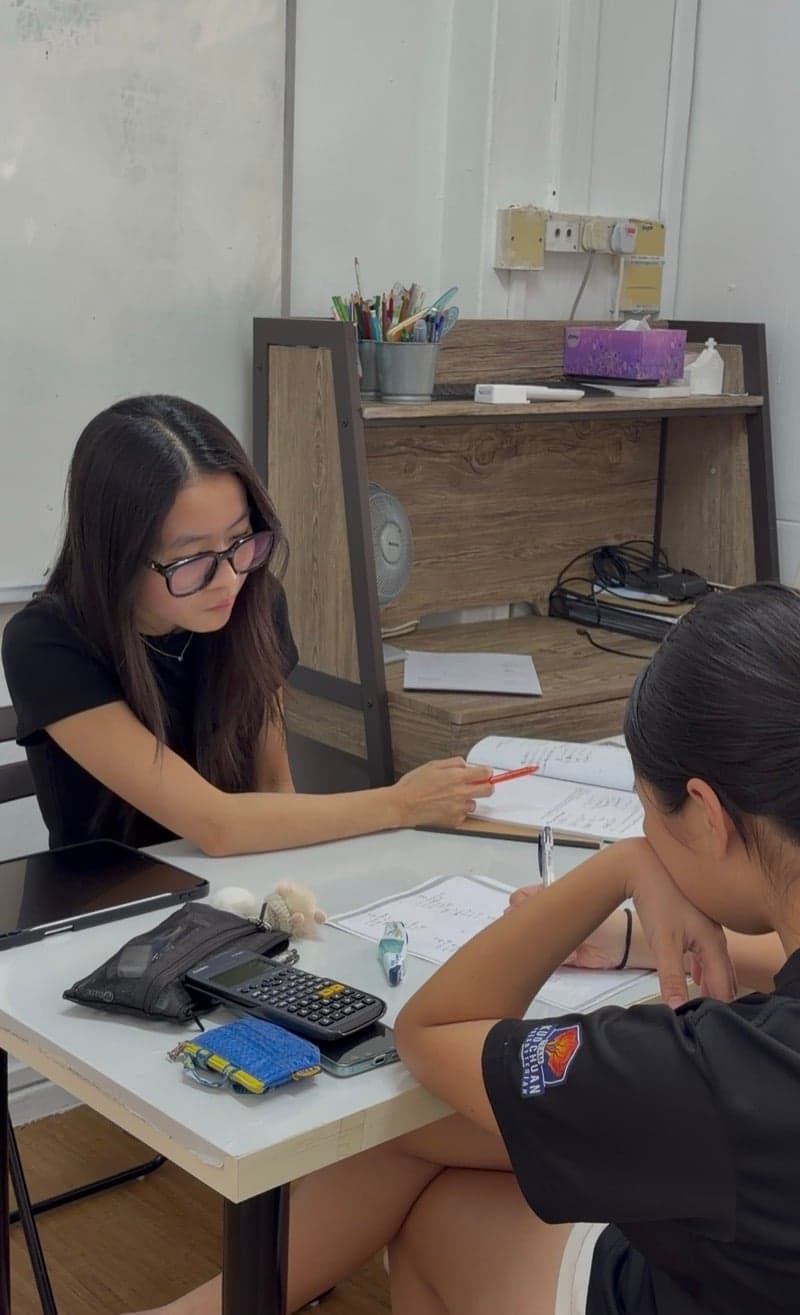
The decision to take Additional Mathematics (A-Maths) in Sec 3 is one of the most consequential academic choices a Singapore secondary student makes — and it hinges almost entirely on Sec 2 maths performance, particularly in algebraic manipulation and abstract reasoning. At Ancourage Academy, this is the question parents ask most frequently between March and July of their child's Sec 2 year: "Is my child ready for A-Maths?"
As Founder and Academic Director at Ancourage Academy, Min Hui has guided hundreds of families through this decision across multiple cohorts. This guide explains what Sec 2 maths covers, which skills predict A-Maths success, and how to make the right choice for your child.
Why Sec 2 Is the Critical Decision Year for Maths
Sec 2 is the last year before students choose their Sec 3 subject combination — and the A-Maths decision shapes which JC subject combinations (H2 Mathematics in particular), polytechnic courses and university STEM pathways stay open, plus the academic workload for the next two years.
Under Full Subject-Based Banding (Full SBB), students taking G3 Mathematics can opt to add A-Maths from Sec 3. This means managing two separate maths subjects — Elementary Mathematics (E-Maths) and Additional Mathematics (A-Maths) — each with its own syllabus, exam papers, and study demands.
The stakes are clear:
- Taking A-Maths opens the JC Science stream: H2 Mathematics at A-Level assumes A-Maths knowledge, and most JCs expect it
- Not taking A-Maths limits STEM pathways: Engineering, computing, and quantitative sciences at university level typically require H2 Maths
- Taking A-Maths when not ready creates cascading stress: Students who struggle with A-Maths often see E-Maths grades drop too, as study time splits between two subjects
Unsure whether your child is ready for A-Maths? Ancourage Academy's diagnostic assessment evaluates readiness — book a trial class (usually $18) at Bishan or Woodlands in small groups of 3-6.
Secondary 2 Maths Topics: What the Sec 2 Syllabus Covers
Sec 2 Mathematics covers algebraic expansion and factorisation, simultaneous linear equations, introductory quadratic expressions, Pythagoras' theorem, basic trigonometric ratios, probability and statistics — and every one of these topics reappears in more advanced form in Sec 3 E-Maths or A-Maths.
| Sec 2 Topic | What It Covers | How It Prepares for A-Maths |
|---|---|---|
| Algebraic expansion and factorisation | Expanding brackets, factorising quadratics, common factor | A-Maths requires fluent manipulation of surds, indices, and polynomials |
| Simultaneous linear equations | Substitution and elimination methods | A-Maths extends to simultaneous equations with quadratics |
| Quadratic expressions (introduction) | Recognising quadratic patterns, basic factorisation | A-Maths requires completing the square, discriminant analysis |
| Pythagoras' theorem | Finding sides, applications in 2D | Foundation for A-Maths trigonometry and coordinate geometry |
| Basic trigonometric ratios | SOH-CAH-TOA for right-angled triangles | A-Maths extends to identities, equations, and non-right triangles |
| Probability | Experimental and theoretical probability | Less directly relevant to A-Maths but builds logical reasoning |
| Statistics | Mean, median, mode, data representation | Minimal direct A-Maths connection; more relevant for E-Maths |
The table illustrates why algebra and trigonometry matter most for the A-Maths decision: these are the topics that extend directly into the O-Level / SEC A-Maths syllabus (4049, SEC code K341).
The Sec 2 Skills That Predict A-Maths Success
A-Maths readiness is not about getting high marks in Sec 2 — it is about fluency in specific skill areas, particularly algebraic manipulation and comfort with abstract reasoning.
Book a trial class (usually $18) at Ancourage Academy for a diagnostic assessment of your child's A-Maths readiness — small groups of 3-6 allow targeted evaluation at Bishan and Woodlands.
Based on Ancourage Academy's experience across multiple cohorts, these three skills are the strongest predictors:
- Algebraic manipulation fluency: Can the student expand, factorise, and rearrange expressions accurately and quickly? Speed matters because A-Maths questions have more steps, and slow algebra creates time pressure
- Comfort with abstraction: Can the student work with problems where the approach is not immediately obvious? A-Maths requires choosing between methods — students who need a formula sheet for every question will struggle
- Multi-step problem tolerance: Can the student sustain concentration through 5-8 step solutions without losing track? A-Maths questions rarely have single-step answers
Score thresholds provide a rough guide: students consistently scoring 65% or above in Sec 2 Mathematics generally have the foundation for A-Maths. Students in the 50-65% range should assess whether their errors are conceptual (gap in understanding) or procedural (careless mistakes) — the latter is more recoverable, and Ancourage Academy's upper-secondary A-Maths tuition track begins by diagnosing exactly which of these is holding a student back.
A-Maths Readiness Checklist for Parents
A Sec 2 student is ready for A-Maths if they can factorise quadratics without prompts, solve simultaneous equations by both substitution and elimination, apply SOH-CAH-TOA to right-angled triangles, set up equations from word problems, score 65% or above consistently in school maths, and attempt unfamiliar problems rather than giving up.
Answer yes or no to each:
- Can your child factorise quadratic expressions (e.g., x² + 5x + 6) without needing a formula or step-by-step prompts?
- Can your child solve simultaneous equations using both substitution and elimination, and choose the more efficient method?
- Can your child apply trigonometric ratios (SOH-CAH-TOA) to find unknown sides and angles in right-angled triangles?
- Can your child set up equations from word problems — translating English descriptions into algebraic expressions?
- Is your child consistently scoring 65% or above in school maths assessments?
- Does your child show willingness to attempt unfamiliar problems rather than giving up when the method is not immediately clear?
If 5-6 answers are yes: A-Maths is a reasonable choice. If 3-4 answers are yes: A-Maths is possible with targeted preparation over the holidays. If 0-2 answers are yes: focus on strengthening E-Maths foundations first — A-Maths may not be the right fit at this stage.
What Happens If Your Child Is Not Ready
Not taking A-Maths is not academic failure — it is a strategic decision that allows your child to focus on E-Maths mastery and pursue pathways that do not require it.
Students who choose not to take A-Maths can still:
- Enter JC Arts stream: H1 Mathematics (not H2) is available without A-Maths prerequisites
- Enter polytechnic: Most polytechnic courses do not require A-Maths. Engineering and computing courses may prefer it but often accept strong E-Maths results
- Focus on E-Maths excellence: A student who scores A1 in E-Maths with strong results in other subjects has strong post-secondary options
G2 Mathematics students can take G2 Additional Mathematics (syllabus K232) under Full SBB, which covers A-Maths content at a slightly different level. This option is worth discussing with your child's school.
How to Strengthen Sec 2 Foundations Before Sec 3
The period between mid-Sec 2 and the start of Sec 3 is the best window for building A-Maths readiness — targeted algebra practice during this time has a disproportionate impact on Sec 3 performance.
Specific actions for June and November-December holidays:
- Algebra bootcamp: 2-3 weeks of focused algebraic manipulation — expansion, factorisation, simultaneous equations, and solving quadratics by all methods (factorisation, formula, completing the square)
- Trigonometry extension: Go beyond SOH-CAH-TOA to understand how ratios connect to the unit circle. This is not in the Sec 2 syllabus but gives a head start on A-Maths trigonometry
- Problem-solving stamina: Practice multi-step questions that require combining concepts. Past papers from past year paper compilations are useful here
- Consider bridging tuition: Ancourage Academy's Sec 2 Mathematics programme includes A-Maths preparation components for students planning to take the subject
Making the Decision: A Framework for Families
The A-Maths decision should weigh four factors: academic pathway goals, current readiness, workload capacity, and teacher recommendation — no single factor should dominate.
- Pathway goals: Does your child aim for JC Science stream? Engineering or computing at university? If yes, A-Maths is strongly recommended. For other subject combinations, it may be optional
- Current readiness: Use the checklist above. Marginal readiness can be addressed with targeted preparation; fundamental gaps in algebra are harder to overcome under Sec 3 workload
- Workload capacity: A-Maths adds 3-4 hours of weekly study time. Students already struggling with time management across other subjects should consider whether adding another subject helps or harms overall performance
- Teacher recommendation: School teachers see your child's daily performance — their recommendation carries weight, especially when it conflicts with test scores (a student scoring 70% with poor work habits may struggle more than one scoring 60% with strong discipline)
For a detailed comparison of what each subject entails, see E-Maths vs A-Maths: What Every Singapore Parent Should Know. For students who have already started A-Maths and are struggling, the A-Maths Survival Guide provides a topic-by-topic recovery plan.
Common Questions About Sec 2 Maths and A-Maths Readiness
Should my child take A-Maths in Sec 3?
A-Maths is strongly recommended for students aiming for JC Science stream: JCs strongly recommend, and some effectively require, an A-Maths background for H2 Mathematics. For students targeting JC Arts stream or polytechnic, A-Maths is optional but may be advantageous for engineering and computing courses. The decision should balance pathway goals with current readiness.
What score does my child need in Sec 2 Mathematics to take A-Maths?
MOE publishes no national mark for A-Maths. Additional Mathematics is an upper-secondary elective, offered from Secondary 3 at G3 (K341) and G2 (K232), and the MOE syllabus for both sets no eligibility threshold — the only percentages in its 38 pages are the 50/50 paper weightings. On offering a subject at a more demanding level, MOE told Parliament on 5 August 2026 that it gives schools "guidelines for identifying suitable students" while "schools have the discretion to make the final decision" — that reply covers G1-to-G2 and G2-to-G3 progression, and MOE has published no equivalent statement, and no mark, for the A-Maths elective itself. Individual schools set and publish their own criteria in their subject-option documents — Damai Secondary, for example, asks for at least 70% in the Algebra component of the end-of-year Mathematics paper and 70% overall in Mathematics. Damai's criterion is the tell: algebraic manipulation fluency — the ability to expand, factorise, and rearrange expressions quickly and accurately — is the real predictor, not the aggregate score. A student scoring 65% with strong algebra is better prepared than one scoring 75% with weak algebra.
What topics should Sec 2 students study before starting A-Maths?
Mastery of algebraic manipulation (expansion, factorisation, simultaneous equations, quadratic expressions) and basic trigonometric ratios (SOH-CAH-TOA) are the most critical prerequisites. Students who can factorise quadratics fluently and solve simultaneous equations without prompts have the foundation for A-Maths.
What are the consequences of not taking A-Maths?
Not taking A-Maths limits access to H2 Mathematics in JC, which affects Science stream eligibility and restricts certain university courses (engineering, computing, quantitative sciences). Polytechnic pathways are largely unaffected. Students can still take H1 Mathematics in JC without A-Maths.
Can my child start A-Maths preparation during the Sec 2 holidays?
Yes. The June and November-December holidays are ideal for A-Maths bridging work. Focus on algebraic fluency and introductory abstract reasoning. Ancourage Academy offers Sec 2 to Sec 3 bridging support at Bishan and Woodlands — book a trial class (usually $18) for a readiness assessment.
Related: The E-Maths/A-Maths decision · Sec 3 Subject Combinations · Surviving Additional Maths · O-Level maths strategies · 2027 SEC Maths Exam Changes · Sec 4 Maths Revision Plan guide