
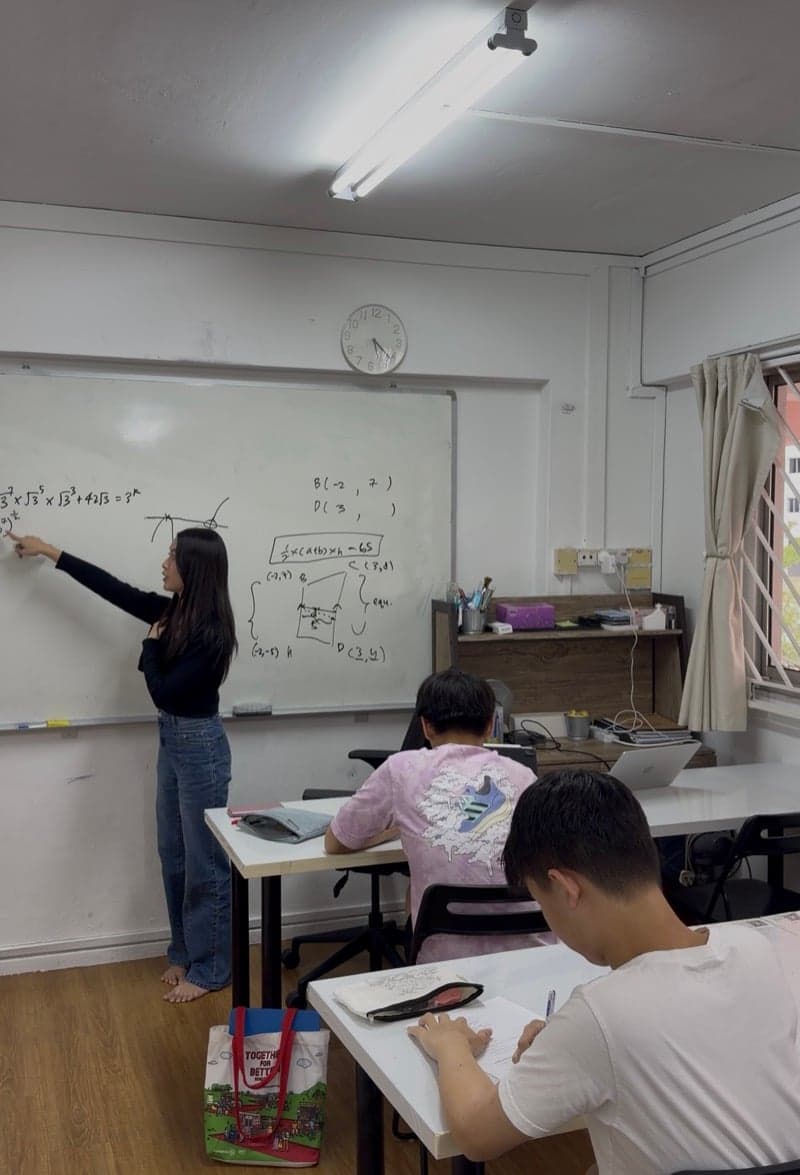
Students who know the content but lack exam technique routinely leave marks on the table in their O-Level / SEC Mathematics papers — and the good news is that technique is entirely learnable. At Ancourage Academy, we see this pattern every year: students who can solve problems at home under no pressure make avoidable errors under timed conditions, leave marks on the table by skipping workings, or misallocate time across questions. This guide covers the specific exam techniques that turn content knowledge into actual marks for both E-Maths (4052) and A-Maths (4049).
These strategies are drawn from years of preparing secondary maths students for the O-Level / SEC examinations. They apply whether your target is A1 or a safe pass — because the underlying principles of time management, workings presentation, and question interpretation are universal. They pair well with topic-level planning: knowing which E-Maths topics carry the most marks tells you where technique gains the biggest return.
Why Exam Technique Matters as Much as Knowledge
A student who understands 80% of the syllabus but applies strong exam technique will often outscore a student who understands 90% but manages time poorly, presents workings badly, or misreads command words. This is not speculation — it reflects how the SEAB marking scheme actually awards marks.
O-Level / SEC Mathematics papers award marks for method, not just final answers — SEAB's only published rule is that 'omission of essential working will result in loss of marks'. In practice a student who sets up the correct approach but makes a calculation error in the final step keeps most of the credit for a multi-mark question — but only if they show their working clearly. A student who jumps to a wrong answer with no working earns zero.
The marks lost to poor technique fall into predictable categories:
- Time misallocation: Spending 15 minutes on a 3-mark question while rushing through 10-mark questions at the end
- Missing method marks: Writing only the final answer when the question awards marks for intermediate steps
- Misreading command words: Treating "show that" as "find" and missing the required proof structure
- Calculator dependency: Over-relying on the calculator for Paper 2 while under-using it, or making mode errors
- No checking strategy: Finishing with time remaining but not knowing what to check first
Each of these is fixable with deliberate practice. The rest of this article addresses each one systematically.
Understanding Paper 1 and Paper 2 Formats
Paper 1 and Paper 2 differ in structure, question count and question style, and students who adjust their approach for each paper consistently outperform those who treat both papers the same way. Approved scientific calculators are permitted in both papers.
| Aspect | Paper 1 | Paper 2 |
|---|---|---|
| Duration | 2 hours 15 minutes | 2 hours 15 minutes |
| Total marks | 90 | 90 |
| Number of questions (E-Maths) | ~26 short questions | 9-10 structured questions |
| Number of questions (A-Maths) | 12-14 questions | 9-11 questions |
| Calculator | Scientific calculator allowed | Scientific calculator allowed |
| Question style | Shorter, testing breadth across topics | Longer, multi-part questions testing depth |
| Strategy emphasis | Mental arithmetic, algebraic manipulation, clean working | Structured problem-solving, calculator efficiency, extended reasoning |
Both E-Maths and A-Maths allow calculators for both papers. However, over-reliance on calculators is still a significant source of mark loss. Students who cannot perform fraction arithmetic, surd manipulation, or trigonometric exact values without a calculator are slower and more error-prone — even when the calculator is permitted. Building mental fluency alongside calculator skills is important for both subjects.
Paper 2 rewards efficient calculator use: students who can store intermediate results, toggle between degrees and radians, and use the table function for pattern-checking gain a measurable speed advantage. More on this in the calculator strategy section below.
Time Allocation: Minutes Per Mark
The single most useful time management formula for O-Level / SEC Maths is: total minutes divided by total marks equals minutes per mark — and for both E-Maths and A-Maths, this works out to approximately 1.5 minutes per mark.
Here is the arithmetic: 135 minutes (2 hours 15 minutes) divided by 90 marks gives exactly 1.5 minutes per mark. This applies to both Paper 1 and Paper 2 for both E-Maths and A-Maths. This means:
- A 2-mark question should take about 3 minutes
- A 4-mark question should take about 6 minutes
- A 6-mark question should take about 9 minutes
- A 10-mark structured question should take about 15 minutes
Build in a buffer by aiming for roughly 1.25 minutes per mark during the main attempt, which frees up the final 15-20 minutes for checking. During timed practice at home, write the target time next to each question before starting — this builds awareness of pacing without needing to clock-watch during the actual exam.
The 2-minute rule for stuck questions: If you have spent 2 minutes on a question and have no idea how to start, circle it and move on. Return to it after completing the rest of the paper. The marks you earn by completing accessible questions elsewhere almost always exceed the marks you might gain by grinding on a question you are stuck on. This is especially critical in Paper 1, where shorter questions mean more switching between topics.
Ancourage Academy's Sec 4 E-Maths and A-Maths classes build exam technique into every session — timed mini-tests, workings review, and Paper 1 vs Paper 2 drills in small groups of 3-6. Book a trial class (usually $18) at Bishan or Woodlands for a diagnostic assessment.
How to Present Workings for Maximum Marks
The way you set out your working determines whether you earn method marks — and method marks are often the difference between a C6 and a B3. The SEAB A-Maths syllabus states that "omission of essential working will result in loss of marks". Here is what that looks like in practice.
The principle: each line of working should show one mathematical step. Do not combine three steps into one line to save space — this is where method marks vanish.
Consider a 3-mark question asking you to solve a quadratic equation by factorisation:
1-mark working (loses 2 method marks):
x = 3 or x = -2
3-mark working (earns full marks):
x² - x - 6 = 0
(x - 3)(x + 2) = 0
x = 3 or x = -2
The second version earns a method mark for rearranging, a method mark for factorising, and an accuracy mark for the correct roots. Even if the student makes a sign error in the factorisation, they still earn the method mark for correctly setting up the equation and attempting to factorise.
Key working presentation rules:
- Write one step per line. Vertically aligned working is easier for markers to follow and for you to check.
- Show substitution explicitly. When using a formula, write the formula first, then show the substitution with values, then simplify. This earns marks even if your arithmetic goes wrong.
- Do not erase or overwrite. If you make an error, draw a single line through it and write the correction clearly. Examiners mark what they can read — messy overwriting creates ambiguity.
- State your units. For questions involving measurement, area, volume, speed, or money, include units in your final answer. Missing units can cost the final accuracy mark.
- Round only at the end. Use exact values or full calculator displays throughout your working, and round only in the final answer to the required number of significant figures or decimal places.
Students preparing for both E-Maths and A-Maths should note that A-Maths marking is particularly strict on working presentation for calculus and trigonometric proof questions. The integration or differentiation steps must appear in sequence — jumping from the question to the final answer, even if correct, may not earn full marks.
"Show That" vs "Find" vs "Prove" — What Each Means
In O-Level / SEC Maths, "find" means calculate the answer and show working for a multi-mark question, "show that" gives you the answer and requires every step that leads to it, and "prove" requires a general algebraic argument rather than a few numerical examples — misreading these command words is one of the most common sources of lost marks among students who know the content.
| Command Word | What It Requires | Common Mistake |
|---|---|---|
| Find | Calculate the answer and state it. Show working for multi-mark questions. | Not showing enough working to earn method marks |
| Show that | The answer is given — you must demonstrate every step that leads to it. No skipping. | Working backwards from the given answer, or skipping intermediate steps |
| Prove | Provide a formal mathematical proof with logical reasoning at every step. | Using specific numerical examples instead of general algebraic proof |
| Hence | Use the result from the previous part. A different method will not earn marks. | Ignoring the previous part and solving from scratch |
| Hence or otherwise | The "hence" method is recommended but you may use any valid method. | Spending too long on the "hence" approach when an alternative is faster |
| Explain | Give a mathematical reason, not just a calculation. Use mathematical vocabulary. | Writing vague descriptions instead of precise mathematical statements |
| Sketch | Draw an approximate graph showing key features (intercepts, turning points, asymptotes). Need not be accurate scale. | Plotting exact points as if it were a "draw" question |
The "show that" category deserves special attention. When a question says "Show that the area is 48 cm²", the answer is already given. What the examiner wants is a complete, gap-free chain of reasoning that arrives at 48. Students who work backwards from 48 — or who skip steps because the endpoint is visible — lose method marks. Treat "show that" questions as if the answer were hidden: set up your approach, work through every step, and arrive at the given value naturally.
"Hence" is another frequent pitfall. If part (a) asks you to factorise an expression and part (b) says "Hence solve the equation," you must use the factorisation from part (a). Solving part (b) independently — even with the correct answer — earns zero marks in strict marking. This catches students who could not complete part (a) and attempt part (b) with a different method. If you are stuck on part (a), attempt it anyway to set up whatever partial result you can use in part (b).
Calculator Strategy and Common Calculator Errors
Your scientific calculator is a tool that multiplies your speed in Paper 2 — but only if you know its functions and avoid the three most common calculator errors that cost marks every year.
Error 1: Degree/Radian mode. This is the single most frequent calculator mistake in A-Maths. E-Maths trigonometry — sine and cosine rules, right-angled triangles, bearings — works in degrees, but 4052 and SEC K310 also examine radian measure in mensuration: arc length rθ, sector area ½r²θ and the area of a segment all take θ in radians. Match the mode to the units the question gives rather than assuming degrees. A-Maths questions involving calculus of trigonometric functions use radians. If your calculator is in the wrong mode, every trigonometric calculation produces a wrong answer — and because the numbers look plausible, students often do not notice. Build a habit: check the mode indicator on your calculator screen before every trigonometric question.
Error 2: Bracket placement. Calculators follow strict order of operations. Entering 1 / 2x when you mean 1 / (2x) produces a completely different result. Similarly, negative numbers raised to powers need careful bracketing: (-3)² = 9 but -3² = -9 on most calculators. When in doubt, add brackets.
Error 3: Premature rounding. Students who round intermediate results before completing a multi-step calculation accumulate rounding errors that affect the final answer. Use the calculator's memory (Ans, M+, or STO) to store full-precision intermediate results. Only round the final answer to the number of decimal places or significant figures the question specifies.
Useful calculator habits for Paper 2:
- Use the Ans key to chain calculations — this avoids re-entering numbers and reduces transcription errors
- Store intermediate values (using A, B, C memory registers) when a calculation has multiple branches that feed into a final answer
- Use the table function to verify graphs or identify roots — this is especially useful for A-Maths functions questions
- Check with estimation: Before accepting a calculator result, do a rough mental estimate to verify the order of magnitude is sensible
Even though calculators are allowed for all O-Level / SEC maths papers, practise mental arithmetic and manual computation regularly. Particular areas to drill: fraction operations, simplifying surds, evaluating exact trigonometric values (sin 30°, cos 45°, tan 60°), and algebraic manipulation without calculator verification. Students who can work without a calculator are faster and less error-prone even when using one.
The Last 15 Minutes: Checking Strategy
Finishing a maths paper early without a checking plan is a missed opportunity — students who use a structured checking strategy in the final 15 minutes typically recover marks that would otherwise be lost to careless errors.
Most students, when told to "check your work," re-read their solutions and confirm that nothing looks obviously wrong. This is ineffective because the same thought process that produced the error will usually overlook it on review. A more effective approach:
- Check high-mark questions first. A careless error in an 8-mark question costs more than one in a 2-mark question. Start your checking with the questions worth the most marks.
- Verify by substitution, not re-solving. If you solved an equation and got x = 5, substitute x = 5 back into the original equation. If you found coordinates of intersection, substitute them into both equations. This catches errors without repeating the same method.
- Check units and significant figures. Circle every final answer and verify: does it have the right units? Is it rounded to the correct number of significant figures or decimal places? These are free marks that students throw away.
- Check for answered parts. Scan through the paper for any sub-part you may have skipped. A blank (b)(ii) that you meant to return to is zero marks — even a partial attempt can earn method marks.
- Check reasonableness. If a question asks for the length of a swimming pool and your answer is 0.3 m, something went wrong. If a probability exceeds 1, something went wrong. Quick sanity checks catch errors that detailed re-calculation does not.
For A-Maths papers specifically, allocate extra checking time for differentiation and integration questions — sign errors and missing constants of integration are among the most common mark-losing mistakes. In past year paper practice, track which question types produce the most checking discoveries and prioritise those during the actual exam.
Building Exam Technique Through Practice
Exam technique is a skill that develops through staged practice — jumping straight to full timed papers without building component skills first is like entering a race without training.
The progression that works for most students preparing for O-Level / SEC Mathematics:
- Untimed topical practice (8-12 weeks before exam): Work through questions by topic with no time pressure. Focus on correct method and clean working presentation. This builds accuracy and proper working habits before adding time pressure.
- Generous timing (6-8 weeks before exam): Attempt full papers with 50% extra time (e.g., 3 hours 20 minutes instead of 2 hours 15 minutes). The goal is to complete every question with proper working. Track which topics take longer than they should.
- Exam timing (4-6 weeks before exam): Do full papers under strict exam conditions — 2 hours 15 minutes, no notes, appropriate calculator restrictions. This is where time management skills develop. Aim for one complete paper per subject per week.
- Exam minus 10 minutes (2-4 weeks before exam): Practise completing papers in 2 hours 5 minutes. This builds a time buffer that reduces exam-day anxiety and ensures time for checking. If a student can finish comfortably in 2:05, they will not panic at 2:15.
Error journal integration: After every timed paper, record each mistake in an error journal. Categorise errors as conceptual (did not know the method), careless (knew the method but made a slip), time-related (ran out of time), or misread (solved the wrong question). Over several papers, patterns emerge — and those patterns tell you exactly where to focus remaining revision. The past year paper strategy guide covers this process in detail.
Students who follow this progression typically see measurable improvement even within 4-6 weeks. At Ancourage Academy, timed practice and error analysis are integrated into every Sec 3 and Sec 4 Maths class — so technique develops alongside content knowledge, not as an afterthought. The prelim-to-O-Level / SEC improvement we see in our students reflects this dual focus. For revision guides across every subject, browse the full O-Level / SEC hub.
Common Questions About O-Level / SEC Maths Exams
How do I score A1 in O-Level / SEC maths?
Scoring A1 in O-Level / SEC Mathematics requires both strong content knowledge and disciplined exam technique. Content-wise, you need mastery across all topics — A1 candidates cannot afford to write off any topic area. Technique-wise, the difference between A2 and A1 usually comes down to minimising careless errors (through a checking strategy), presenting full workings (to secure every method mark), and managing time so that you complete the paper with 15 minutes to spare for review. At Ancourage Academy, students targeting A1 work through past papers under timed conditions with systematic error tracking to identify and eliminate their specific mark-losing patterns.
How should I manage my time in the O-Level / SEC maths exam?
Use the 1.5 minutes-per-mark formula: a 2-mark question gets about 3 minutes, a 5-mark question gets about 7-8 minutes. Aim to finish the main attempt in about 2 hours, leaving 15 minutes for checking. If you are stuck on a question for more than 2 minutes with no clear approach, circle it and move on — return after completing the rest of the paper. Practise this discipline during timed revision papers so it becomes automatic on exam day. Many students at Ancourage Academy Bishan and Woodlands find that once they internalise the per-mark timing, exam-day anxiety decreases significantly.
What is the difference between Paper 1 and Paper 2 in O-Level / SEC E-Maths?
Both E-Maths and A-Maths have the same format: Paper 1 (2 hours 15 minutes, 90 marks) and Paper 2 (2 hours 15 minutes, 90 marks), totalling 180 marks. Calculators are allowed for both papers in both subjects. Paper 1 has shorter questions testing breadth across the syllabus. Paper 2 has longer structured questions requiring sustained multi-step reasoning. The key strategic difference is that Paper 1 rewards speed and topic-switching ability, while Paper 2 rewards depth and structured problem-solving.
How many marks do I lose for not showing working?
SEAB does not publish its mark schemes, but both syllabuses state that 'omission of essential working will result in loss of marks' — so a bare correct answer to a multi-mark question forfeits the marks tied to the working, and a wrong answer with no working earns nothing. Over a full paper, students who skip working forfeit marks on question after question compared to students who show every step. This is why Ancourage Academy's E-Maths and A-Maths lessons emphasise working presentation from day one — it is the single highest-impact exam habit.
When should I start practising full O-Level / SEC maths papers?
Begin full timed papers approximately 8-12 weeks before the exam, after you have completed the syllabus and done untimed topical practice. Start with generous timing (50% extra time), move to strict exam timing by 4-6 weeks out, and practise finishing 10 minutes early in the final 2-4 weeks. Aim for one full paper per subject per week during this period. Pair each timed attempt with thorough error analysis using an error journal — the learning happens during the review, not just during the attempt.
Related: Secondary maths study methods · Comparing E-Maths and A-Maths · Past Year Paper Strategy · Prelim vs O-Level Score Gap · Woodlands & Bishan Secondary Maths Tuition · Sec 4 O-Level Maths revision plan · Common O-Level E-Maths mistakes · Sec 3 maths grade-drop recovery · A-Maths Coordinate Geometry & Circles explained · A-Maths Quadratic Functions, Equations & Inequalities guide