
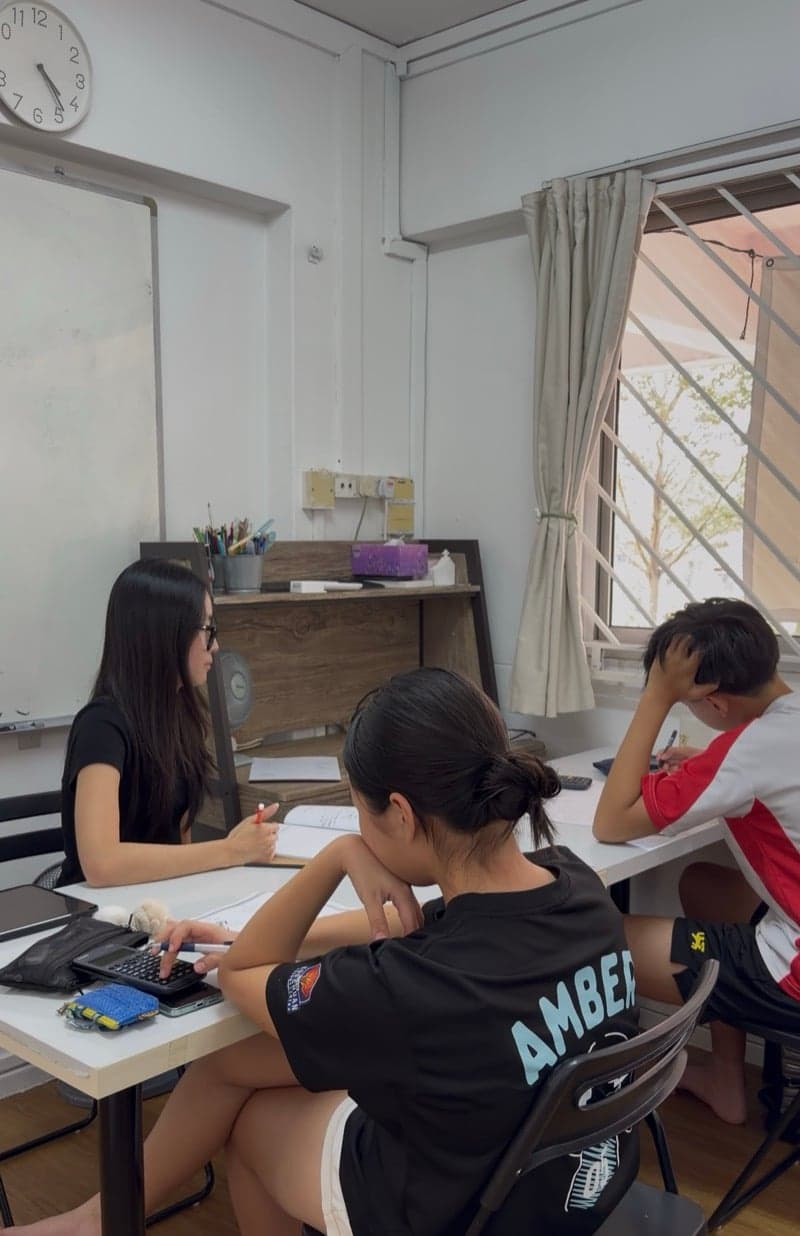
Secondary 3 is when most maths grades drop — and for predictable reasons. E-Maths topics jump sharply in difficulty while A-Maths introduces entirely new concepts like calculus and logarithms. Students who coasted through Sec 1-2 suddenly face a double workload that exposes every gap in their foundations. This guide is by Ancourage Academy, whose Mathematics tutors work with Sec 3 students rebuilding after a grade drop.
As Founder and Academic Director at Ancourage Academy, Min Hui has guided Sec 3 students through this exact pattern for over 11 years — and recovery follows a predictable path when the right gaps are identified. This guide breaks down exactly where things go wrong — topic by topic — and provides a term-by-term recovery plan for both E-Maths and A-Maths.
Why Sec 3 Is the Hardest Year for Maths
Sec 3 combines the steepest E-Maths difficulty jump with the introduction of A-Maths, creating a double workload that no other secondary year matches.
Three factors converge at the same time:
- E-Maths topics become abstract: Sec 1-2 mathematics is largely procedural — follow the steps, get the answer. Sec 3 E-Maths introduces topics like quadratics, coordinate geometry, and circle properties that require conceptual understanding, not just formula application.
- A-Maths is entirely new: Students who chose A-Maths in their Sec 3 subject combination encounter surds, logarithms, and trigonometric identities for the first time. These topics have no equivalent in lower secondary maths.
- Cumulative gaps surface: Weak algebra from Sec 1-2 that previously caused minor errors now causes complete breakdowns. A student who cannot factorise fluently will struggle with almost every Sec 3 topic in both subjects.
The result: a student scoring B3 in Sec 2 might drop to C5 or C6 by the Sec 3 Term 2 weighted assessments. Parents often assume the child stopped trying. More often, the child is trying harder than ever but facing topics that demand skills they never fully built.
If your child's maths grades have dropped in Sec 3, Ancourage Academy's diagnostic assessment pinpoints exactly where the breakdown is — book a trial class (usually $18) at Bishan or Woodlands in small groups of 3-6.
E-Maths Topics That Trip Up Sec 3 Students
Four E-Maths topics cause the majority of Sec 3 grade drops: quadratic equations, coordinate geometry, trigonometry beyond basic ratios, and circle properties. Each one demands a different kind of thinking from what students practised in Sec 1-2.
The table below ranks these topics by difficulty and shows which foundational skill each one depends on:
| E-Maths Topic | Difficulty Level | Foundational Skill Required | Common Failure Point |
|---|---|---|---|
| Quadratic equations & functions | High | Algebraic manipulation, factorisation | Choosing between factorisation, completing the square, and formula |
| Coordinate geometry | High | Linear equations, gradient concept | Connecting algebra to graphical meaning |
| Trigonometry (sine/cosine rule, bearings) | Medium-High | Basic trig ratios, angle properties | Applying ratios to non-right-angled triangles |
| Circle properties | Medium-High | Angle properties, logical reasoning | Selecting the correct theorem and justifying steps |
| Set language & Venn diagrams | Medium | Logical thinking, notation | Translating word problems into set notation |
| Matrices | Medium | Arithmetic accuracy, spatial thinking | Order of multiplication (AB ≠ BA) and checking dimension compatibility before multiplying |
Quadratics cause the most damage because students must choose the right method for each question. Some quadratics factorise neatly. Others require the quadratic formula. Some questions ask for the vertex form, which needs completing the square. Students who learn only one method try to force it on every question — and fail.
Coordinate geometry is the first E-Maths topic where algebra and geometry fully merge. Students must move between equations and graphs fluently, interpreting gradient as a rate of change rather than just a number to calculate. The O-Level / SEC E-Maths syllabus (4052, SEC code K310) lists four outcomes under topic G6: finding the gradient of a straight line from the coordinates of two points, finding the length of a line segment from its end points, interpreting and finding the equation of a straight line in the form y = mx + c, and solving geometric problems using coordinates — all in multi-step contexts. The midpoint formula and the conditions for parallel and perpendicular lines are A-Maths content (4049, SEC code K341), not E-Maths.
Trigonometry expands from basic SOH-CAH-TOA to the sine rule, cosine rule, and bearings. Students who memorised the basic ratios without understanding what they represent struggle to apply them in unfamiliar triangle configurations.
A-Maths Topics That Feel Impossible at First
A-Maths introduces four topic areas that have no precedent in lower secondary maths: surds and indices, logarithms, trigonometric identities, and introductory calculus. Each one requires a different mental model that students have never encountered before.
Surds and indices: Students must manipulate irrational numbers and follow index laws with fractional and negative exponents. The rules feel arbitrary until students understand the underlying logic. A student who memorises "multiply the indices" without understanding why will make errors when the rule does not apply directly.
Logarithms: This is the single topic that produces the most A-Maths anxiety. Logarithms reverse the process of exponentiation — a concept most students have never thought about. Converting between exponential and logarithmic form, applying log laws, and solving logarithmic equations all require comfort with a completely new notation. Our A-Maths survival guide covers specific strategies for this topic.
Trigonometric identities: Unlike E-Maths trigonometry (which involves calculation), A-Maths trigonometric identities require proof and algebraic manipulation. Students must show that one expression equals another using identities like sin2x + cos2x = 1. This is closer to algebra than geometry, and students who see trig as a "shapes topic" struggle with the shift.
Introductory calculus: Differentiation and integration are powerful but abstract. Students must understand gradient as a function, apply chain rule and product rule, and interpret results in context. The O-Level / SEC A-Maths syllabus (4049, SEC code K341) allocates significant weight to calculus — it is not a topic students can afford to skip or delay.
The common thread across all four areas: students who rely on memorisation hit a wall. A-Maths rewards understanding over recall. The students who recover fastest are those who accept that A-Maths requires a different study approach from anything they have done before — the principle that shapes Ancourage Academy's Additional Mathematics tuition for upper-secondary students.
Ancourage Academy's Sec 3 A-Maths programme uses diagnostic assessments to identify exactly which concepts a student has not internalised — then builds understanding from that point. Book a trial class (usually $18) at Bishan or Woodlands to find out where the gaps are.
Managing Two Maths Subjects Simultaneously
Students taking both E-Maths and A-Maths must manage two separate syllabuses, two sets of homework, and four exam papers (Paper 1 and Paper 2 for each subject) — and the key to managing this is understanding how the two subjects reinforce each other rather than treating them as competitors for study time.
Practical time allocation guidelines:
- When both are weak: Prioritise E-Maths first. E-Maths algebraic skills (factorisation, solving equations, graph sketching) directly support A-Maths. Strengthening E-Maths foundations lifts A-Maths performance too.
- When A-Maths is weak but E-Maths is stable: Allocate 60-70% of maths study time to A-Maths. Use E-Maths practice for confidence and momentum.
- When E-Maths is weak but A-Maths is manageable: This is less common but happens when students enjoy abstract thinking. Focus on E-Maths application questions and word problems, which require different skills from A-Maths manipulation.
Topics that overlap between E-Maths and A-Maths — and where studying one benefits the other:
- Algebra: A-Maths manipulations (partial fractions, surds) strengthen E-Maths algebraic fluency
- Coordinate geometry: E-Maths covers lines; A-Maths extends to circles. Mastering E-Maths coordinate geometry makes A-Maths circles significantly easier
- Trigonometry: E-Maths sine/cosine rules and A-Maths identities share foundational concepts. Students who understand the unit circle find both subjects easier
The worst strategy is alternating randomly between subjects. Instead, block study time: focus on one subject per session and switch between sessions. This prevents the mental fatigue of constantly switching mathematical frameworks.
The Sec 2 Foundations That Sec 3 Exposes
Most Sec 3 maths struggles are not Sec 3 problems — they are Sec 1-2 gaps that finally become visible when topics grow complex enough to require those foundations.
Weak algebra is the most common culprit. A student who cannot fluently:
- Expand and simplify expressions with brackets
- Factorise quadratic expressions (including non-trivial cases like 6x2 + x − 2)
- Solve simultaneous equations using substitution and elimination
- Manipulate equations with fractions and negative terms
...will struggle with almost every Sec 3 topic. Quadratic equations require factorisation. A-Maths logarithms require equation manipulation. Coordinate geometry requires solving simultaneous equations. The cascade effect is severe.
Beyond algebra, two other Sec 2 gaps frequently surface:
- Angle properties: Sec 3 circle properties build directly on angle theorems from Sec 2. Students who memorised angle rules without understanding them cannot extend those rules to circles.
- Graph interpretation: Sec 3 coordinate geometry and calculus require students to read and interpret graphs — a skill that develops through practice in Sec 1-2 but is often treated as secondary to calculation.
Self-assessment checklist for parents and students:
- Can your child factorise x2 + 5x + 6 without hesitation? What about 2x2 − 7x + 3?
- Can they solve 3x + 2y = 11 and x − y = 1 simultaneously within 2 minutes?
- Can they sketch y = 2x + 3 without a table of values?
- Can they state the angle in a semicircle theorem and explain why it works?
- Can they convert between subject of formula (e.g. make r the subject of A = πr2)?
If the answer to more than two of these is "no" or "unsure," Sec 2 gaps are likely contributing to Sec 3 difficulty. Addressing these gaps — even briefly — often produces faster improvement than pushing ahead with Sec 3 content. As our secondary maths strategies guide explains, sometimes progress means going backwards first.
Term-by-Term Recovery Timeline
Recovery from a Sec 3 maths grade drop follows a predictable timeline — the key is diagnosing correctly in Term 1 and closing gaps systematically rather than panicking into random practice.
Term 1 (January–March): Diagnose and stabilise
- Identify exactly which Sec 2 foundations are weak using a diagnostic assessment (not just a general "maths is bad" conclusion)
- Address the top 2-3 foundational gaps alongside current school topics
- Set a realistic target: aim to understand the current topic, not to immediately raise grades. Understanding precedes grade improvement by 4-8 weeks
- Milestone: Student can complete school homework independently (with occasional help), even if slowly
Term 2 (April–June): Close gaps and build fluency
- Foundational gaps should be largely closed by mid-Term 2
- Begin timed practice for current topics to build exam-speed fluency
- For A-Maths, focus on the first three chapters taught (typically surds/indices and logarithms) until they are solid before moving on
- Milestone: Term 2 weighted assessment grades stabilise (stop dropping) or show early improvement. A 5-10 mark increase from Term 1 indicates the approach is working
Term 3 (July–September): Build exam readiness
- Shift from gap-closing to exam technique: time management, question interpretation, showing working clearly
- Practise full papers under timed conditions at least fortnightly
- Review error patterns from the Term 2 weighted assessment systematically — categorise errors as careless, conceptual, or time-related
- Milestone: Student completes a full past paper within the time limit with at least 60% accuracy
Term 4 (October–November): Consolidate for year-end exams
- Focus on weaker chapters identified from Term 3 practice papers
- Reduce new learning; maximise revision and retrieval practice
- Practise under exam conditions: strict timing, no notes, full papers
- Milestone: Year-end exam grade improves by at least one grade from the Term 2 weighted assessment (e.g. C6 to B4)
This timeline assumes consistent weekly effort. Students who start recovery in Term 3 can still improve, but the ceiling is lower — catching up on 6 months of gaps in 10 weeks limits how much improvement is possible before year-end exams.
Warning Signs Parents Should Watch For
Grade drops in Sec 3 maths follow six recognisable warning signs — a sudden 10-mark drop between exams, homework avoidance or rushing, repeatedly saying 'I don't understand the question', test anxiety that was not there before, studying more but scoring less, and talk of dropping A-Maths. Catching them early makes recovery faster and less stressful for everyone.
- Sudden grade drop (10+ marks between exams): A drop from 70% to 55% between the Sec 2 year-end exam and the Sec 3 Term 2 weighted assessment is the clearest signal. This is not a blip — it reflects the difficulty jump and usually worsens without intervention.
- Homework avoidance or rushing: Students who previously completed maths homework willingly but now avoid it, rush through it, or copy from classmates are signalling that they cannot do it independently. The avoidance is often embarrassment, not laziness.
- "I don't understand the question": When a student repeatedly says they do not understand what a question is asking (not that they cannot solve it), the problem is usually foundational. They lack the vocabulary or conceptual framework to parse the question, not just the technique to answer it.
- Test anxiety that was not there before: A student who was confident in Sec 2 maths exams but now dreads them has likely experienced repeated failure in class tests or quizzes. The anxiety is a response to genuine difficulty, not a personality trait.
- Studying more but scoring less: This is the most frustrating pattern for parents and students. It usually means the student is practising at the wrong level — doing questions they already understand rather than confronting the topics they find difficult.
- Dropping A-Maths talk: If your child begins suggesting they should drop A-Maths within the first term, take it seriously. It may be a genuine assessment of the workload, or it may be an avoidance response. Either way, a diagnostic conversation is warranted before making decisions.
The single most important parental action: avoid attributing the drop to effort alone. Saying "you need to study harder" to a student already struggling with conceptual gaps reinforces helplessness. Instead, help identify specific gaps and seek targeted support.
How Effective Sec 3 Maths Tuition Works
Effective Sec 3 maths tuition starts with diagnosis, not content delivery — the first priority is identifying exactly which foundations are weak before adding new material on top.
What distinguishes productive tuition from unproductive tuition:
| Approach | Effective Tuition | Ineffective Tuition |
|---|---|---|
| First session | Diagnostic assessment to identify gaps | Jumps straight into current school topic |
| Class size | Small groups (3-6) for individual attention | Large classes (15+) with one-size-fits-all pacing |
| E-Maths + A-Maths | Coordinated approach recognising overlaps | Treats each subject in isolation |
| Foundation gaps | Addresses Sec 2 gaps alongside Sec 3 content | Ignores foundations and hopes they resolve |
| Progress tracking | Regular updates to parents on understanding, not just grades | Reports only test scores |
At Ancourage Academy, Sec 3 maths tuition follows a diagnostic-first approach:
- Diagnostic assessment: Every new student completes an assessment covering Sec 2 foundations and current Sec 3 topics. This identifies the specific gaps causing difficulty — not just the symptoms.
- Small groups of 3-6: Tutors can address each student's specific weak points within the same session. One student might need help with logarithms while another needs factorisation reinforcement.
- Coordinated E-Maths and A-Maths support: Ancourage Academy offers both Sec 3 E-Maths and Sec 3 A-Maths classes, allowing tutors to coordinate across both subjects and leverage overlapping topics.
- School-aligned pacing: Tuition follows the student's school schedule, ensuring revision aligns with upcoming tests and exams rather than following a generic curriculum.
Ancourage Academy operates at both Bishan and Woodlands. Start with a trial class (usually $18) at Bishan or Woodlands — the trial includes a diagnostic assessment that identifies your child's specific Sec 3 gaps. For revision guides across every subject, browse our O-Level / SEC preparation guides.
Common Questions About Sec 3 Maths
Why is Sec 3 maths so hard compared to Sec 1-2?
Sec 3 maths is harder for three reasons: E-Maths topics become more abstract (quadratics, coordinate geometry, circle properties), A-Maths introduces entirely new concepts (logarithms, calculus, trigonometric identities), and both subjects now require Sec 1-2 algebra as a fluent foundation rather than a topic in itself. The combined effect creates the steepest difficulty increase in secondary school mathematics.
Is Sec 3 too late to start maths tuition?
Sec 3 is not too late, but the approach matters. Tuition that starts with a diagnostic assessment and addresses foundation gaps alongside current topics can produce meaningful improvement within one to two terms. Tuition that simply piles on more practice without identifying root causes is less effective at any stage. Students who begin support in Sec 3 Term 1 typically show grade improvement by the Term 2 weighted assessments.
What are the hardest topics in Sec 3 maths?
For E-Maths, quadratic equations and coordinate geometry cause the most difficulty because they require conceptual understanding beyond formula application. For A-Maths, logarithms and trigonometric identities are the most challenging new topics — they use notation and reasoning methods students have never encountered. Calculus (differentiation and integration) is complex but often taught later and more systematically. The full A-Maths topic list is in the Ancourage Academy glossary entry for Additional Mathematics.
Should my child focus on E-Maths or A-Maths first?
When both subjects are weak, focus on E-Maths first. E-Maths algebraic skills (factorisation, solving equations, graph interpretation) directly support A-Maths performance. Strengthening E-Maths foundations typically lifts A-Maths results as well, because both subjects share an algebra core. Once E-Maths is stable, shift more study time to A-Maths topics that do not overlap, such as logarithms and calculus.
Does Ancourage Academy offer combined E-Maths and A-Maths support?
Yes. Ancourage Academy offers separate Sec 3 E-Maths and Sec 3 A-Maths classes, but tutors coordinate across both subjects to ensure consistent progress. Students taking both benefit from aligned teaching — for example, when E-Maths covers coordinate geometry and A-Maths covers equations of circles in the same period, the tutor connects the two topics explicitly. All classes run in small groups of 3-6 at the Bishan and Woodlands centres.
Related: Help for struggling A-Maths students · E-Maths vs A-Maths Explained · Secondary maths exam techniques · Sec 3 Subject Combination Guide · A-Maths Indices, Surds, Logarithms & Exponentials · a guide to A-Maths Quadratic Functions, Equations & Inequalities · E-Maths Topic Weightage explained · Sec 4 Maths Revision Plan