
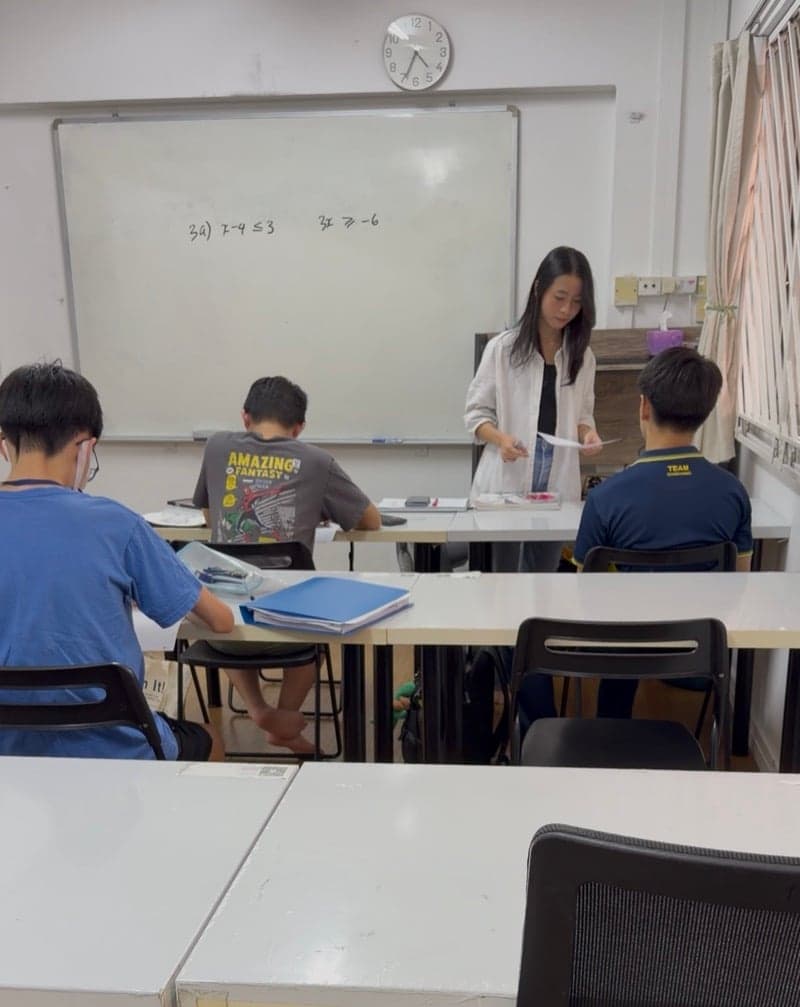
Most avoidable mark loss in O-Level / SEC Elementary Mathematics comes from a small set of recurring mistake patterns — and they are the same patterns year after year. Ancourage Academy tracks error data across cohorts at our Bishan and Woodlands centres, and the consistency is striking. Students who learn to recognise these patterns before exam day recover marks that would otherwise slip away on autopilot. This guide walks through the specific mistakes, shows what the correct working looks like, and explains how to build habits that prevent each one.
As Founder and Academic Director at Ancourage Academy, Min Hui has spent over 11 years tracking error patterns across hundreds of O-Level / SEC Mathematics students. The mistake categories in this guide are drawn from that data — not theory. The SEAB 4052 syllabus and the upcoming SEC G3 Mathematics K310 syllabus both test the same competencies — and the same mistake traps appear in both.
Why E-Maths Mistakes Are Predictable
Most E-Maths mark loss comes from approximately ten recurring mistake patterns, not from a lack of content knowledge. Students who score in the B3-C6 range typically understand enough content to achieve A1-B3 — but they leak marks through errors that feel random yet follow clear patterns.
At Ancourage Academy, tutors tag every marked error into one of three categories: conceptual (the student does not understand the method), procedural (the student knows the method but executes it incorrectly), or exam technique (the student solves correctly but loses marks through presentation or time issues). In our own marking we see roughly the same split each year:
- Procedural errors: the largest share — sign slips, distribution mistakes, formula misapplication
- Exam technique errors: the next largest — rounding too early, missing units, poor time allocation
- Conceptual errors: the smallest share — genuine misunderstanding of the method
The implication is encouraging. Three-quarters of marks lost come from fixable habits, not from gaps in understanding. The sections below address each category with specific examples from the secondary Maths syllabus.
If your child keeps losing marks to the same mistakes, Ancourage Academy's diagnostic assessment identifies the specific error patterns — book a trial class (usually $18) at Bishan or Woodlands in small groups of 3-6.
Algebra Mistakes That Follow Students from Sec 1
Algebraic manipulation errors account for more lost marks than any other single topic area in E-Maths, and most of them originate from weak habits formed in Secondary 1-2. These are not "hard" mistakes — they are fast, automatic errors that students make because they never built reliable routines for basic operations. The secondary maths strategies guide covers the broader algebra foundation; here we focus on the specific errors that cost marks in exams.
The table below shows the four most common algebra errors alongside the correct working:
| Mistake Type | Incorrect Working | Correct Working | Why It Happens |
|---|---|---|---|
| Sign error when moving terms | 3x − 7 = 2 → 3x = 2 − 7 | 3x − 7 = 2 → 3x = 2 + 7 = 9 | Student moves the term without flipping the sign |
| Distribution error with negatives | −2(x − 3) = −2x − 6 | −2(x − 3) = −2x + 6 | Negative sign not applied to second term in bracket |
| Expression vs equation confusion | Simplify 3x + 5: student writes "3x + 5 = 0, x = −5/3" | 3x + 5 cannot be simplified further (it is an expression, not an equation) | Student tries to "solve" when asked to "simplify" |
| Cross-multiplication errors | (x+1)/3 = 5 → x + 1 = 5/3 | (x+1)/3 = 5 → x + 1 = 15 | Student divides instead of multiplying across |
Each of these errors carries a compounding effect. A sign error in the first line of a 5-mark question can invalidate every subsequent step. Even if the method is perfect from that point onward, the examiner awards zero marks for the final answer and at most partial method marks — often just 1 out of 5.
The fix is not "be more careful." The fix is a checking routine: after every algebraic manipulation step, students should verify by substituting a simple number (like x = 1) into both the original and the rearranged expression. If the values do not match, the step contains an error. This takes five seconds and catches the majority of sign and distribution mistakes. Students in Ancourage Academy's small classes of 3-6 practise this routine until it becomes automatic.
Trigonometry and Geometry Errors
Trigonometry errors in E-Maths cluster around three failure points: selecting the wrong formula, calculator mode mistakes, and unjustified angle assumptions. Unlike algebra errors, which are procedural, many trigonometry errors are partly conceptual — students do not fully understand when to use which approach.
The most common mistakes:
- Sine rule vs cosine rule confusion: The sine rule applies when you have a known angle-side pair (ASA or AAS). The cosine rule applies when you have two sides and the included angle (SAS) or all three sides (SSS). Students who memorise both formulas without learning the selection criteria waste time trying the wrong rule first, then panicking when it does not produce a clean answer.
- Calculator in radian mode: This is the single most preventable mistake in E-Maths. A student calculates sin(30) expecting 0.5 but gets −0.9880 because the calculator is set to radians. The answer looks plausible enough that many students do not notice. Fix: check calculator mode at the start of every exam and after every battery change.
- Angle property assumptions: Students assume a triangle is right-angled when the diagram looks like it has a right angle, or assume lines are parallel without justification. Examiners penalise heavily for using properties (Pythagoras, alternate angles) without stating them. If the question does not state the property, the student must prove it.
- Bearing notation errors: Bearings must be three-digit, measured clockwise from north. Writing "45°" instead of "045°" costs a mark. Measuring from east or anticlockwise produces completely wrong answers.
For E-Maths specifically, the trigonometry content stays within basic ratios, the sine rule, and the cosine rule. Students do not need advanced identities. Mastering just these three tools with correct selection criteria covers every trigonometry question on the 4052 paper.
Coordinate Geometry and Graph Reading Mistakes
Coordinate geometry questions test precision, and students lose marks through sign errors in gradient calculations, slips in the length-of-a-line-segment formula, and poor scale reading on graphs. These are high-yield questions — getting the method right typically earns full marks, but a single numerical slip cascades through the entire solution.
Common pitfalls:
- Gradient sign errors: When calculating gradient as (y₂ − y₁)/(x₂ − x₁), students frequently subtract in inconsistent order — taking y₂ − y₁ on top but x₁ − x₂ on the bottom, flipping the sign of the gradient. The fix: always label Point 1 and Point 2 clearly, and always subtract in the same order.
- Length-of-segment errors: Finding the length of a line segment as √((x₂−x₁)² + (y₂−y₁)²), students square only one difference before adding, or drop the square root entirely and report the squared length. Subtracting in a different order for x and y is harmless here — the squares remove the sign — which is exactly why the same carelessness costs marks in the gradient question above.
- Scale reading on graphs: When reading values from a plotted graph, students miscount gridlines or assume each square represents 1 unit when the scale is 1:2 or 1:5. Always check axis labels before reading any value.
- Missing labels: Students lose presentation marks by not labelling axes, not marking intercepts, or not including the equation of the line on graph sketches. These are free marks that require no calculation.
If your child keeps losing marks to the same mistakes, book a trial class (usually $18) at Ancourage Academy for a diagnostic assessment that identifies the specific error patterns holding back their grade. Centres at Bishan and Woodlands.
Statistics and Probability Errors
Statistics and probability questions appear straightforward but contain traps that cost marks when students apply formulas mechanically without thinking about what the numbers mean. This topic area appears only in E-Maths, not A-Maths, so every E-Maths student encounters it.
- Cumulative frequency curve errors: Students plot cumulative frequency against the upper class boundary — not the midpoint, not the lower boundary. Plotting against midpoints is the single most common statistics error. Students also forget that the curve must start from zero at the lower boundary of the first class.
- Probability tree diagrams: Branches from each node must sum to 1. Students who draw incomplete trees (missing one branch) or whose branches sum to more than 1 lose all marks for that section. For "without replacement" questions, the second-stage probabilities must reflect the reduced total.
- Mean from grouped data: Students use class boundaries instead of midpoints when calculating the estimated mean. The formula uses the midpoint of each class interval multiplied by its frequency, not the boundary values.
- Confusing median and mean: In grouped data, the median is read from the cumulative frequency curve (at n/2), not calculated as the arithmetic mean. Students who calculate the mean when asked for the median get zero marks even if their arithmetic is correct.
The past-year papers guide explains how to use exam papers for targeted practice in weak topic areas like statistics.
Exam Technique Mistakes That Cost Marks
Exam technique errors are the most frustrating category because they involve correct mathematical understanding — the student knows the content but loses marks through presentation, timing, or rounding errors. These mistakes are entirely preventable and account for roughly 30% of avoidable mark loss.
| Exam Technique Error | Typical Marks Lost per Paper | How to Prevent It |
|---|---|---|
| Premature rounding (rounding intermediate steps) | 3-6 marks | Keep at least 4 significant figures in working; round only the final answer |
| Not showing working for "show that" questions | 2-4 marks | Write every algebraic step, even if it seems obvious |
| Wrong number of significant figures or decimal places | 2-4 marks | Read the question: "3 significant figures" ≠ "3 decimal places" |
| Poor time allocation (spending 15 minutes on a 2-mark question) | 6-10 marks (unattempted questions) | Allocate roughly 1.5 minutes per mark (135 minutes for 90 marks); skip and return to hard questions |
| Not answering the question asked | 1-3 marks | Re-read the question after solving; check units match what was asked |
| Missing units in final answer | 1-2 marks | Circle the unit in the question and include it in the answer line |
The total column is a worst case — the marks at risk if every one of these errors appears in the same paper. In practice, exam technique accounts for about 30% of a typical student's 15-30 marks of avoidable loss, or roughly 5-9 marks per paper — still easily the difference between a B3 and an A2, or between a C5 and a B4. No amount of content revision fixes these issues. They require deliberate practice under timed exam conditions.
One Sec 4 student at Ancourage Academy scored a C5 in her mid-year exam. Error analysis showed she understood every topic tested. Her marks were leaking through premature rounding (4 marks lost), unattempted questions due to poor time management (8 marks), and missing units (3 marks). After two months of timed practice with strict exam discipline, she scored a B3 in her preliminary exam — with no additional content teaching. The knowledge was already there.
How to Build an Error Journal
An error journal is the most effective tool for turning mistake awareness into mark recovery — at Ancourage Academy, the students who keep one consistently are the ones whose repeated-error count falls fastest within a term. The concept is simple: after every practice paper or test, categorise each mistake and record the fix.
A useful error journal format has four columns:
- Date and source: Which paper, which question number
- Error description: What went wrong — be specific (e.g., "forgot to flip sign when moving −4 across equals sign"), not vague ("careless mistake")
- Category: Conceptual (did not understand the method), procedural (knew the method but executed incorrectly), or exam technique (correct solution but lost marks on presentation/timing)
- Fix: One concrete action to prevent recurrence (e.g., "substitute x = 1 to check after every rearrangement step")
After four to five papers, patterns emerge. A student might discover that 60% of their errors are sign errors in algebra — a clear signal to slow down on algebraic steps and build a checking habit. Another might find that most marks are lost to time pressure, pointing toward timed practice rather than more content revision.
The error journal also serves as a revision tool. Before exams, students review their journal rather than reworking entire topics. This targets revision time at the specific weaknesses that have cost marks historically, rather than spreading effort thinly across everything. Students in our Sec 4 E-Maths programme maintain error journals as part of their regular practice routine.
When Mistakes Signal Deeper Gaps
Not all mistakes are "careless" — some recurring errors indicate genuine conceptual gaps that require targeted reteaching, not just more practice. Distinguishing between the two is critical because the interventions are completely different.
Signs that a mistake is careless (procedural):
- The student can explain the correct method when asked
- The error is inconsistent — they get the same type of question right sometimes
- The error typically involves sign flips, arithmetic slips, or copying errors
- Speed or fatigue is a factor — mistakes cluster in the second half of the paper
Signs that a mistake reflects a conceptual gap:
- The student cannot explain why the method works, only how to apply it
- The error is consistent — the same wrong approach appears every time
- The student does not recognise the error even when pointed out
- Related topics are also weak (e.g., errors in simultaneous equations often accompany weak algebraic manipulation)
When the error journal reveals consistent conceptual errors in a topic area, the response is not more practice questions — it is reteaching. The student needs to rebuild understanding from an earlier stage. This is often where structured tuition support — such as our upper-secondary Maths classes — becomes necessary, because conceptual reteaching requires an experienced tutor who can identify exactly where understanding broke down. Students preparing for O-Level / SEC examinations at the Bishan or Woodlands schools near Ancourage Academy centres can access diagnostic assessments to pinpoint these gaps. See also our guide on primary maths mistakes — many secondary errors trace back to primary-level foundations. For the complete library of E-Maths, A-Maths and problem-solving guides, browse our maths learning hub.
Common Questions About O-Level / SEC E-Maths Mistakes
What are the most common mistakes in O-Level / SEC E-Maths?
The most common O-Level / SEC E-Maths mistakes are algebraic sign errors (moving terms without flipping signs), distribution errors with negative brackets, selecting the wrong trigonometry formula, premature rounding of intermediate calculations, and poor time management leading to unattempted questions. These five error types alone account for the majority of avoidable mark loss across both Paper 1 and Paper 2.
How do I avoid careless mistakes in the O-Level / SEC maths exam?
Build three specific habits: first, use a substitution check after every algebraic rearrangement step (plug in a simple value like x = 1 to verify). Second, read the question twice — once for understanding, once to identify exactly what is being asked and in what form (significant figures, units, "show that" vs "find"). Third, allocate time by marks (roughly 1.5 minutes per mark — both papers give 135 minutes for 90 marks) and skip questions that stall you for more than 3 minutes, returning to them at the end.
Is O-Level / SEC E-Maths hard to pass?
O-Level E-Maths is designed so that students who have attended lessons and practised regularly can pass. The pass rate is consistently high. However, achieving A1-A2 requires not just content knowledge but also strong exam technique and low error rates. Many students who understand the content well enough for an A grade end up with a B or C because of avoidable mistakes. The Sec 3 and Sec 4 E-Maths programmes at Ancourage Academy focus specifically on closing the gap between understanding and exam performance.
How many marks can careless mistakes cost in O-Level / SEC E-Maths?
In our marking, most avoidable loss comes from procedural errors like sign mistakes, then exam technique, with genuine conceptual gaps the smallest share. Across both papers (total 180 marks), that is 30-60 marks — often the difference between two full grades. Procedural errors like sign mistakes account for roughly 45% of this loss, exam technique failures about 30%, and genuine conceptual gaps about 25%.
Does Ancourage Academy help students identify their E-Maths mistake patterns?
Yes. Every student who joins the secondary Maths programme goes through diagnostic error analysis as part of the trial class (usually $18). Tutors categorise each error as conceptual, procedural, or exam technique, then design a targeted improvement plan. In small classes of 3-6 students, tutors can observe working in real time and catch errors as they happen — before they become ingrained habits.
Related: E-Maths vs A-Maths Guide · Scoring in secondary maths · Mistakes to avoid in primary maths · How to Use Past Year Papers Effectively · Fixing a Sec 3 maths grade drop · E-Maths Topic Weightage · a guide to Sec 4 Maths Revision Plan