
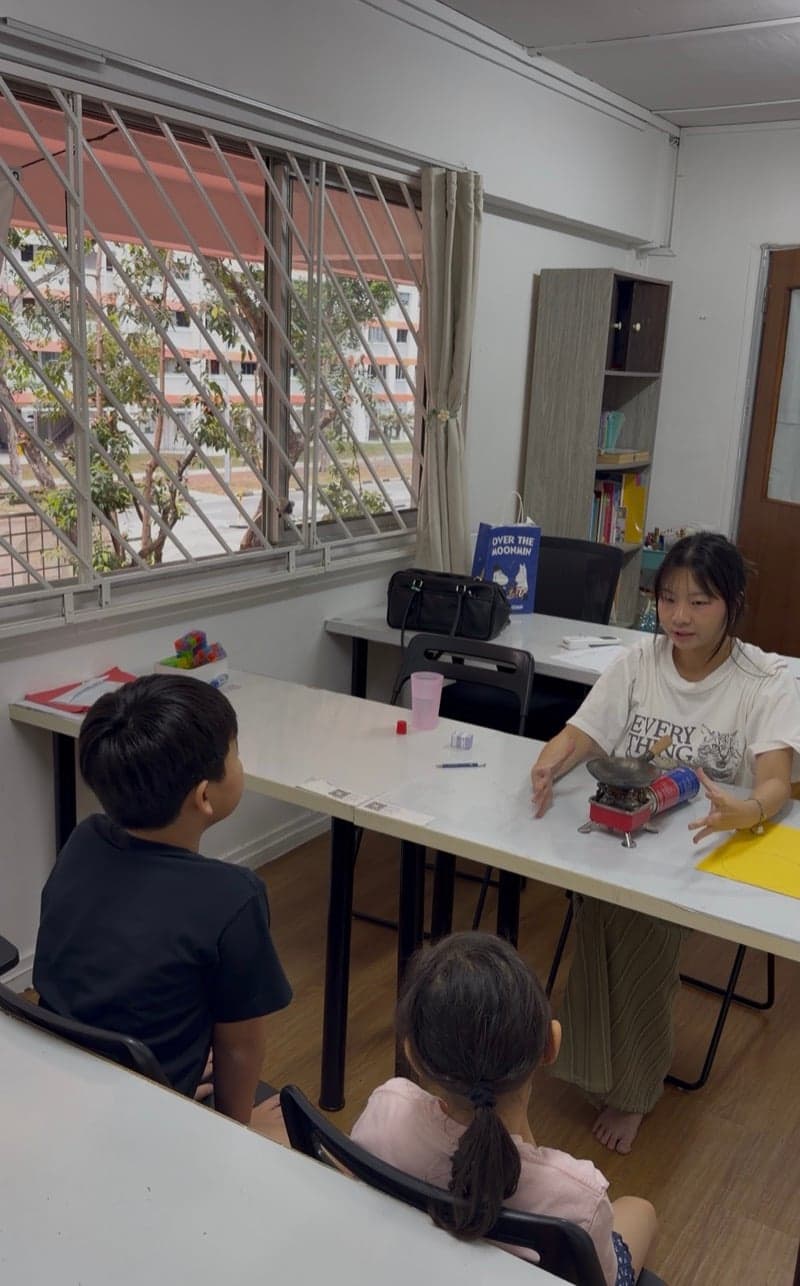
Bishan primary schools — Kuo Chuan Presbyterian, Ai Tong, and Catholic High — consistently produce students with strong Science content knowledge. The challenge for these students is not understanding concepts; it is expressing that understanding with the precision PSLE markers require. Ancourage Academy teaches P3-P6 Science in small groups of 3-6 students, focusing on the exam technique that converts content knowledge into top Achievement Level scores.
With 8 years of experience in early childhood and primary education, Charmaine has helped Bishan students close the gap between knowing and scoring — turning students who understand Science well but lose marks on paper into confident, precise examination writers.
The MOE Primary Science syllabus covers five themes (Diversity, Cycles, Systems, Interactions, Energy) in a spiral structure from P3 to P6. For most Bishan students from rigorous schools, the curriculum content itself is rarely the problem. The issue is that the PSLE increasingly tests application of knowledge in unfamiliar contexts, not recall of memorised facts — and this is where even strong students stumble.
Book a trial class (usually $18) at Ancourage Academy's Bishan centre for a diagnostic Science assessment that identifies exactly where your child's exam technique needs strengthening.
P3-P4: Where Bishan Students Are Usually Strong
Students from Kuo Chuan Presbyterian, Ai Tong, and Catholic High typically handle P3-P4 Science well due to strong school rigour — the foundation years are where these schools invest heavily in structured Science instruction.
P3 introduces formal Science with topics like classifying living things, material properties, and magnets, alongside the process skills (observing, comparing, classifying, inferring) that underpin every future examination — see the Primary 3 Science transition for what to expect in this first year. P4 builds on this with systems thinking — heat energy, light, the digestive system, and plant parts and their functions.
For Bishan students at these schools, P3-P4 tuition is typically only needed if a child has specific content gaps or struggles with the transition from informal to scientific language. Most Bishan families first notice the need for Science support at P5, when the curriculum makes a significant leap in complexity and written answer expectations.
Ancourage Academy's P3 and P4 Science programmes focus on building precise scientific vocabulary early so students do not develop informal language habits that are harder to correct later. See all our Primary Science levels for the full P3-P6 overview.
P5: The Application Gap Appears
P5 is when Ancourage Academy first sees Bishan students who score 85+ on school tests but 70 on practice papers — a gap that reveals the difference between school-calibrated assessments and PSLE-standard questions.
School tests often match the textbook examples students have studied, while PSLE deliberately presents familiar concepts in unfamiliar scenarios. A student who memorised the standard metal-spoon example may freeze when the question uses a plastic-handled saucepan or a foam cup of soup — even though the underlying concept (heat flows from the hotter object to the colder one, faster through good conductors than poor ones) is identical.
P5 also introduces abstract topics that require more than recall:
- Electrical systems: Predicting what happens when circuit components change — requires spatial reasoning
- Plant and human reproduction: Multi-step processes requiring sequential explanation
- The water cycle: Evaporation and condensation and the changes of state that move water between land, sea and atmosphere — frequently tested in unfamiliar contexts, such as why a cold glass develops droplets on its outside
Ancourage Academy's P5 Science programme specifically targets this application gap. Students practise answering questions they have never seen before — building the flexible thinking that PSLE demands and school revision alone does not develop.
P6: Precision Under Pressure
The PSLE Science paper comprises Booklet A (30 MCQ, 60 marks) and Booklet B (10-11 open-ended questions, 40 marks) — and for high-performing Bishan students, the path to AL 1-2 runs through Booklet B precision.
P6 consolidates all P3-P5 content and adds energy conversion, forces, and environmental interactions. The real challenge is integration across all four years. For example, a question about why food rots faster in a warm kitchen involves heat energy (P4), microorganism activity (P3 living things), and interaction with the environment (P6). Students who revised each topic as an isolated chapter cannot make these cross-topic connections under timed conditions.
For students aiming for AL 1-2, time management becomes critical. High-performing students need to complete Booklet A in 30-35 minutes to leave 40+ minutes for Booklet B. Many Bishan students who score well in school lose PSLE marks because they spend too long double-checking MCQ answers, leaving insufficient time for the open-ended questions in Booklet B, worth 40 of the paper's 100 marks.
Ancourage Academy's P6 Science programme drills timed Booklet A + B practice under exam conditions weekly, building the pace and confidence students need. See the PSLE Science guide for Bishan schools for detailed school-specific strategies.
Precision Answering: From "Mostly Right" to Full Marks
High-performing Bishan students often get 1 out of 2 marks on open-ended questions — they state the correct fact but omit the linking explanation that earns the second mark. Closing this gap is the fastest route to AL improvement.
The 2-Mark Trap
Many 2-mark questions require both a statement and an explanation. Writing "Heat is transferred from the hot water to the cold spoon" earns 1 mark. Adding "by conduction, as the metal spoon is a good conductor of heat" earns the full 2 marks. Ancourage Academy tutors call this the "2-mark trap" because students who understand the concept consistently leave the linking sentence out, assuming the marker can infer what they mean.
The pattern is: What happens + How/Why it happens = Full marks. Students drill this pattern on every topic until it becomes automatic.
Eliminating Careless MCQ Errors
For students already scoring 24-27 out of 30 on Booklet A, the fastest improvement route is not learning new content — it is eliminating 2-3 careless MCQ errors per paper. Ancourage Academy teaches three MCQ habits: read ALL four options before selecting (avoid anchoring on the first plausible answer), underline "NOT" and "EXCEPT" in question stems, and sketch quick diagrams for forces and circuits questions rather than solving them mentally. These habits are especially important for thorough students from Catholic High and Ai Tong who sometimes overthink MCQ questions.
For a comprehensive guide to answering frameworks, see the Primary Science answering techniques article.
School-Specific Science Approaches in Bishan
Different Bishan primary schools develop different Science strengths in their students, and understanding these patterns allows Ancourage Academy tutors to provide targeted support that fills specific gaps rather than repeating what schools already do well.
Kuo Chuan Presbyterian Primary School
KCPPS runs the E-Cube (Engage, Excite, Express) Applied Learning Programme, which develops confident communicators through drama, choral reading, and skits on social issues that Primary 3 to 5 pupils co-write with their teachers and present to the public. The school also has a dedicated Science laboratory where students conduct hands-on investigations. Students from Kuo Chuan tend to be comfortable with practical applications and show genuine curiosity during experiments.
The gap Ancourage Academy tutors commonly see is in converting that hands-on understanding into precise written language. A KCPPS student might know exactly why a circuit does not work after rewiring it in the lab, but when asked to explain the same concept in writing, they use informal language like "the electricity cannot flow" instead of "the circuit is incomplete because there is a gap in the conducting path, so current cannot flow." Ancourage Academy's sessions with KCPPS students focus heavily on keyword precision and structured answer writing to translate their practical knowledge into examination marks.
Ai Tong School
Ai Tong's disciplined academic environment produces students with strong content recall and systematic study habits. These students tend to score well on multiple-choice questions because they can identify correct facts quickly. Their revision is typically thorough and their factual knowledge is solid.
Where Ai Tong students often need support is in application questions that present familiar concepts in unfamiliar contexts. They memorise model answers effectively, but when a question twists the scenario — asking about heat transfer in a cooking pot instead of the usual metal spoon example — they struggle to adapt. Ancourage Academy tutors help Ai Tong students build flexible thinking by exposing them to varied question contexts and teaching them to identify the underlying concept regardless of the surface scenario.
Catholic High School (Primary)
Catholic High's rigorous SAP curriculum develops systematic thinkers with strong logical reasoning. These boys tend to approach Science methodically, following structured frameworks well and showing high work ethic during revision. Their answers are usually well-organised.
The area where Catholic High students sometimes need additional support is creative application — questions that require lateral thinking or have multiple valid approaches. Systematic learners can be thrown by questions that do not fit neatly into a familiar pattern. Ancourage Academy tutors also work on speed optimisation, as thorough Catholic High students sometimes write excessively detailed answers that eat into time for other questions. The sessions teach them to identify exactly what each question requires and to answer with precision rather than volume.
When to Start Science Tuition: A Decision Matrix
The right time for Science tuition depends on your child's current performance level and the type of gap — content, technique, or application.
| Current Score Range | Likely Gap Type | Recommended Start |
|---|---|---|
| 85+ consistently | Exam technique only (MCQ speed, open-ended precision) | P5 Term 3 — focus on refinement for PSLE |
| 70-84 | Application gap (knows content, struggles with unfamiliar questions) | P5 Term 1 — close the application gap before P6 intensity |
| Below 70 | Content gaps from P3-P4 compounding at P5 | P4 Term 3 — address foundational gaps before P5 complexity hits |
For Bishan students from rigorous schools, the most common scenario is the 70-84 range: strong content recall from school revision but inconsistent performance on questions that present familiar concepts in new contexts. This application gap is best addressed before P6, when PSLE preparation adds time pressure.
"The Bishan students I work with rarely have knowledge gaps — they have technique gaps," notes Charmaine, Early Childhood & Primary Education Specialist at Ancourage Academy. "A student who scores 90 on school tests and 78 on practice papers does not need more content revision. They need to practise answering questions they have never seen before, under timed conditions, with feedback on exactly where their marks are leaking."
Book a trial class (usually $18) at Ancourage Academy's Bishan centre to see how Ancourage Academy tutors identify and address your child's specific gaps. You can also visit the Bishan centre to learn more about Ancourage Academy's programmes, or WhatsApp us with any questions.
Home Science Practice to Complement Tuition
Students who practise Science between tuition sessions improve faster — but the right kind of practice matters more than the amount.
- Explain concepts aloud: Ask your child to teach you one Science concept per week using proper scientific vocabulary. If they cannot explain it clearly, they have not truly understood it. This "teach-back" method is the single most effective revision technique for Science
- Cross-topic connections: When revising, challenge your child to link the current topic to something from a previous year. "How does what you learnt about heat energy in P4 connect to this P6 question about food preservation?" Building these connections prepares students for PSLE questions that combine multiple topics
- Read Science in context: News articles about the environment, health, or technology provide real-world applications of syllabus concepts. When your child reads about water purification or solar energy, ask them to identify which Science topics apply
- Practise open-ended answers in writing: Have your child write out full answers to past paper questions, then check whether they included both the "what happens" and the "how/why" components. This addresses the 2-mark trap described above
Parents do not need to be Science experts. The most helpful role is asking questions that require your child to articulate their understanding, and ensuring they practise writing answers rather than only reading model answers.
Common Questions About Science Tuition in Bishan
What makes P3 Science difficult for students?
The challenge is not content difficulty but learning to communicate scientifically. Students must shift from everyday language to precise scientific vocabulary and from casual observation to structured reasoning. This transition is harder for students without prior exposure to inquiry-based thinking.
My child understands Science but keeps getting 1/2 on open-ended — why?
This is the "2-mark trap" — the most common issue for high-performing Bishan students. They state what happened but omit the linking explanation. In a 2-mark "explain why the ice melted" question, "the ice melts" restates the question and scores nothing on its own; the answer that earns both marks says "the ice gains heat energy from the warmer surroundings and melts, changing from a solid to a liquid." Marks follow the specific question's mark scheme, so Ancourage Academy drills the "what happens + how/why" pattern until it becomes automatic.
Is Science tuition needed for students already scoring AL 3-4?
It depends on the target. Students scoring 75-84 (AL 3-4) who want to push to AL 1-2 (85+) benefit from exam technique refinement — MCQ error elimination, timed Booklet B practice, and cross-topic integration questions. Students comfortably at 90+ typically do not need tuition unless they want structured PSLE preparation that school revision does not provide.
Which P5-P6 Science topics are hardest?
Electrical circuits and energy conversion consistently produce the most errors in P5-P6 Science. Circuits require predicting outcomes when components change in series and parallel configurations. Energy conversion questions require tracing energy through multiple stages and expressing the transformation chain precisely using scientific terminology.
Related reading: P2-P4 Maths Tuition in Bishan · Primary English Tuition in Bishan · Primary Chinese Tuition in Bishan · PSLE Science for Bishan Schools · Primary Science Answering Techniques · Bishan parents' guide · Pricing