
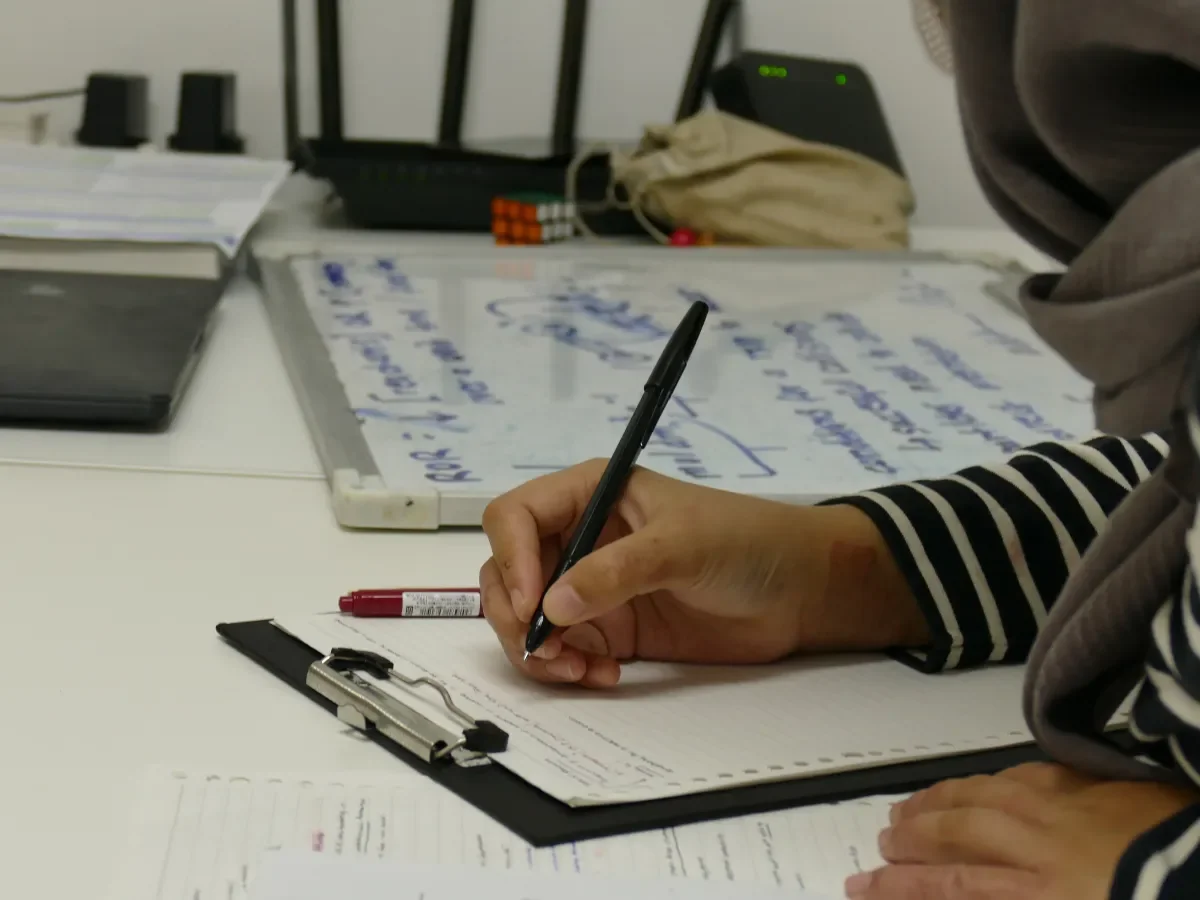
Ancourage Academy in Bishan helps Primary 2 to Primary 4 (P2-P4) students build the Mathematics foundations that determine PSLE success years later. Ancourage Academy's small groups of 3-6 students and ESB (Ebbinghaus, Socratic, Bruner) methodology allow tutors to identify and close gaps at the exact point where each child's understanding breaks down — before those gaps compound into larger problems at upper primary.
As a mathematics educator with over 11 years of experience, Min Hui has guided hundreds of students through the critical P2-P4 transition — the years where abstract mathematical thinking either takes root or gaps begin to compound.
Primary 2, 3, and 4 are arguably the most important years in a child's Mathematics journey. These are the years when maths transitions from concrete counting to abstract reasoning — from adding apples to understanding fractions of wholes. For Bishan parents, getting the foundations right during P2-P4 means your child enters upper primary with confidence rather than anxiety. This guide explains what happens at each level, what to watch for, and how schools in your neighbourhood approach these critical years.
What P2, P3, and P4 Mathematics Covers
Each year from P2 to P4 introduces concepts that PSLE Mathematics tests at a higher level: P2 makes times-table recall automatic, P3 stretches fractions and the bar model into multi-step problems, and P4 adds decimals, angles and word problems chaining 2-3 operations — weaknesses left unaddressed here compound rapidly in upper primary. The progression follows the MOE Primary Mathematics syllabus:
- P2 is when Mathematics becomes computational. Automatic recall of times tables (2, 3, 4, 5, 10) is the single most important P2 skill — students who leave P2 still counting on fingers will struggle with every subsequent topic. Ancourage Academy's P2 Mathematics programme builds this fluency through spaced repetition.
- P3 stretches fractions, introduced in P2, and the bar model into multi-step problems, and these are the two concepts most correlated with PSLE success. Students who grasp these confidently in P3 tend to remain strong through to PSLE. Those who do not often begin a decline that becomes harder to reverse each year. See Ancourage Academy's P3 programme.
- P4 bridges to upper primary with decimals, angles, and multi-step word problems requiring 2-3 operations in sequence. The decimal-fraction connection (understanding that 0.75 and 3/4 are the same value) becomes essential for P5-P6 percentage and ratio work. See the P4 programme.
If your child needs Maths support, Ancourage Academy at our Bishan centre offers targeted Primary Maths tuition in small groups of 3–6 — book a trial class (usually $18) for a diagnostic assessment.
For detailed topic breakdowns, common mistakes at each level, and practice strategies, see the complete guide to common primary maths mistakes in Singapore. For P5-P6 PSLE preparation, see the Upper Primary Maths guide for Bishan, or view our Primary Mathematics programme (P1-6) for the full range of levels.
School-Specific Approaches for Bishan Students
Bishan's primary schools each have distinct academic cultures that shape how students learn Mathematics. Understanding your child's school environment helps Ancourage Academy tutors tailor the tutoring approach to complement rather than conflict with what they learn in class. Here is what Ancourage Academy has observed from teaching students across Bishan's major primary schools.
Kuo Chuan Presbyterian Primary School (KCPPS)
KCPPS runs the E-Cube (Engage, Excite, Express) Applied Learning Programme, which develops civic awareness and confident communication through drama, choral reading, and skits on social issues that Primary 3 to 5 pupils co-write with their teachers and present to the public. The school's balanced academic culture produces students who are generally articulate and confident learners across subjects including Mathematics.
However, KCPPS students at Ancourage Academy sometimes show gaps in procedural fluency. Common areas they need support with:
- Structured heuristics: Students generate creative solutions but may not present working in the format that earns method marks
- Times table speed: Conceptual understanding is strong but automatic recall may lag behind more drill-focused schools
- Fraction procedures: Students understand what fractions mean but may be slower with mechanical operations like finding common denominators
Ancourage Academy complements the KCPPS approach by adding procedural practice alongside their strong conceptual base. These students usually respond well to timed challenges and structured methods because they already understand the "why" — they just need practice with the "how."
Ai Tong School
Ai Tong is a SAP (Special Assistance Plan) school under the Singapore Hokkien Huay Kuan, where every pupil takes Chinese or Higher Chinese alongside a rigorous academic programme. The school's disciplined culture produces students with strong study habits and a methodical approach to work.
The specific challenge for Ai Tong students in Mathematics is time allocation. Because Higher Chinese Language demands significant curriculum time, Ai Tong students may have slightly fewer hours of dedicated maths practice compared to non-SAP schools. This does not affect their ability — Ai Tong students are typically capable and hardworking — but it means their revision must be more efficient and targeted.
Common areas Ancourage Academy addresses with Ai Tong students:
- English maths vocabulary: Strong Chinese foundations sometimes mean less familiarity with English mathematical terms like "remainder," "quotient," or "denominator"
- Method flexibility: The disciplined approach can create preference for one method even when a problem requires a different strategy
- Word problem interpretation: Bilingual students occasionally misread English-language word problems, particularly problems with complex phrasing
Ancourage Academy's approach for Ai Tong students focuses on high-yield topics and efficient practice. Rather than broad revision, tutors identify the specific topics where each student loses marks and target those directly. This respects their busy schedule while ensuring their Mathematics keeps pace with their strong Chinese results.
Catholic High School (Primary)
Catholic High is an all-boys SAP school with a reputation for academic rigour and competitive excellence. Students in this environment are typically driven, ambitious, and accustomed to high expectations from both teachers and peers.
The competitive atmosphere produces strong work ethic, but it can also create specific challenges:
- Perfectionism under pressure: Some boys freeze on questions they cannot solve immediately rather than attempting a partial solution
- Speed over accuracy: The competitive drive can lead to rushing through problems, producing careless errors
- Resistance to new methods: Boys who are accustomed to their school's approach may resist alternative strategies even when those strategies are more efficient for certain problem types
Ancourage Academy helps Catholic High students channel their competitive energy productively. The small group setting allows them to compete with peers at similar levels while learning to approach difficult problems strategically — attempting partial solutions, using estimation to check answers, and building resilience when a first attempt does not work.
How Bishan's School Culture Shapes Maths Learning
Bishan's concentration of SAP schools in District 20 creates a distinct academic environment that directly influences how children experience Mathematics. Catholic High and Ai Tong are both SAP schools, meaning every pupil at these schools takes Chinese or Higher Chinese alongside an already demanding academic programme. The additional language load reduces available study time for Mathematics practice, making tuition sessions more valuable because they need to be efficient and targeted.
The competitive culture across Bishan schools — particularly in all-boys Catholic High — means students often benchmark themselves against high-performing peers. While this drives ambition, it can also create anxiety around Mathematics. Students who score 80 out of 100 may feel inadequate when classmates score 95. Ancourage Academy's small group setting provides a calmer environment where students can focus on closing their own gaps rather than competing.
KCPPS offers a different dynamic. Its E-Cube ALP develops creative expression rather than academic competition, producing students who are confident thinkers but may need more structured procedural practice for exam-format Mathematics. Understanding which school your child attends helps Ancourage Academy tutors calibrate the right balance of conceptual exploration and procedural drilling.
Common P2-P4 Maths Mistakes to Watch For
Each level has characteristic mistakes that signal underlying gaps rather than simple carelessness. The most common patterns Ancourage Academy tutors see in Bishan students: fraction misconceptions in P3 (believing 1/8 is larger than 1/4), multiplication reversal in P2, and multi-step errors in P4 where students get the first step right but carry the wrong value forward.
"The most common pattern I see is parents attributing fraction errors to carelessness, when the child actually has a fundamental misconception about what fractions represent," notes Min Hui, Founder and Academic Director at Ancourage Academy. "Once we address the visualisation gap — showing them what 3/4 actually looks like compared to 2/3 — the procedural errors resolve themselves."
For a comprehensive breakdown of mistakes by level and how to address them, see the guide to common primary maths mistakes in Singapore.
When Should Bishan Parents Start Maths Tuition?
The right time to start is when you notice a gap forming, not when results have already declined significantly. In Ancourage Academy's experience, the most effective intervention window is P2-P3, when foundational concepts are being introduced and gaps are still small enough to close quickly.
Consider seeking support if your child:
- Cannot recall multiplication tables fluently by the end of P2
- Shows confusion or frustration with fractions in P3
- Struggles to set up bar models for word problems
- Scores more than 15% below their class average consistently
- Avoids maths homework or becomes emotional when practising
You do not need to commit to long-term tuition to find out whether your child would benefit. The trial class (usually $18) at Bishan is designed specifically for assessment — Ancourage Academy tutors evaluate your child's current level, identify specific gaps, and give an honest recommendation on whether tuition would help or whether targeted home practice would be sufficient. The small class sizes of 3-6 students mean your child gets genuine individual attention even in a group setting. You can also WhatsApp us if you have any questions.
How Ancourage Academy Supports P2-P4 Students
Ancourage Academy's ESB (Ebbinghaus, Socratic, Bruner) methodology mirrors how children naturally learn — moving from concrete understanding to abstract mastery. With small classes of 3-6 students, every child receives direct tutor interaction during each lesson. This is fundamentally different from school classrooms of 30-40 students, where a teacher cannot monitor every child's working in real time. Learn more about the ESB approach.
Getting to Ancourage Academy Bishan
Ancourage Academy Bishan is at 152 Bishan Street 11, about a six-minute walk from Kuo Chuan Presbyterian Primary and a short bus or MRT ride from the other Bishan primary schools.
- By MRT: Approximately 10-minute walk from Bishan MRT (NSL/CCL interchange, NS17/CC15). Exit towards Bishan Street 11
- By bus: Bus routes 54, 56, and 410G stop within a 2-3 minute walk of the centre
- Driving: HDB parking lots along Bishan Street 11 are readily available. Weekend drop-off is straightforward with short waiting time along the access road
KCPPS, Ai Tong, and Catholic High Primary are all within the Bishan-Ang Mo Kio area (District 20), making after-school tuition sessions logistically convenient for families. Many parents drop off their children directly after school dismissal.
Common Concerns From Bishan Parents
These are the questions Ancourage Academy hears most frequently from parents in the Bishan area:
- "Will my child cope with Higher Chinese AND Maths tuition at a SAP school?" — Yes. Ancourage Academy's targeted approach means sessions focus on the specific topics where your child loses marks, not broad revision. This respects their busy schedule while keeping Mathematics on track alongside their Chinese commitments
- "My child's school uses inquiry-based methods but PSLE requires procedural speed — how do you bridge this?" — Ancourage Academy adds procedural practice and exam technique alongside the strong conceptual understanding that schools like KCPPS develop. Students learn to present their reasoning in the format that earns method marks
- "How do Bishan schools compare to each other for P3 Maths readiness?" — Each school has strengths. KCPPS develops creative problem-solving, Ai Tong builds discipline and routine, Catholic High fosters competitive drive. The key is identifying which school-specific gaps your child has and addressing those directly
For families in the northern corridor, see the P2-P4 Maths guide for Woodlands. You can also WhatsApp us if you have any questions.
Common Questions About P2-P4 Maths Tuition in Bishan
What do P2 students commonly struggle with in Mathematics?
The most common P2 struggle is multiplication table fluency. Students may understand multiplication conceptually but cannot recall facts quickly enough for timed work. Division, multi-step problems, and mental calculation all depend on instant recall of times tables (2, 3, 4, 5, 10).
Is the P3-P4 difficulty jump really that big?
Yes. Fractions start at P2 under the MOE Primary Mathematics syllabus, while the bar model is used from the early primary years — and P3 is where both are stretched into multi-step problems — a real step up from anything before. Fractions require understanding parts of a whole rather than counting discrete objects. P4 then adds decimals and multi-step problems. Students shaky on P3 fractions typically struggle substantially in P4.
How much does P2-P4 Maths tuition cost in Bishan?
Ancourage Academy offers competitive group tuition rates for small classes of 3-6 students. Fees vary by level and frequency. Visit the pricing page for packages and what is included, or book a trial class (usually $18) to experience the teaching approach before committing.
When should my child start Maths tuition?
Start when you first notice a persistent gap — not after results have dropped significantly. P2-P3 is ideal because gaps are still small and concepts build directly on each other. Waiting until P5-P6 means addressing compounded gaps under PSLE pressure. See the detailed guide on when to start tuition.
Related: P5-P6 Maths Tuition in Bishan · P2-P4 Maths in Woodlands · Primary English Tuition in Bishan · Primary Science Tuition in Bishan · Primary Chinese Tuition in Bishan · Common Primary Maths Mistakes · PSLE Maths for Bishan Schools · Ancourage Academy Bishan parents' guide · Pricing · Lower Primary English in Bishan (P1–P2) · a guide to Art Enrichment for Upper Primary in Woodlands · PSLE Maths Model Method guide