
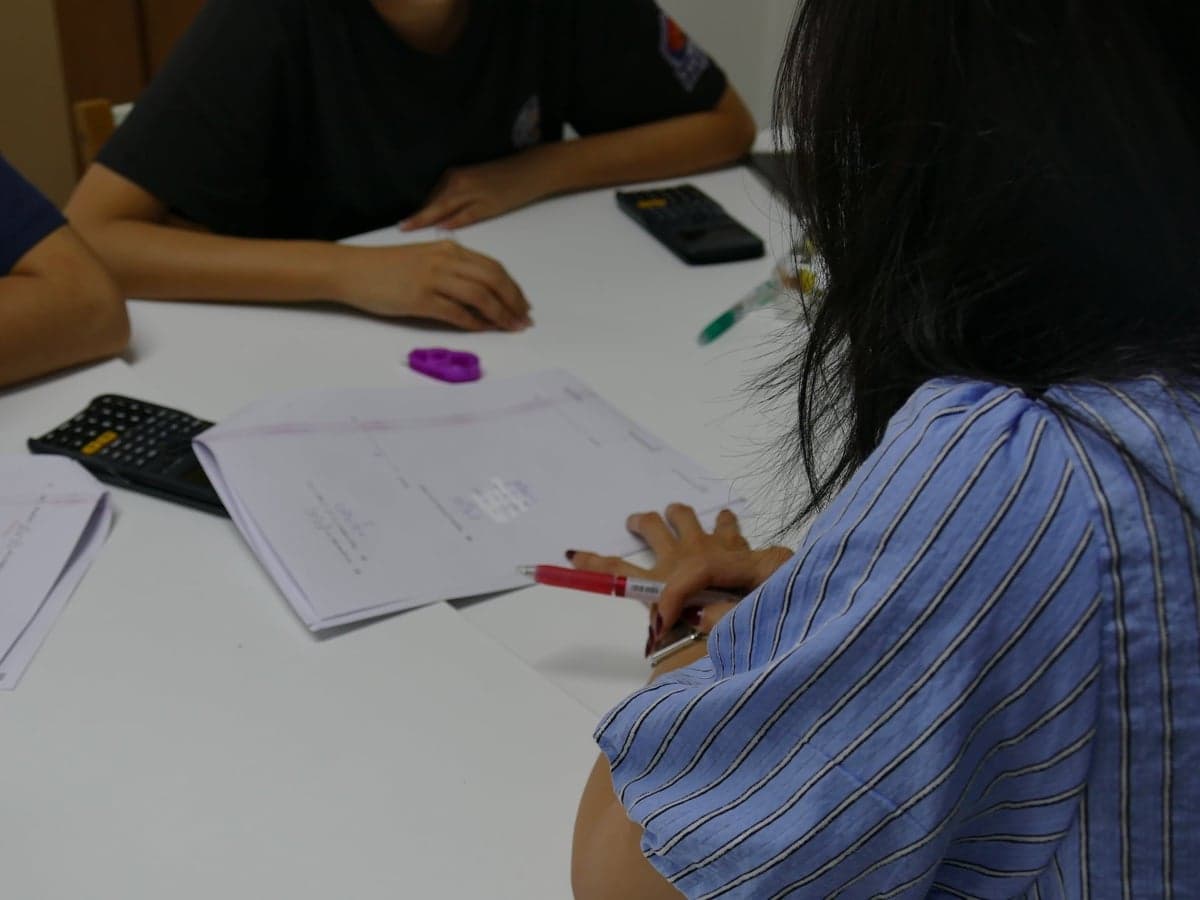
Additional Mathematics (A-Maths) is the secondary school subject with one of the steepest learning curves — and most students who struggle are not bad at Maths, they are unprepared for the shift from procedural calculation to abstract reasoning — a pattern Ancourage Academy sees across every new A-Maths cohort. The A-Maths syllabus (O-Level 4049; SEC G3 K341 from 2027) introduces calculus, advanced trigonometry, and algebraic proofs that have no equivalent in E-Maths. At Ancourage Academy, many of the Sec 3 students who join for A-Maths tuition describe the same experience: strong results in Sec 1-2 Mathematics, followed by a sudden drop when A-Maths begins.
As Founder and Academic Director at Ancourage Academy, Min Hui has taught Additional Mathematics across multiple O-Level cohorts. This guide explains why A-Maths feels so different, identifies the three topics where most students first struggle, and provides a realistic recovery plan.
What Is Additional Mathematics and Why Is It Hard?
Additional Mathematics (A-Maths) is the Sec 3–4 elective taken alongside E-Maths that extends it into calculus, trigonometric identities and algebraic proof — and it feels hard because it demands a fundamentally different type of mathematical thinking, with the transition happening abruptly at the start of Sec 3.
In E-Maths, most questions follow a recognisable procedure: identify the formula, substitute values, and calculate. A-Maths requires students to manipulate expressions, prove identities, and apply concepts in unfamiliar contexts. There is no single "right method" for many questions — students must decide which approach to use, and this decision-making skill takes time to develop.
The SEAB syllabus 4049 covers topics that are conceptually new to most students: differentiation and integration (calculus), trigonometric identities and equations, surds and indices at an advanced level, and coordinate geometry involving circles and tangents. These topics build on each other, so falling behind in one creates a cascading effect.
The good news: A-Maths difficulty is front-loaded. Most students find Sec 3 harder than Sec 4 because the foundational concepts are being learned for the first time. By Sec 4, with sufficient practice, patterns become familiar and speed improves.
The Three Topics Where Most Students First Struggle
Based on patterns observed across Ancourage Academy's Sec 3 and Sec 4 cohorts, three topic areas account for the majority of early A-Maths failures: trigonometric identities, surds and indices manipulation, and the transition to calculus.
- Trigonometric identities and equations: Students must prove that one expression equals another using identities like sin²x + cos²x = 1, which requires working backwards from the answer — a skill that feels counterintuitive. Many students can substitute values but cannot manipulate the expressions algebraically.
- Surds and indices: Advanced manipulation of expressions with roots and powers is a prerequisite for almost every other A-Maths topic. Students who do not master this early find every subsequent chapter more difficult.
- Calculus (differentiation and integration): The concept of rates of change and area under curves is genuinely new. Students who have never encountered the idea of a derivative often need 4-6 weeks of focused practice before the concept clicks.
If your child is struggling with A-Maths, identifying which of these three areas is the primary bottleneck is the first step. A student who understands calculus but struggles with trigonometric identities needs very different support from one who cannot differentiate basic functions.
Book a trial class (usually $18) at Ancourage Academy — Bishan or Woodlands — for a diagnostic assessment of your child's A-Maths gaps. Small groups of 3-6 allow tutors to identify specific weak areas in the first session.
How to Diagnose Where Your A-Maths Foundation Broke
The fastest way to diagnose A-Maths gaps is to review the most recent test or exam paper question by question, categorising each error as a conceptual gap, an algebraic manipulation error, or a question interpretation problem.
- Conceptual gaps: The student does not understand what the question is asking or which concept to apply. This is the most serious type of gap and requires re-teaching of the underlying concept, not more practice questions.
- Algebraic manipulation errors: The student knows the approach but makes errors in simplification, factorisation, or rearrangement. This is common and improves with targeted algebraic practice — often E-Maths level algebra drills are the right starting point.
- Question interpretation: The student can solve familiar question types but freezes when the question is presented differently. This requires exposure to varied question formats, typically through past papers from multiple schools.
A student with mostly conceptual gaps needs tuition that re-teaches topics from scratch. A student with manipulation errors may benefit from a focused algebra bootcamp. A student with interpretation issues needs timed practice with varied papers.
What Is a Realistic 3-Month A-Maths Recovery Plan?
A student who is currently failing A-Maths can realistically improve to a C5-C6 — the conventional O-Level pass; the SEC G3 certificate is awarded from E8 — within 3 months of focused, diagnostic-based revision, but the approach must be targeted, not blanket revision.
The 3-month plan:
- Month 1 — Foundation repair: Focus exclusively on the 2-3 weakest topics. Do not attempt full papers yet. Use topical worksheets and work through solutions step by step. If surds/indices is weak, spend 2 weeks on this alone — it unlocks every other topic.
- Month 2 — Expansion and connection: Add 2-3 more topics while continuing to reinforce Month 1 topics. Begin seeing connections between topics (e.g., how differentiation applies to coordinate geometry). Start doing individual paper sections, not full papers.
- Month 3 — Exam readiness: Full timed papers weekly. Both A-Maths papers run 2h 15min for 90 marks, so pace at roughly 1.5 minutes per mark on each; the difference is question size — Paper 1 sets 12-14 questions of up to 10 marks, Paper 2 sets 9-11 of up to 12 marks, so Paper 2 punishes getting stuck harder. Build an error journal and review it before each practice paper.
This timeline assumes 4-6 hours of A-Maths study per week (including tuition sessions). Students who can dedicate more time may see faster improvement.
Topic-by-Topic Strategies: Algebra, Trigonometry, and Calculus
Each A-Maths topic area responds to a different study strategy — rebuild fluent algebraic manipulation first, learn trigonometric identities by studying worked proofs and transforming one side only, treat calculus as rules to memorise then applications to practise, and approach coordinate geometry as the place algebra and differentiation meet — because what works for calculus does not work for trigonometric proofs.
Algebra and Equations: Mastery of algebraic manipulation is the prerequisite for everything else. Students should be able to factorise quadratics, complete the square, and solve simultaneous equations fluently before tackling advanced topics. If these skills are shaky, return to secondary maths foundations before progressing.
Trigonometry: Trigonometric identities require a different mindset — start from the more complicated side only and transform it step by step until it matches the other side. The most effective practice method is to study worked solutions of proofs, then attempt similar proofs independently, then check. Memorising the core identities (Pythagorean, double angle, addition formulae) is non-negotiable.
Calculus: Differentiation and integration follow clear rules that, once memorised, apply consistently. The difficulty is in application — knowing when to differentiate and how to interpret the result. Practice should focus on application questions (rate of change, maxima/minima, area under curve) rather than pure computation, which most students master quickly.
Coordinate Geometry: This topic connects algebra, calculus, and geometry. Students who have solid algebra and differentiation skills typically find coordinate geometry manageable. The key is practising circle equations and tangent/normal problems, which combine multiple skills in a single question.
The E-Maths Connection: Skills That Transfer
Strong E-Maths foundations directly support A-Maths — and students struggling with A-Maths often benefit from reinforcing E-Maths skills first.
Skills that transfer directly from E-Maths to A-Maths:
- Algebraic manipulation: Factorisation, expansion, simplification — the E-Maths versions of these skills are the foundation for A-Maths algebra
- Coordinate geometry basics: E-Maths gradient and length-of-a-line-segment work is the prerequisite for A-Maths coordinate geometry, which adds the midpoint formula, the parallel and perpendicular conditions, and circles
- Trigonometric ratios: E-Maths SOH-CAH-TOA extends into A-Maths identities and equations
- Graph sketching: E-Maths graphing skills transfer to A-Maths curve sketching and calculus applications
At Ancourage Academy, students taking both E-Maths and A-Maths often find that improvement in one subject accelerates improvement in the other.
When to Drop A-Maths vs When to Push Through
Dropping A-Maths is a significant decision that closes certain post-secondary pathways — it should be a last resort, not a first response to difficulty.
Consider continuing A-Maths if:
- The student aims for JC Science stream (A-Maths is assumed knowledge for H2 Mathematics)
- The student's struggles are concentrated in 1-2 topic areas rather than across the entire syllabus
- The student has not yet had targeted, diagnostic-based support (struggling alone is different from struggling with the right help)
- There are at least 6 months before the O-Level / SEC exam
Consider dropping A-Maths if:
- The student is consistently scoring grade 9 (the lowest grade on both the O-Level and SEC G3 scales) despite sustained effort and tuition support
- A-Maths preparation is severely compromising performance in other subjects
- The student's post-secondary goal does not require A-Maths (most polytechnic courses and JC Arts stream do not)
- The student is in Sec 4 with less than 4 months to the exam and has fundamental gaps across multiple topics
The subject combination guide explains how A-Maths fits into L1R5/L1R4 calculations and which pathways require it.
How Structured Tuition Accelerates A-Maths Recovery
A-Maths is one of the subjects where structured tuition has the highest impact — because the subject requires guided problem-solving practice, not just content knowledge.
Self-study works for content subjects where reading and memorisation are the primary activities. A-Maths requires students to attempt problems, receive feedback on their approach (not just the answer), and learn alternative methods. This feedback loop is difficult to create alone.
At Ancourage Academy, A-Maths tuition follows a diagnostic model: the first session identifies the specific topics and error types that are causing the most mark loss. Subsequent sessions target those areas directly, with the tutor modelling problem-solving approaches and gradually shifting responsibility to the student. With 3-6 students per class, there is sufficient individual attention to address each student's specific gaps.
Book a trial class (usually $18) at Bishan or Woodlands for an A-Maths diagnostic — or WhatsApp Ancourage Academy to discuss your child's A-Maths situation.
Common Questions About Struggling with A-Maths
Is it too late to improve A-Maths if I am failing in Sec 4?
Not necessarily. With 6 or more months before the O-Level / SEC exam, a student who commits to 4-6 hours of focused A-Maths study per week can realistically improve from grade 9/E8 to C5/C6. The key is diagnostic-based revision — targeting the specific topics where marks are being lost rather than re-studying everything. With less than 4 months remaining, improvement is still possible but the gains will be smaller.
Can I drop A-Maths after starting in Sec 3?
Yes, but check with the school first — some schools have cut-off dates for subject changes. If you drop A-Maths, it will not appear on your O-Level / SEC certificate. However, dropping it makes the JC Science stream considerably harder to enter — most JCs expect A-Maths for H2 Mathematics at A-Level, though some offer bridging support.
How many hours per week should I spend on A-Maths revision?
For a struggling student aiming to pass, 4-6 hours per week is a reasonable minimum — this includes tuition sessions and self-practice. For a student aiming for B3 or higher, 6-8 hours per week with a mix of topical practice and timed papers is more appropriate. Quality matters more than quantity: 2 hours of focused, diagnostic-based practice is more effective than 4 hours of unfocused repetition.
Does A-Maths get easier over time or does it keep getting harder?
A-Maths difficulty peaks in the middle of Sec 3 when the core concepts (trigonometric identities, calculus) are first introduced. Once these fundamentals are understood, Sec 4 topics build on them in predictable ways. Most students find Sec 4 A-Maths more manageable than Sec 3, provided the Sec 3 foundations are solid. The exam-year focus on past paper practice also helps because students become familiar with question patterns.
Is A-Maths necessary for JC Science stream?
Usually, but it depends on the JC. Some colleges — Hwa Chong Institution, for example — make H2 Mathematics compulsory for every Science combination, and H2 Maths assumes A-Maths knowledge; others require only two H2 subjects from the Mathematics and Sciences group, so H1 Mathematics stays possible. Students who did not take A-Maths are usually advised toward H1 Mathematics, though some JCs allow H2 Maths with bridging support. That restricts university course options, particularly for engineering, computing, and quantitative sciences. For the bridging and H1-Maths options if you did not take A-Maths, read whether you need A-Maths for H2 Math.
Visit Ancourage Academy at Bishan or Woodlands, check the A-Maths programme, or WhatsApp Ancourage Academy with any questions.
Related: Choosing between E-Maths and A-Maths · Secondary Maths Strategies · Sec 3 Subject Combinations · Secondary to JC Transition · H2 Mathematics JC Guide · O-Level Preparation · A-Maths calculus topics · Sec 3 Maths Grade Drop · A-Maths Trigonometry Guide · A-Maths Binomial Theorem Guide · A-Maths Quadratics · A-Maths Indices & Logarithms · A-Maths Polynomials & Partial Fractions · A-Maths Coordinate Geometry · A-Maths Linear Law · How SEC 2027 Changes A-Maths