
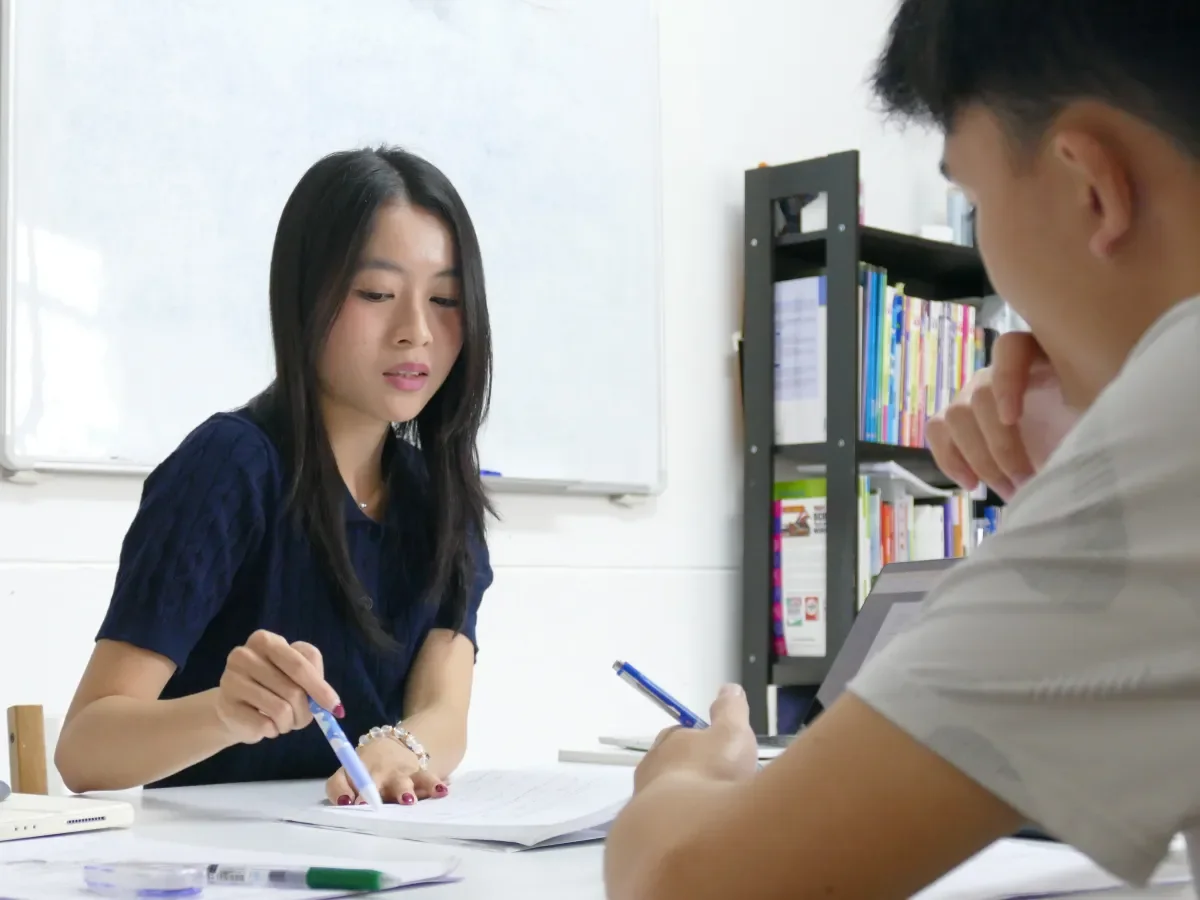
Ancourage Academy in Woodlands provides Primary 3 to Primary 6 (P3-P6) Science tuition in small groups of 3 to 6 students. Woodlands is home to some of Singapore's most inquiry-driven primary schools, including Riverside Primary, Admiralty Primary, and Si Ling Primary. Ancourage Academy helps students translate their school's hands-on learning experiences into structured, exam-ready Science answers.
With 8 years of experience in early childhood and primary education, Charmaine has helped students across Woodlands build strong Science foundations from P3 through P6.
The PSLE Science paper has two booklets: Booklet A (30 MCQ, 60 marks) and Booklet B (10-11 open-ended questions, 40 marks). The open-ended questions in Booklet B require precise scientific language and structured answering, which is where many students lose marks. Woodlands students with strong STEM school backgrounds often understand concepts well but struggle to convert that understanding into the written format examiners expect.
How the MOE Science Curriculum Progresses (P3-P6)
The MOE Primary Science syllabus uses a spiral curriculum, revisiting five core themes — Diversity, Cycles, Systems, Energy and Interactions — at increasing depth from P3 to P6.
If your child needs Science support, Ancourage Academy at our Woodlands centre offers targeted Primary Science tuition in small groups of 3–6 — book a trial class (usually $18) for a diagnostic assessment.
The five themes are Diversity, Cycles, Systems, Interactions, and Energy. Each theme appears at multiple levels with growing complexity. For instance, a student who builds a water filtration system in Admiralty Primary's DTS programme understands interactions and systems experientially, but the PSLE may test the same concepts through a diagram-based question requiring precise vocabulary like "evaporation" and "condensation" rather than hands-on demonstration. This spiral design means a gap at any level creates compounding difficulty in later years.
Understanding this progression helps parents identify whether a child's struggle is a content gap from an earlier level or a skills gap in the current year. At Ancourage Academy, the first step in every new enrolment is pinpointing exactly where the breakdown occurs so tuition targets the root cause rather than just the symptoms.
P3 Science: Building Foundations
P3 is the most critical transition year because Science is entirely new to the formal curriculum, and students must learn both content and scientific thinking simultaneously.
The P3 syllabus introduces foundational topics across several themes:
- Living and Non-Living Things: Characteristics that distinguish living organisms from non-living objects
- Animals and Plants: Classification by observable features, body parts and their functions
- Fungi and Bacteria: Basic awareness of microorganisms and their roles
- Life Cycles: Stages in the life cycles of plants and animals
- Materials: Properties such as flexibility, strength, and ability to absorb water
- Magnets: Magnetic and non-magnetic materials, attraction, repulsion, and poles
Beyond content, P3 introduces process skills that underpin every Science examination from this point forward: observing, comparing, classifying, inferring, and communicating findings using scientific vocabulary. These are not soft skills. They are assessed directly. A student who writes "the leaf is big and green" instead of "the leaf has a broad, flat blade with a smooth margin and green colouration" loses marks from the very first exam.
The P3 Science programme at Ancourage Academy focuses on building process skills alongside content knowledge. For an overview of our primary Science tuition across all levels, visit the Primary Science page. Students develop the habit of precise scientific communication from the start, which prevents the costly unlearning of informal language in later years.
P4 Science: Systems Thinking
P4 shifts from observation and classification to understanding how components work together as systems, a conceptual leap that challenges many students.
Key P4 topics include:
- States of Matter: Solid, liquid, gas and their properties; changes of state through heating and cooling
- Human System: The digestive system — identifying its parts (mouth, gullet, stomach, small intestine, large intestine) and describing their functions
- Plant System: The parts of a plant (leaf, stem, root) and the function of each
- Heat: Heat as energy, heat gain and loss, good and poor conductors of heat, the distinction between heat and temperature
- Light: Light sources, reflection, shadows, and how the eye sees objects
The heat and temperature distinction is one of the most commonly confused concepts in PSLE Science, and it originates at P4. Students who do not grasp that heat is energy while temperature is a measurement will lose marks on energy conversion questions at P6.
The P4 Science programme at Ancourage Academy uses hands-on demonstrations and structured note-taking to move students beyond memorisation into genuine understanding of how systems operate.
P5 Science: Connecting Concepts
P5 is when Science difficulty escalates sharply because the content becomes more abstract, topics interconnect across themes, and written explanation skills are tested more rigorously.
The P5 syllabus introduces several demanding topics:
- Cells: Recognising that a cell is the basic unit of life — introduced inside the P5 Reproduction topic
- Reproduction in Plants: Pollination, fertilisation, seed and fruit formation, seed dispersal
- Reproduction in Humans: Fertilisation — a sperm fusing with an egg — and recognising the same process at work in flowering plants (animal life cycles are covered earlier, in the P3 Life Cycles topic)
- The Water Cycle: Evaporation and condensation as a continuous process — frequently tested in unexpected contexts, such as why a cold glass develops water droplets on its outer surface
- Electrical Systems: Complete and incomplete circuits, conductors, insulators, series and parallel configurations
Electrical circuits are consistently one of the hardest topics across all PSLE Science papers. Students must predict outcomes when components are added, removed, or rearranged, which requires spatial reasoning and systematic logic rather than recall. The P4–P5 science difficulty jump is where Ancourage Academy sees the most new enrolments from Woodlands families. Parents often ask when to start Science tuition -- and the answer is before these gaps compound.
The P5 Science programme at Ancourage Academy addresses this by teaching students to connect concepts across topics and to express understanding in structured written answers that earn full marks.
P6 Science: PSLE Preparation
P6 consolidates all content from P3 to P5 and adds final topics, making mastery of answering technique just as important as content knowledge.
P6 topics include:
- Environmental Impact: How human activities affect ecosystems and what can be done to mitigate damage
- Interactions within the Environment: Food chains and food webs — the energy pathway from the Sun through living things and the roles of producers, consumers, predators and prey — plus adaptations, habitats, and how organism, population and community differ
- Energy Conversion and Transfer: Tracing energy changes across multiple stages in diverse contexts
- Interaction of Forces: Frictional force, gravitational force and elastic spring force — and the effects a force has on an object's motion and shape
The real challenge at P6 is integration. A question about why a plant grows better near a window involves light (P4), water transport in plants (P5), and photosynthesis (P6). Students who studied each topic in isolation often cannot connect them under exam conditions. Ancourage Academy's P6 Science programme focuses on revision across all four years combined with intensive exam technique drilling, so students enter the PSLE confident in both knowledge and execution.
Open-Ended Answering Techniques for PSLE Science
Booklet B's open-ended questions account for 40 of the 100 marks, yet this is where the majority of marks are lost -- not from missing knowledge, but from imprecise communication and poor answer structure.
Ancourage Academy teaches the CER framework (Claim-Evidence-Reasoning) for structuring open-ended answers. Many parents wonder whether Science can be made interesting for children who find it dry -- structured answering frameworks like CER help by giving students confidence in their responses:
- Claim: State the answer directly. "Plant A grew taller than Plant B."
- Evidence: Reference the specific observation or data from the question. "Plant A was placed near the window and received more sunlight."
- Reasoning: Explain the science that connects the evidence to the claim. "Sunlight is needed for photosynthesis, which produces food (glucose) for the plant to grow. With more sunlight, Plant A carried out more photosynthesis and produced more food for growth."
Three additional techniques that consistently improve Booklet B scores:
Keyword Precision
STEM students who built an actual plant irrigation system understand water transport intuitively — but the mark follows the mechanism, not the register: "water is taken in by the roots and transported through the water-carrying tubes to the rest of the plant" earns credit where "the water goes up the plant" does not, because only the first says what actually happens. The MOE syllabus is explicit that a pupil may explain using their own words, and the PSLE Science chief marker has said what loses the mark is the missing step, not the informal phrasing. The syllabus is explicit that the terms xylem and phloem, and the concept of transpiration pull, are not required at primary level. Ancourage Academy maintains keyword banks for every P3-P6 topic, helping STEM students translate their hands-on understanding into exam vocabulary.
Cause-and-Effect Chains
The CER framework structures this naturally: the Claim states the outcome, the Evidence identifies the cause, and the Reasoning explains the mechanism. Examiners reward answers following a logical sequence — "Because [concept], [process occurs], therefore [outcome]" consistently earns full marks. Students from inquiry-based STEM programmes often have the reasoning ability but need training to express it in this specific written format.
Diagram Skills
Students from inquiry-focused schools are often comfortable drawing but may not follow exam conventions — rulers for straight lines, arrows for direction, and labels placed outside the diagram with leader lines. A Riverside PlayWorks student who draws creative lab reports needs to shift to the precise, standardised scientific drawing format PSLE expects. This is a quick skill to teach once students understand the difference.
School-Specific Science Approaches in Woodlands
Woodlands primary schools emphasise STEM and sustainability more heavily than most Singapore districts, which gives students strong inquiry skills but can leave specific PSLE content areas underdeveloped.
Admiralty Primary School
Admiralty Primary runs the Design Thinking for Sustainability (DTS @ Admiralty) programme as its Applied Learning Programme. The school embeds STEM learning through eco-friendly projects where students design solutions for real environmental problems. Students participate in hands-on sustainability challenges and laboratory work that develop inquiry skills and analytical thinking.
Strengths: Students develop strong observation, hypothesis formation, and data analysis skills through their sustainability projects. They are comfortable asking questions and designing simple investigations, which aligns well with PSLE process skills.
Gaps Ancourage Academy addresses: Applied sustainability projects tend to focus on environmental topics, which means students may not get equal drilling on PSLE content areas like light, forces, electrical systems, and energy conversions that are less connected to sustainability. Additionally, project-based learning emphasises exploration over structured exam-format answering. Ancourage Academy helps Admiralty Primary students systematically cover all five PSLE themes and convert their strong conceptual understanding into precise written answers.
Riverside Primary School
Riverside Primary's Applied Learning Programme is PlayWorks, which nurtures critical and inventive thinkers through interdisciplinary inquiry. The programme uses five inventive thinking processes -- Understand, Plan, Design, Build, and Improvise -- to engage students in hands-on problem-solving. Riverside students learn to design experiments, draw conclusions from observations, and present findings creatively.
Strengths: The inquiry-based approach at Riverside aligns naturally with PSLE process skills. Students are trained to observe carefully, identify patterns, and reason through unfamiliar scenarios, which is exactly what Booklet B demands.
Gaps Ancourage Academy addresses: The inventive and creative emphasis may not translate directly into structured exam-format answering. A Riverside student might understand perfectly why a circuit does not work after experimenting with it, but when asked to explain the same concept in writing, they describe it in informal language without the clear cause-and-effect explanation a PSLE answer needs. Ancourage Academy focuses on bridging this gap between understanding and written expression for Riverside students.
Si Ling Primary School
Si Ling Primary runs a STEM-Sustainability programme through its Environmental Science Applied Learning Programme. Students engage in hands-on environmental projects that develop observational skills and ecological awareness.
Strengths: Students build strong foundations in environmental science topics, including food chains, food webs, habitats, and human impact on ecosystems. Their observational skills from field projects are typically above average.
Gaps Ancourage Academy addresses: Similar to Admiralty Primary, Si Ling's environmental focus may mean less emphasis on non-environmental PSLE topics such as electrical systems, forces, and light. Students who excel at ecology-related questions may struggle with physics-based topics that require abstract reasoning rather than observation. Ancourage Academy ensures Si Ling students receive balanced coverage across all five PSLE themes, with particular attention to the physical science topics their school programme may cover less intensively.
When to Start Science Tuition
P3 is the ideal starting point for Science tuition because the subject is entirely new to the curriculum, and early habits -- both good and bad -- shape performance for the next four years.
Consider Science tuition if a child from a STEM-focused Woodlands school shows any of these patterns:
- Demonstrates understanding in school experiments but loses marks on written test answers: This is the signature STEM-to-exam gap — hands-on competence that does not translate into clear, context-specific written explanations
- Talks about Science enthusiastically at home but produces vague, keyword-light answers on paper: The child's curiosity and conceptual grasp are strong, but they have not been trained to write in the structured format examiners expect
- Skipped foundational topics that their school's focus may not have emphasised: Schools with specialised ALPs invest heavily in their programme areas, which can mean less classroom time on physics-based PSLE topics like forces, light, and circuits
- Aces questions matching their ALP project topics (e.g., food webs, habitats) but freezes on physics-based questions: Uneven topic confidence is common when school STEM programmes specialise in certain themes
- Enjoyed hands-on Science activities in lower primary but shows growing frustration with written assessments: The transition from experiential learning to exam-format writing is where many STEM-strong students lose motivation
"Many Woodlands students understand Science concepts well from their school's STEM projects, but they lose marks because their written answers skip the step the question actually asks about," notes Charmaine, Early Childhood & Primary Education Specialist at Ancourage Academy. "Bridging that gap between understanding and exam-ready writing is often the fastest win."
The earlier these patterns are addressed, the less intensive the intervention needs to be. A P3 or P4 student with a technique gap can often close it within one term. By P6, the same gap requires much more concentrated work with PSLE approaching.
Book a trial class (usually $18) at the Woodlands centre to see how Ancourage Academy identifies and addresses specific gaps. The centre is located at Vista Point, 548 Woodlands Drive 44, a 5-minute walk from Woodlands South MRT (TE3). You can also WhatsApp us if you have any questions. For more P3 to P6 Science answering guides, browse our full Science guides hub.
Common Questions About Science Tuition in Woodlands
Is Science tuition necessary if my child's school has a strong STEM programme?
STEM programmes build strong inquiry skills, but PSLE Science is marked on written explanations: marks are awarded when the idea is expressed clearly and is relevant and scientifically accurate to the question's context. Many STEM-strong students understand concepts deeply but lose marks because their written answers are vague or ignore the context given in the question — not because they missed a fixed keyword. Ancourage Academy's small groups of 3-6 bridge this gap between understanding and examination performance.
When should Science tuition start -- P3 or later?
P3 is the most efficient starting point because Science is brand new and habits formed early persist. P4 and P5 are also effective if specific gaps are identified. The key signal is whether a child can explain concepts in writing using correct scientific terms. If they answer verbally but not on paper, tuition will help.
How does PSLE Science scoring work?
PSLE Science has two booklets: Booklet A (30 MCQ, 60 marks) and Booklet B (10-11 open-ended questions, 40 marks), completed in 1 hour 45 minutes. The score converts to an Achievement Level (AL) from 1 to 8 under the PSLE scoring system. Booklet B is where most marks are lost.
What is the class format at Ancourage Academy?
Ancourage Academy teaches Science in small groups of 3 to 6 students. Each class covers content revision and exam technique practice, with individual feedback on written answers. The small group format allows tutors to identify each student's specific gaps and address them within the same session.
Can my child take Science tuition alongside English, Maths, or Chinese at the Woodlands centre?
Yes. Many Woodlands families enrol a child in more than one subject at Ancourage Academy, since the same small groups of 3-6 run across the primary subjects at our Woodlands centre. If you are weighing which subjects to prioritise, start with the area where written answers lag understanding, then add others as needed. For deeper subject-specific guidance, see Lower Primary Maths Foundations in Woodlands, Primary English Tuition in Woodlands, or Primary Chinese Tuition in Woodlands. The simplest next step is to book a trial class (usually $18), where a diagnostic assessment shows exactly where to begin.
Related reading: Lower Primary Maths Foundations in Woodlands · Primary English Tuition in Woodlands · Primary Chinese Tuition in Woodlands · Primary Science Answering Techniques · PSLE Science for Woodlands Schools · after-school routines in Woodlands · Pricing