
Under Full Subject-Based Banding (Full SBB), secondary mathematics in Singapore is offered at three G-levels — G1, G2, and G3 — and a student's G-level for maths directly determines whether they can take Additional Mathematics, which SEC papers they sit for (the O-Level / SEC papers at G3), and which post-secondary pathways are available. Unlike the old Express/Normal Academic/Normal Technical streaming system, students can now take maths at a different G-level from their other subjects. This guide is from Ancourage Academy, whose Sec 1–4 Mathematics tutors teach across all three Full SBB levels and help students upgrade where eligible.
As Founder and Academic Director at Ancourage Academy, Min Hui has taught mathematics across all G-levels since Full SBB was implemented. This guide explains what each G-level covers for mathematics specifically, how placement works, and what upgrading or downgrading between levels involves.
What G1, G2, and G3 Mean for Maths
G-levels replace the old streaming labels (Express, Normal Academic, Normal Technical) with a subject-specific difficulty scale — G3 is the most demanding, G1 is the most foundational, and students can be at different G-levels across different subjects.
The key difference from old streaming: under the previous system, a Normal Academic student took all subjects at the same level. Under Full SBB, a student might take G3 Mathematics and G2 English — each subject is assessed independently based on the student's ability in that subject.
| G-Level | Equivalent Under Old System | SEC Exam Level (from 2027) | O-Level Equivalent (until 2026) |
|---|---|---|---|
| G3 | Express | G3-level papers | O-Level |
| G2 | Normal Academic (N(A)) | G2-level papers | N(A)-Level |
| G1 | Normal Technical (N(T)) | G1-level papers | N(T)-Level |
For more detail on how the SEC exam replaces O-Levels from 2027, see the comprehensive SEC guide.
G3 Mathematics: The O-Level / SEC Path
G3 Mathematics covers the full O-Level / SEC syllabus (currently 4052, transitioning to K310 from 2027) — it is the most demanding level and the only one that leads to G3 A-Maths (K341) and counts towards the JC L1R4 — G2 students can still take G2 A-Maths (K232).
G3 Mathematics covers:
- Number and Algebra: Numbers and operations, ratio and proportion, percentage, rate and speed, algebraic manipulation, equations and inequalities, quadratics, indices, functions and graphs, set language and Venn diagrams, matrices
- Geometry and Measurement: Angles, triangles and polygons, congruence and similarity, properties of circles, Pythagoras' theorem and trigonometry (including the sine and cosine rules), mensuration, coordinate geometry, and vectors in two dimensions
- Statistics and Probability: Data handling and analysis — tables, bar graphs, histograms, stem-and-leaf and cumulative frequency diagrams, box-and-whisker plots, mean/mode/median, quartiles, range, interquartile range and standard deviation — plus probability of single and combined events
G3 students can add Additional Mathematics (A-Maths) from Sec 3, which the JC H2 Mathematics syllabus assumes as prior knowledge.
G2 Mathematics Syllabus (K210): What It Covers and Upgrading
G2 Mathematics covers core mathematical concepts at a moderate level — equivalent to the former N(A) standard — with the possibility of upgrading to G3 for students who demonstrate strong performance.
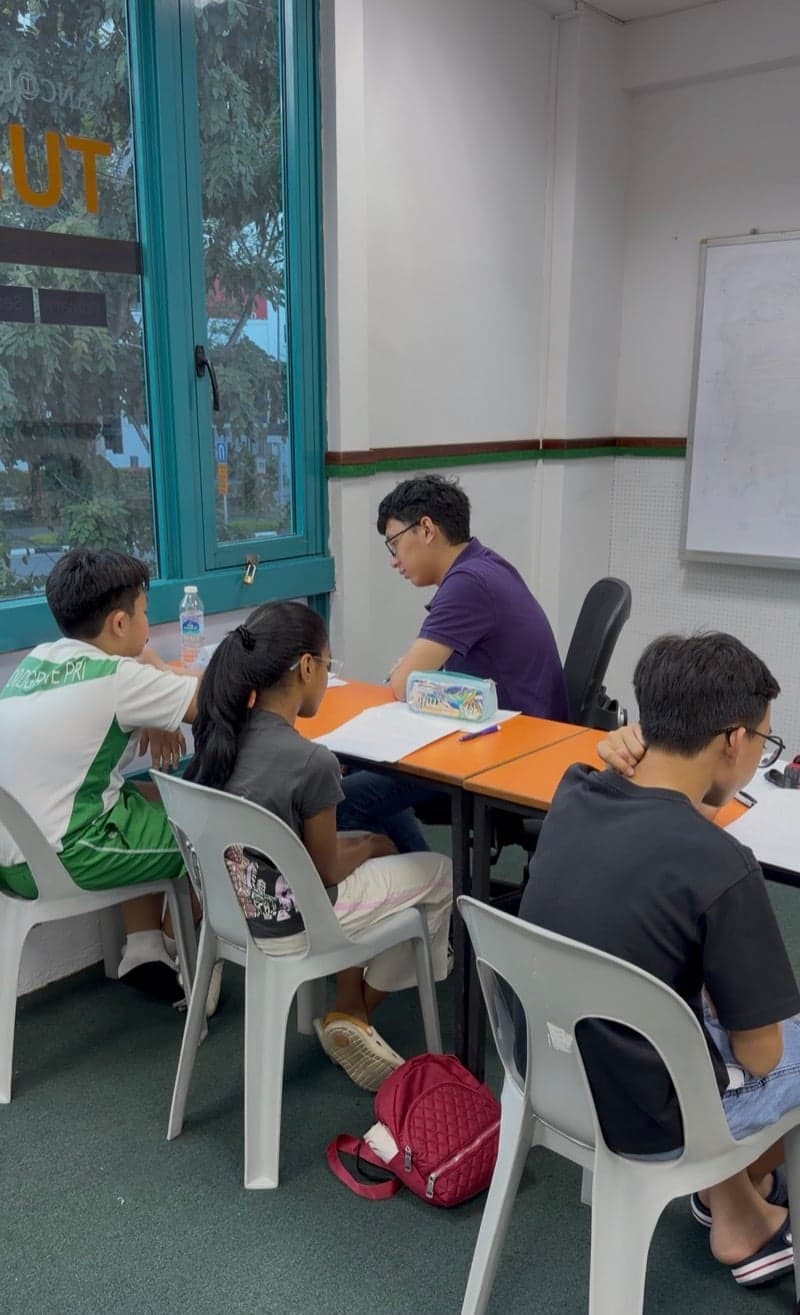
Ancourage Academy teaches both G2 and G3 Mathematics at Bishan and Woodlands in small groups of 3-6 — book a trial class (usually $18) for a diagnostic assessment at your child's current G-level.
G2 Mathematics covers similar topic areas to G3 but at reduced depth and complexity. Key differences:
- Algebraic complexity: G2 and G3 share the same algebraic-fraction and quadratic-equation content (including completing the square and fractional equations reducible to quadratics) — the G3-only algebra is sketching quadratics from the completed-square and factorised forms, and linear inequalities beyond the simple ax ⩽ b form
- Topics G2 does not cover: Set language and notation, Matrices, and Vectors in two dimensions are G3-only. G2 keeps the full trigonometry topic (including the sine and cosine rules), circle properties, standard deviation and probability of combined events — SEAB's K210 wording for those is identical to K310
Under the SEC examination system, G2 Mathematics uses syllabus code K210. G2 students may also access G2 Additional Mathematics (K232), which covers A-Maths content at G2 level.
| Aspect | G3 Mathematics | G2 Mathematics |
|---|---|---|
| Syllabus code (O/N-Level) | 4052 (O-Level) | 4045 (N(A)-Level) |
| Syllabus code (SEC 2027) | K310 | K210 |
| A-Maths available? | Yes (4049 / K341) | Yes, at G2 level (K232) |
| JC eligibility | Direct pathway to H2 Mathematics | May require upgrading for H2 Maths |
| Polytechnic eligibility | All courses | Most courses (some engineering courses prefer G3) |
| Upgrading possible? | N/A (highest level) | Yes, to G3 with school recommendation |
G1 Mathematics Syllabus (K110): Practical and Applied Focus
G1 Mathematics focuses on practical numeracy and applied mathematical skills — equivalent to the former N(T) standard — preparing students for ITE courses and vocational pathways.
Maths is one subject in a wider G1 picture. The level carries its own SEC syllabuses across every subject, plus three applied subjects that exist at no other level — Mobile Robotics, Smart Electrical Technology and Retail Operations, taught with ITE. Our G1 subjects guide lists the codes and paper structures.
G1 Mathematics covers:
- Practical arithmetic: Operations with whole numbers, fractions, decimals, percentages in everyday contexts
- Basic algebra: Simple algebraic expressions, solving basic equations
- Measurement: Units, perimeter, area, volume of common shapes
- Data handling: Reading and interpreting graphs, charts, and tables
G1 Mathematics uses syllabus code K110 under the SEC system. A-Maths is not available at G1 level. Students aiming for polytechnic should discuss upgrading from G1 to G2 with their school, as most polytechnic courses require at least G2 Mathematics.
How PSLE Scores Determine G-Level Placement
A student's Posting Group — set by their overall PSLE Score — guides the subject levels they start Secondary 1 with, while their individual subject Achievement Level (AL) determines whether they are eligible to offer that subject at a more demanding level.
| PSLE Score (total) | Posting Group | Indicative level for most subjects at the start of Sec 1 |
|---|---|---|
| 4-20 | 3 | G3 — all subjects at the most demanding level |
| 21-22 | 2 or 3 | G2 or G3 |
| 23-24 | 2 | G2 |
| 25 | 1 or 2 | G1 or G2 |
| 26-30 (with AL 7 or better in English and Mathematics) | 1 | G1 |
The individual Mathematics AL moves in one direction only. A student posted through Posting Group 1 or 2 who did well in Maths at the PSLE may be offered Maths at a more demanding level than their Posting Group's default; a weaker Maths AL never moves a Posting Group 3 student out of G3 Maths, because Posting Group 3 students take all subjects at G3.
Important: these are typical placements, not rigid rules. G-level placement is determined through Posting Groups based on the student's overall PSLE score, combined with individual subject AL scores that determine eligibility for upward movement. A student in Posting Group 2 who scored AL 5 in Mathematics may still be offered G3 Mathematics if the school assesses readiness. Each subject is placed independently — a student with AL 5 in Maths and AL 3 in English could take G2 Maths and G3 English.
Upgrading and Downgrading Between G-Levels
G-level placement is not permanent — students can upgrade (move to a more demanding level) or downgrade (move to a less demanding level) based on academic performance and school recommendation.
How upgrading typically works:
- Timing: Schools assess students for upgrading at the end of Sec 1 or Sec 2 (some schools also consider mid-year results)
- Criteria: Strong and sustained performance in that subject, a positive learning attitude, and a teacher recommendation. MOE sets no national cohort-rank bar for movement beyond Sec 1 — individual schools publish their own criteria, commonly an overall score of 75% or higher in the subject, subject to class-size and resourcing limits
- Process: Teacher recommendation, followed by discussion with parents and student. Some schools require a bridging assessment
- Support: Students who upgrade may need additional support to bridge the gap between levels. Ancourage Academy's Sec 1 and Sec 2 programmes include upgrading preparation for students transitioning between G-levels
Downgrading works similarly but in reverse: if a student consistently struggles at their current G-level despite support, the school may recommend moving to a less demanding level. This is not failure — it allows the student to build confidence and mastery at an appropriate pace.
For a broader discussion of G-level choices across all subjects, see G2 vs G3 Subject Levels.
G3 A-Maths (K341) and G2 A-Maths (K232): Eligibility Across G-Levels
A-Maths eligibility depends on G-level — G3 students access the full A-Maths syllabus, G2 students can access G2 A-Maths, and G1 students do not have an A-Maths option.
| G-Level | A-Maths Available? | A-Maths Syllabus Code | Pathway Impact |
|---|---|---|---|
| G3 | Yes | 4049 (O-Level) / K341 (SEC) | Enables H2 Mathematics in JC; recommended for STEM pathways |
| G2 | Yes (G2 level) | K232 (SEC) | Provides A-Maths exposure; may support polytechnic engineering courses |
| G1 | No | N/A | Focus on G1 Mathematics mastery; consider upgrading to G2 for broader options |
G2 A-Maths is not new under Full SBB — it is the former N(A)-Level Additional Mathematics under a new code. MOE has published an Additional Mathematics syllabus for the Normal (Academic) course since the 2013 Secondary 3 cohort, and SEAB lists the 2027 SEC code K232 against the same subject's 2026-and-earlier code, 4051. What Full SBB changes is the framing: A-Maths is now described by subject level rather than by stream, so a student offering G2 Mathematics can take it wherever the school offers it and assesses readiness — keeping more pathways open.
Choosing the Right G-Level for Your Child
The right G-level balances academic stretch with realistic workload — a student who is challenged but not overwhelmed will learn more than one who is either coasting or drowning.
Consider these factors:
- Current performance vs potential: A student consistently scoring 80%+ at G2 should consider upgrading to G3. A student struggling at 40% in G3 may benefit from consolidating at G2 temporarily
- Pathway goals: If JC Science stream is the goal, G3 Mathematics is essential. For polytechnic or ITE pathways, G2 is typically sufficient
- Workload across subjects: A student at G3 for all subjects may be overloaded. Full SBB allows mixing — G3 Maths with G2 in another subject is a legitimate and common combination
- Teacher recommendation: Teachers observe daily engagement and work quality. Their recommendation often captures readiness factors that test scores miss
At Ancourage Academy, the diagnostic assessment during the trial class (usually $18) evaluates a student's current level and provides guidance on whether their G-level placement is appropriate — at Bishan or Woodlands.
Common Questions About G-Level Mathematics
What do G1, G2, and G3 stand for in Singapore schools?
G-levels (General levels) are the three subject difficulty tiers under Full SBB: G3 is the most demanding (equivalent to Express/O-Level standard), G2 is moderate (equivalent to Normal Academic), and G1 is foundational (equivalent to Normal Technical). Students can be at different G-levels for different subjects.
Can a G2 student take A-Maths?
Yes. Under the SEC examination system, G2 students can take G2 Additional Mathematics (syllabus K232). This covers A-Maths content at G2 level. G3 Additional Mathematics (K341) requires G3 Mathematics. Students aiming for JC H2 Maths should consider upgrading to G3 if possible.
Can students change G-levels after Secondary 1?
Yes. Schools assess students for upgrading or downgrading at the end of each year, and sometimes at mid-year. Upgrading typically requires strong and sustained performance at the current G-level, plus teacher recommendation. The process varies by school.
What PSLE scores determine G1, G2, or G3 placement?
G-level placement is determined through Posting Groups based on the student's overall PSLE score, combined with individual subject AL scores. The starting level comes from the Posting Group: a PSLE Score of 4-20 gives Posting Group 3 (G3 for all subjects), 21-22 gives Posting Group 2 or 3, 23-24 gives Posting Group 2, 25 gives Posting Group 1 or 2, and 26-30 with AL 7 or better in English and Maths gives Posting Group 1. The individual subject AL then decides whether a Posting Group 1 or 2 student may be offered that subject at a more demanding level — it never places a subject below the Posting Group's default. Placement is subject-specific, so a student can be at different G-levels across subjects.
Does Ancourage Academy teach G2 Mathematics?
Yes. Ancourage Academy offers both G2 and G3 Mathematics at Sec 1-4 levels at Bishan and Woodlands in small groups of 3-6. The trial class (usually $18) includes a diagnostic assessment at the student's current G-level.
Related: Full SBB Guide · G2 vs G3 Subject Levels · the same decision in English · Choosing between E-Maths and A-Maths · O-Level maths strategies · a guide to H2 Math Sequences & Series