
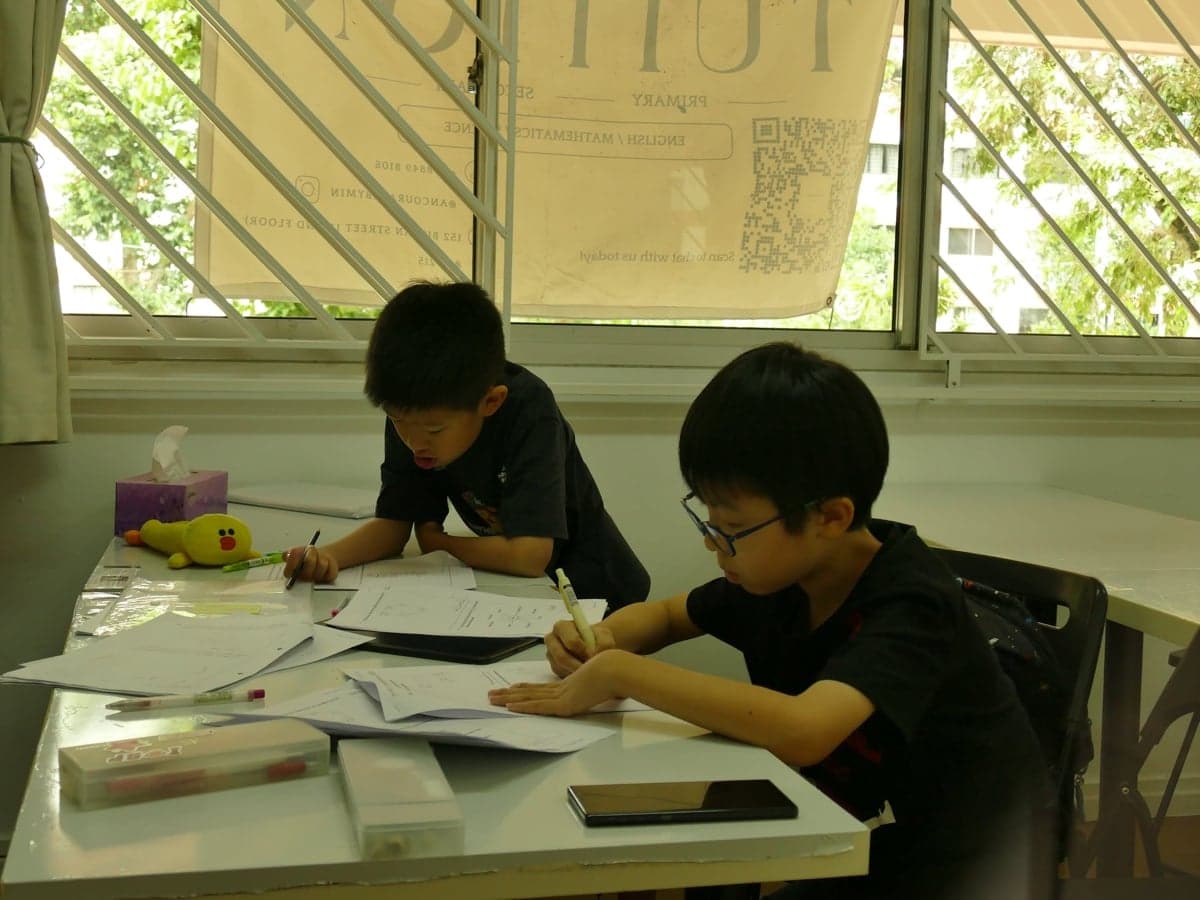
PSLE English Paper 2 contains three cloze components — Vocabulary Cloze in Booklet A (5 multiple-choice marks), Grammar Cloze in Booklet B (10 marks) and Comprehension Cloze in Booklet B (15 marks) — and Ancourage Academy's analysis shows technique matters more than vocabulary size. Together they carry 30 of Paper 2's 90 marks. Many students treat the cloze sections the same way — reading the passage quickly and filling in what "sounds right." This approach works for easy blanks but fails for the trickier ones that distinguish AL 1-2 students from AL 3-4 students.
As Early Childhood & Primary Education Specialist at Ancourage Academy, Charmaine teaches cloze strategies to P5-P6 students every week in primary English tuition classes. The difference between a student who scores 8/15 and one who scores 13/15 on cloze is almost never vocabulary size — it is technique. Students who learn to identify contextual clues, eliminate wrong answers systematically, and check for grammar consistency score significantly higher. This guide covers each cloze type with the specific techniques that work.
What Are the Three Cloze Components in PSLE English?
PSLE English Paper 2 contains three cloze components: Vocabulary Cloze in Booklet A (5 multiple-choice items, 5 marks), Grammar Cloze in Booklet B (10 items, 10 marks, answered from a box of 15 words) and Comprehension Cloze in Booklet B (15 open-ended items, 15 marks).
- Vocabulary Cloze (Booklet A, 5 marks): Five multiple-choice blanks set in a short passage, each with a list of options — students choose the word whose meaning fits the context. It is the only cloze component that is multiple-choice.
- Grammar Cloze (Booklet B, 10 marks): A short passage with 10 blanks and a lettered box of words to choose from, each used only once, with more words in the box than blanks so the extras act as distractors. SEAB classes the items as open-ended rather than multiple-choice, but the answers still come from that fixed list — follow the printed instruction on whether to write the word or its letter. The blanks test grammar rather than vocabulary: articles (a, an, the), prepositions (in, on, at), conjunctions (but, although, because), pronouns (he, she, they, it), or verb forms. The skill is matching the grammar rule to the right word in the box and eliminating the ones already used or that break the sentence.
- Comprehension Cloze (15 marks): A longer passage with blanks where students must supply a word that fits both the meaning and the grammar of the sentence. No word bank is given — students generate the word themselves, and it has to fit the passage as a whole, not just the sentence it sits in.
Grammar cloze and comprehension cloze require different strategies. Grammar cloze is rule-based — students who know the grammar rules can answer correctly even with unfamiliar vocabulary. Comprehension cloze is vocabulary-based — students need a broad vocabulary AND the ability to use contextual clues to identify the right word.
The PSLE English syllabus (0001) tests both receptive and productive vocabulary, meaning students must not only recognise words but produce them accurately in context.
How Should Students Use Context Clues in Comprehension Cloze?
The most reliable strategy for comprehension cloze is to read the entire sentence — and often the sentences before and after — to identify clues that point to the missing word.
Types of contextual clues to look for:
- Definition clues: The passage may define or explain the missing word nearby. "He felt a sense of _____, a deep sadness that would not go away." The explanation "deep sadness" defines the blank as "grief" or "sorrow."
- Synonym clues: A word with similar meaning appears in the surrounding text. "She was _____ and exhausted after the long journey." The synonym "exhausted" suggests the blank is "tired" or "weary."
- Contrast clues: Signal words like "but," "however," "unlike," "instead" indicate the blank means the opposite of something stated. "Unlike her cheerful brother, she was always _____." The contrast suggests "gloomy" or "quiet."
- Cause-effect clues: The reason or result of something points to the missing word. "Because the road was _____, the driver had to slow down." The effect (slowing down) suggests the road was "slippery," "narrow," or "winding."
- Collocation clues: Certain words naturally pair together. "She made a _____ effort" — the collocation is "great" or "tremendous." "He paid close _____" — the collocation is "attention."
Book a trial class (usually $18) at Ancourage Academy for a diagnostic of your child's cloze skills — Bishan or Woodlands, small groups of 3-6.
Grammar Cloze: Rules That Appear Most Often
Grammar cloze blanks follow predictable patterns — the same 8-10 grammar rules account for the vast majority of blanks across all PSLE papers.
| Grammar Rule | What to Look For | Example |
|---|---|---|
| Articles (a/an/the) | Is the noun specific (the) or general (a/an)? | "She picked up ___ apple from the table." |
| Prepositions (in/on/at/to/for) | Time, place, or direction context | "The meeting is ___ Monday." |
| Conjunctions (but/because/although/so) | Relationship between clauses (contrast, cause, addition) | "She was tired ___ she kept working." |
| Pronouns (he/she/it/they/them) | What noun does the pronoun replace? | "The children finished ___ homework." |
| Subject-verb agreement | Singular or plural subject? | "Each of the students ___ given a book." |
| Tense consistency | What tense is the surrounding passage in? | "She walked home and ___ (cook) dinner." |
| Relative pronouns (who/which/that) | Is the blank referring to a person or thing? | "The boy ___ won the prize was happy." |
| Quantifiers (much/many/few/some) | Countable or uncountable noun? | "There were not ___ people at the park." |
Students who memorise these eight patterns and practise identifying them quickly can answer most grammar cloze blanks with confidence. The PSLE editing guide covers many of the same grammar rules in more detail.
How to Eliminate Wrong Answers Systematically
When unsure of the answer, systematic elimination is more reliable than guessing — start by determining the word type required, then narrow down possibilities.
- Identify the word type: Read the sentence structure. Does the blank need a noun, verb, adjective, adverb, preposition, or conjunction? This eliminates most wrong options immediately.
- Check grammar constraints: If the blank needs a verb, what tense? If a noun, singular or plural? If an adjective, positive or negative?
- Read the full sentence with your answer: Does the sentence make complete sense grammatically and logically?
- Check against surrounding sentences: Does your answer maintain the overall meaning and tone of the passage?
For comprehension cloze specifically, if the first word that comes to mind does not fit grammatically, think of synonyms. "Happy" does not fit? Try "pleased," "delighted," "glad." The right synonym will match both meaning and grammar.
Common Cloze Traps and How to Avoid Them
PSLE cloze passages contain deliberate traps that catch students who rely on "what sounds right" rather than systematic analysis.
- Near-synonyms: Two words that mean almost the same thing but only one fits the grammar. "Effective" vs "effectively" — one is an adjective, the other an adverb. Check the word type required.
- Tense shifts: A passage mostly in past tense may contain one sentence in present tense for emphasis or dialogue. Students who default to past tense for all blanks miss this.
- Collocation traps: "Do homework" not "make homework." "Take a photograph" not "capture a photograph." Collocations must be learned through exposure, not logic.
- Spelling variants: In comprehension cloze, a correctly identified word spelled wrongly scores zero. "Occassion" (wrong) vs "occasion" (right). If unsure of spelling, choose a simpler synonym you can spell correctly.
- Double blanks: Some sentences have two blanks that depend on each other. Solve the easier blank first, then use it to determine the harder one.
Practice Method: Building Cloze Accuracy Over Time
Cloze accuracy improves through a combination of targeted grammar drills, vocabulary expansion, and regular passage practice — not just doing paper after paper.
- Grammar drills (2-3 times per week): Practise the eight grammar rules from the table above with fill-in-the-blank exercises. Focus on one rule per session until it becomes automatic.
- Vocabulary building through reading: Daily reading is the single best way to build the vocabulary that comprehension cloze requires. Encourage your child to note unfamiliar words and look up their meaning in context.
- Cloze-specific practice: Do 2-3 cloze passages per week, alternating between grammar cloze and comprehension cloze. After each practice, review every answer — including correct ones — to understand why each word fits.
- Error tracking: Keep a list of cloze errors by type (grammar rule, vocabulary gap, spelling, or misread context). This reveals patterns that targeted practice can address.
At Ancourage Academy, cloze practice is woven into weekly P5 and P6 English sessions alongside comprehension and composition work.
How Ancourage Academy Teaches Cloze Techniques
Ancourage Academy's approach to cloze is diagnostic: the first step is identifying whether a student's cloze errors are primarily grammar-based, vocabulary-based, or technique-based — because each requires a different intervention.
A student who consistently gets grammar cloze wrong needs rule reinforcement. A student who struggles with comprehension cloze needs vocabulary building and contextual clue training. A student who knows the right answer but spells it wrong needs a targeted spelling programme.
With small groups of 3-6, tutors at Ancourage Academy can observe each student's cloze process in real time — noting whether they read the full sentence, check grammar constraints, and use elimination techniques. This level of individual feedback is difficult in a class of 30-40 students.
Book a trial class (usually $18) at Bishan or Woodlands — or WhatsApp Ancourage Academy to discuss your child's PSLE English preparation.
Common Questions About PSLE Cloze Passages
How many marks is the cloze section worth in PSLE English?
Grammar Cloze is worth 10 marks and Comprehension Cloze 15, both in Booklet B — 25 marks between them. Adding the 5-mark Vocabulary Cloze in Booklet A brings all three cloze components to 30 of Paper 2's 90 marks, as set out in the SEAB syllabus. Because cloze answers are either right or wrong (no partial marks), accuracy is critical — every correct answer counts.
Is grammar cloze or comprehension cloze harder?
This depends on the student. Students with strong grammar but limited vocabulary find comprehension cloze harder. Students with broad vocabulary but weak grammar find grammar cloze harder. The key is diagnosing which type causes more errors and targeting practice accordingly.
How can my child improve comprehension cloze quickly?
The fastest improvement comes from learning the five contextual clue types (definition, synonym, contrast, cause-effect, collocation) and practising them deliberately. Do 3-4 comprehension cloze passages per week with explicit attention to identifying clues before filling in blanks. Also, daily reading of 15-20 minutes builds the vocabulary base that comprehension cloze depends on.
Should my child memorise vocabulary lists for cloze?
Memorising isolated word lists is less effective than learning words in context through reading. However, learning common collocations (word pairs that naturally go together) IS useful for cloze — "make a decision" (not "do a decision"), "heavy rain" (not "strong rain"), "pay attention" (not "give attention"). A collocation journal is more useful than a vocabulary list.
What if my child knows the right word but spells it wrongly?
In comprehension cloze, a misspelled word scores zero even if the intended word is correct. If your child frequently loses marks to spelling, build a "commonly misspelled words" list from past cloze errors and practise those specific words. When unsure of a spelling during the exam, choose a simpler synonym that you can spell with confidence.
Visit Ancourage Academy at Bishan or Woodlands, check primary English courses, or WhatsApp us with any questions.
Related: PSLE Comprehension Guide · PSLE Editing Guide · PSLE Oral 2026 Guide · Scoring in PSLE English · PSLE Composition Guide · Primary English Tips · How to Score Well in PSLE · What's changing in PSLE 2026 · PSLE Synthesis and Transformation Guide