
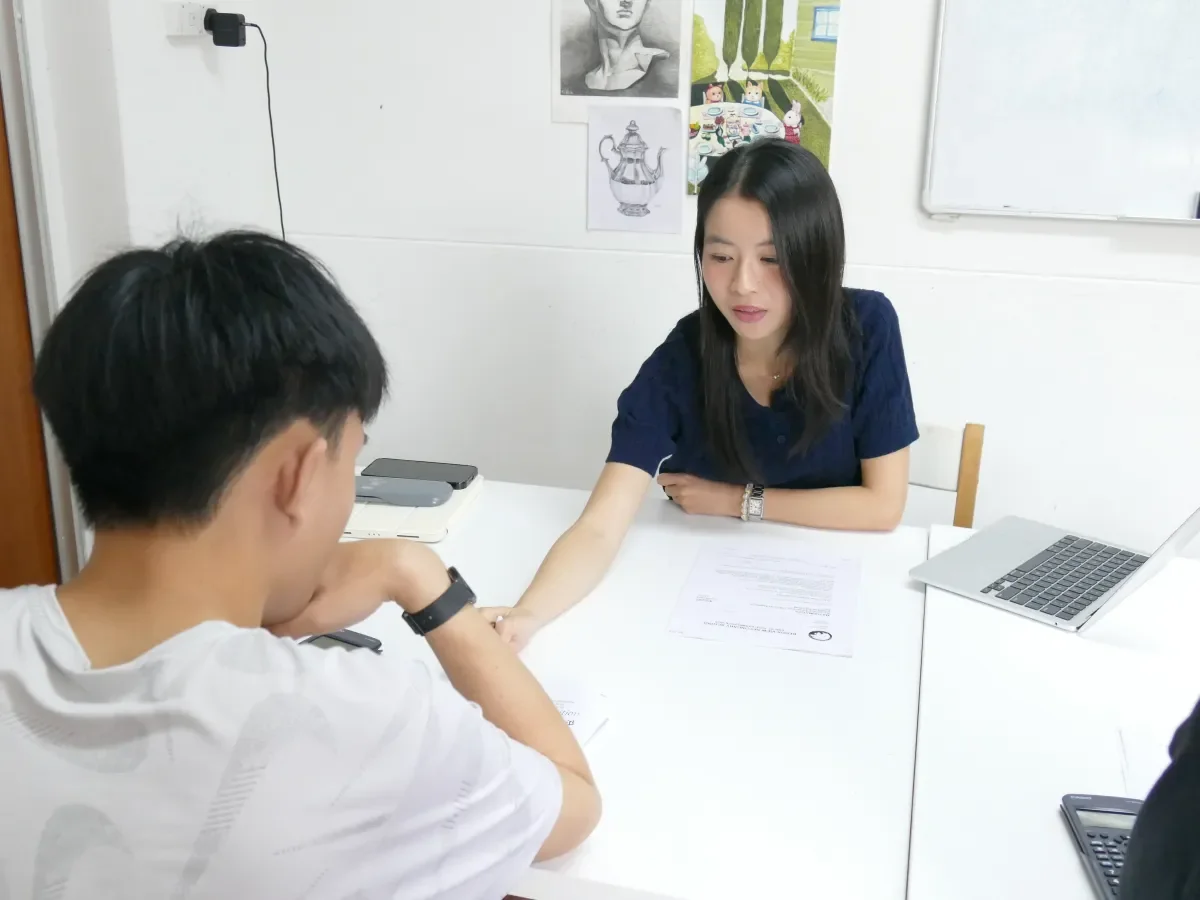
Ancourage Academy in Bishan helps Primary 1 and Primary 2 (P1-P2) students build the English language foundations that every subsequent year of school depends on. Ancourage Academy's small groups of 3-6 students and ESB (Ebbinghaus, Socratic, Bruner) methodology allow tutors to catch phonics gaps, reading hesitancy, and early writing difficulties at the exact stage where intervention is most effective — before these gaps widen into composition and comprehension problems at upper primary.
With 8 years of experience in early childhood and primary education, Charmaine has guided hundreds of P1-P2 students through the critical transition from learning to read to reading to learn — the shift that defines whether a child enters P3 with confidence or with compounding gaps.
The first two years of primary school determine a child's relationship with English for the rest of their education. P1-P2 is when children move from decoding letters and sounds to constructing sentences, reading passages, and expressing ideas in writing. For Bishan parents, getting these foundations right means your child enters middle primary ready for the composition and comprehension demands that begin in P3. This guide explains what P1 and P2 English covers, what to watch for at home, and how schools in your neighbourhood approach early English learning.
Why Lower Primary English Matters
English is the medium of instruction for every other subject in Singapore's education system — Mathematics word problems, Science explanations, and Social Studies texts all require English reading comprehension. A child who struggles with English at P1-P2 does not just fall behind in one subject; they fall behind across the entire curriculum.
The MOE primary English syllabus follows a spiral curriculum where P1-P2 skills form the base that every subsequent year builds upon. Phonics mastery enables independent reading. Sight word fluency enables comprehension speed. Sentence construction enables paragraph writing. Each skill is a prerequisite for the next, and gaps left open at P1-P2 do not stay the same size — they compound as curriculum demands increase.
Teaching experience and educational consensus support that children who read fluently by the end of P2 are better positioned across all subjects by P4. The reason is straightforward: fluent readers spend their cognitive energy understanding content rather than decoding words. A child still sounding out words at P3 cannot simultaneously analyse a comprehension passage or plan a composition.
Ancourage Academy's Bishan Centre for P1-P2 English
If your child needs English support, Ancourage Academy at the Bishan centre offers targeted Primary English tuition in small groups of 3-6 — book a trial class (usually $18) for a diagnostic assessment of your child's reading and writing level.
The centre is located at 152 Bishan St 11, approximately 10 minutes' walk from Bishan MRT (NS17/CC15), near Junction 8. KCPPS, Ai Tong, and Catholic High Primary are all within the Bishan-Ang Mo Kio area (District 20), making after-school sessions logistically convenient. Many parents drop off their children directly after school dismissal.
P1 English: What Children Learn
Primary 1 English focuses on three foundational pillars: phonics, sight words, and basic sentence construction. These are the building blocks that determine whether a child becomes a confident reader or develops avoidance behaviours around English text.
Phonics
Phonics teaches children to decode unfamiliar words by sounding out individual letters and letter combinations. By the end of P1, children should be able to blend consonant-vowel-consonant (CVC) words independently (cat, dog, sit), recognise common digraphs (sh, ch, th, wh), and attempt unfamiliar words using phonetic strategies rather than guessing from pictures or context alone.
The most common P1 phonics gap Ancourage Academy tutors see is vowel confusion — particularly between short vowels (bat vs bet vs bit vs bot vs but). Children who cannot distinguish these sounds reliably will misread words throughout primary school. Ancourage Academy's P1 English programme uses multi-sensory phonics activities to make these distinctions concrete and memorable.
Sight Words
Sight words are high-frequency words that children must recognise instantly without sounding out — words like "the," "said," "because," "would," and "through." These words often do not follow regular phonics rules, so they must be memorised through repeated exposure.
By the end of P1, a child should recognise approximately 100-150 sight words automatically. This fluency is critical because sight words make up roughly 50-75% of any English text. A child who must pause to decode "because" or "would" every time they encounter it reads so slowly that comprehension suffers — they forget the beginning of the sentence by the time they reach the end.
Sentence Construction
P1 sentence construction starts simple: subject + verb + object. "The cat sat on the mat." By mid-P1, children learn to expand sentences with adjectives ("The big cat sat on the blue mat") and time connectors ("Yesterday, the big cat sat on the blue mat"). By the end of P1, children write 3-4 sentence paragraphs based on picture prompts.
For Bishan families where Chinese is the dominant home language, sentence construction is where English gaps first become visible. Chinese sentence structure differs fundamentally from English — word order, tense marking, and article usage all work differently. A child who thinks in Chinese may write "Yesterday cat sit mat" because that structure makes perfect sense in Chinese grammar. Early correction of these patterns prevents them from becoming ingrained habits. For the full P1-P4 English guide, see Primary English Tuition in Bishan.
P2 English: The Reading-to-Writing Transition
P2 is the pivotal year when English shifts from a decoding exercise to a communication tool — children move from learning to read to reading to learn, and from writing sentences to writing paragraphs with purpose.
The P2 English curriculum introduces several demands that represent a genuine difficulty jump from P1:
- Paragraph writing: Students must write coherent 4-6 sentence paragraphs with a topic sentence, supporting details, and a concluding sentence. This requires planning and sequencing skills that P1 does not demand
- Basic comprehension passages: For the first time, students answer questions about texts they read independently — locating information, making simple inferences, and understanding vocabulary in context
- Grammar in context: Tenses (simple past, simple present, present continuous), prepositions, and conjunctions (and, but, so, because) must be used correctly in writing, not just identified in isolation
- Expanded vocabulary: P2 expects children to use precise words — "sprinted" instead of "ran," "enormous" instead of "big" — and to understand descriptive language in passages
The most telling P2 gap is the difference between reading ability and writing ability. Many P2 students can read grade-level texts fluently but cannot produce written sentences at the same level. They understand what they read but cannot express equivalent ideas in their own writing. Ancourage Academy's P2 English programme bridges this gap systematically, moving students from guided sentence expansion to independent paragraph writing.
For detailed advice on P1 readiness including English, see Preparing for Primary One in Singapore.
Bishan Primary Schools and Lower Primary English
Bishan's primary schools each have distinct cultures and programmes that shape how young students experience English learning. Understanding your child's school environment helps Ancourage Academy tutors tailor support to complement rather than duplicate what they receive in class.
Kuo Chuan Presbyterian Primary School (KCPPS)
KCPPS runs E-Cube (Engage, Excite, Express), an Applied Learning Programme MOE registers in the Languages domain. It develops confident communicators through drama and choral reading, with Primary 3 to 5 pupils co-writing their skits on social issues with their teachers and presenting them to the public. At lower primary, KCPPS students typically develop strong oral confidence and a positive attitude toward reading.
Where KCPPS P1-P2 students sometimes need support:
- Phonics-to-spelling transfer: Strong readers may rely on visual memory rather than phonetic strategies, causing inconsistent spelling of unfamiliar words
- Structured writing: The creative, expressive culture can mean students write enthusiastically but without the sentence-level precision that upper primary demands
- Grammar rule awareness: Students who read widely develop good instincts but may not understand why a sentence is correct, which limits their ability to self-correct errors in formal writing
Ai Tong School
Ai Tong is a SAP (Special Assistance Plan) school under the Singapore Hokkien Huay Kuan, where every pupil takes Chinese or Higher Chinese alongside English. The school develops exceptional bilingual ability, but the additional Chinese curriculum hours mean P1-P2 students at Ai Tong receive proportionally less English immersion than peers at non-SAP schools.
Where Ai Tong P1-P2 students often need support:
- Active English vocabulary: Students may understand English words when reading but lack the active vocabulary to use them in writing and conversation
- English sentence patterns: Chinese grammar structures (missing subjects, no tense conjugation, different word order) can transfer into early English writing
- Reading fluency speed: Students comfortable reading Chinese may read English texts more slowly, affecting their enjoyment and willingness to read independently
Catholic High School (Primary)
Catholic High is an all-boys SAP school with a reputation for academic rigour and discipline. At lower primary, Catholic High boys are typically well-behaved, responsive to structured activities, and motivated by competition and recognition.
Where Catholic High P1-P2 students often need support:
- Expressive writing: Disciplined environments can make boys cautious about taking creative risks in writing — sentences may be grammatically correct but lack descriptive detail
- Reading for pleasure: If reading feels like a task rather than a choice, boys may develop technically competent reading without genuine engagement, which limits vocabulary growth
- English oral confidence: In a Chinese-dominant SAP environment, some P1-P2 boys are hesitant to speak English at length, affecting oral communication development
Home Reading Strategies for P1-P2
Daily reading at home is the single most impactful habit parents can establish during P1-P2 — more effective than any worksheet or drill for building vocabulary, comprehension, and a positive relationship with English.
- Read aloud together (15-20 minutes daily): For P1, read to your child and have them follow along. For P2, take turns — you read a page, they read a page. This builds fluency, models expression, and exposes children to sentence patterns more complex than what they can produce independently
- Let your child choose books: Children who select their own reading material read more willingly and for longer. Bishan Public Library's children's section has excellent selections across reading levels. Even comics and graphic novels build vocabulary and reading stamina
- Ask questions, not quizzes: After reading, ask open-ended questions: "What do you think will happen next?" or "Why do you think the character did that?" This builds comprehension skills naturally without turning reading into a test
- Create an English-rich environment: Label items around the house in English. Play English audiobooks during car rides. Watch English-language shows with subtitles. For families where Chinese is the dominant home language, these ambient exposures supplement the structured English learning that happens at school
- Keep a word journal: When your child encounters a new word — in a book, on a sign, or in conversation — write it in a small notebook with a simple definition and a sentence. Review previous entries weekly. This builds vocabulary systematically without the tedium of memorising word lists
"The P1-P2 children who improve fastest are the ones who read for 15-20 minutes every night at home — not as homework, but as a routine they enjoy," notes Charmaine, Early Childhood & Primary Education Specialist at Ancourage Academy. "Parents do not need to teach grammar or run spelling tests. Just reading together builds the language instincts that make everything else easier."
For more strategies on building English foundations early, see Building Strong Language Foundations.
Signs Your Child Needs English Support Early
Early intervention at P1-P2 is far more effective than remediation at P3-P4, because language habits formed in the first two years of school become increasingly difficult to change. Consider seeking English support if your child shows any of these patterns:
- Reading avoidance: Your child resists reading English books, makes excuses to stop reading, or consistently chooses Chinese books over English ones. This suggests reading English feels effortful rather than enjoyable
- Guessing instead of decoding: When encountering an unfamiliar word, your child guesses based on the first letter or the picture rather than sounding it out. This indicates phonics foundations are incomplete
- Oral hesitancy: Your child speaks confidently in Chinese but gives one-word or fragmented English responses. At P1-P2, children should be able to speak in complete English sentences, even if grammar is imperfect
- Writing reluctance: Your child can dictate ideas verbally but resists putting them in writing, or produces sentences far below their speaking ability. This gap often signals difficulty with spelling, grammar rules, or the physical act of writing
- Comprehension disconnect: Your child reads aloud fluently but cannot answer simple questions about what they just read. Fluent decoding without understanding is a common pattern that worsens rapidly if unaddressed
- Consistent below-average results: If your child scores more than 10% below the class average in English across multiple assessments, the gap is real and likely to widen without targeted support
For a comprehensive guide to recognising when tuition would help, see Signs Your Child Needs Tuition. You do not need to commit to long-term tuition to find out whether your child would benefit — the trial class (usually $18) at Bishan includes a diagnostic assessment where Ancourage Academy tutors evaluate your child's reading, writing, and phonics level and give an honest recommendation.
How Ancourage Academy Approaches Lower Primary English
Ancourage Academy's ESB methodology — based on Ebbinghaus (spaced repetition), Socratic (questioning-based learning), and Bruner (scaffolded progression) — is specifically adapted for P1-P2 learners who need structured, engaging English development.
- Ebbinghaus (spaced repetition): Sight words, phonics rules, and grammar patterns are revisited at calculated intervals across lessons. Instead of drilling 20 new words in one session, children encounter 5 new words plus 15 review words — ensuring long-term retention rather than short-term memorisation that fades between lessons
- Socratic (questioning-based learning): Rather than telling children answers, tutors guide them through targeted questions. "What sound does 'sh' make? Can you find another word that starts with 'sh'?" This builds independent thinking and self-correction habits that P1-P2 children carry into every English lesson
- Bruner (scaffolded progression): P1 students start with guided sentence construction using word cards and picture prompts, progressing to independent sentence writing. P2 students move from guided paragraph frameworks to composing paragraphs independently, with scaffolding gradually removed as confidence grows
With small classes of 3-6 students, every child reads aloud during each lesson, has their writing checked in real time, and receives immediate feedback on pronunciation, grammar, and sentence structure. This level of individual attention is not possible in school classrooms of 30-40 students, where a teacher cannot listen to every child read or review every sentence.
Visit the pricing page for packages and what is included, or WhatsApp Ancourage Academy with any questions about the P1-P2 English programme. For more English reading across every primary and secondary level, browse our full English guides hub.
Common Questions About P1-P2 English Tuition in Bishan
What do P1 students typically struggle with in English?
The most common P1 English struggles are phonics gaps (difficulty blending sounds to read unfamiliar words), limited sight word recognition (pausing on common words like "said" or "because"), and sentence construction influenced by home language patterns. Children who speak predominantly Chinese at home may write sentences following Chinese grammar structure rather than English word order.
How is P2 English different from P1?
P2 introduces a significant jump in expectations. Students move from writing individual sentences to constructing coherent paragraphs (4-6 sentences). Basic comprehension passages require independent reading and answering questions. Grammar expands to include tenses, prepositions, and conjunctions used correctly in context — not just identified in worksheets. The MOE syllabus treats P2 as the year when reading transitions from a skill being learned to a tool for learning other subjects.
How much does P1-P2 English tuition cost in Bishan?
Ancourage Academy offers competitive group tuition rates for small classes of 3-6 students. Fees vary by level and frequency. Visit the pricing page for packages and what is included, or book a trial class (usually $18) to experience the teaching approach and receive a diagnostic assessment before committing.
My child reads well but writes poorly. Is that normal at P1-P2?
Yes — a gap between reading and writing ability is common and expected at P1-P2. Reading is a receptive skill (understanding language created by others) while writing is a productive skill (creating language independently). Most P1-P2 students can read texts above their writing level. However, if the gap is large — for example, reading at P2 level but writing at pre-P1 level — targeted support can help bridge it before the P3 composition demands arrive.
When should I start English tuition for my P1 child?
Start when you notice a gap forming, not when results have already declined significantly. For P1 students, the clearest signals are reading avoidance, persistent phonics confusion, and writing that is substantially below speaking ability. A trial class (usually $18) at Ancourage Academy's Bishan centre provides a diagnostic assessment — tutors evaluate your child's level and give an honest recommendation on whether tuition would help or whether targeted home reading would be sufficient. See the P1 English readiness guide for detailed benchmarks.
My P1-P2 child gets upset or shuts down during English reading at home. What can I do?
This is common in Bishan's SAP-school community, where children often feel more fluent and confident in Chinese, so English reading can feel like the harder, less rewarding task. The most important shift is relational, not academic: protect the read-aloud time as something warm and shared rather than a test. Let your child pick the books (even comics count), read the harder pages yourself so they are not set up to fail, and praise effort over accuracy. Keep sessions short — ten minutes enjoyed beats twenty-five endured. As confidence returns, fluency tends to follow. If the reluctance persists despite a gentle routine, a small group where peers are at the same level often rebuilds confidence faster than one-to-one pressure at home.
Related: P1-P4 English Tuition in Bishan · P5-P6 English Tuition in Bishan · P1 English Readiness · Building Strong Language Foundations · P2-P4 Maths in Bishan · Pricing