JC 1 H2 Maths Tuition
Ancourage Academy · JC · JC1
Content reviewed: Sep 2026
JC1 (J1) H2 Maths tuition at Ancourage Academy in Singapore (Bishan & Woodlands) offers small-group classes of 3-6 students, following Singapore's MOE A-Level syllabus. Weekly 2-hour lessons use our ESB methodology to build advanced skills in algebra, calculus, vectors, and statistics for A-Level and university preparation. "Numbers tell stories—our role is to help students read them with fluency," shares our curriculum director. Our structured approach helps students develop the mathematical maturity needed for STEM and economics pathways.
In person at our Bishan and Woodlands centres.
What Makes Us Different
Our proven teaching methodology combines evidence-based approaches for maximum learning effectiveness
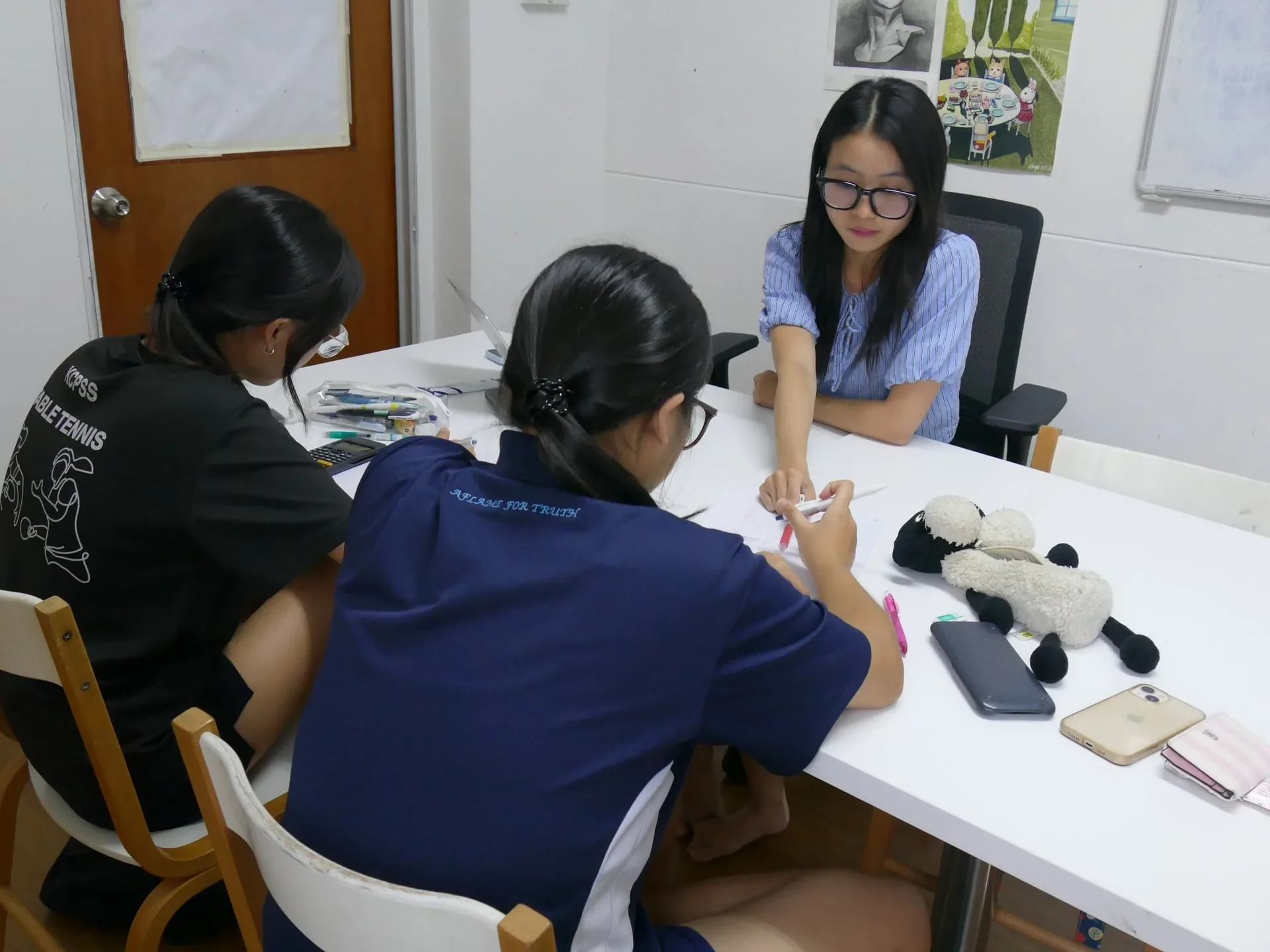
Ebbinghaus Memory Theory
Self-directed retrieval cycles across algebra, calculus, and applied topics — students identify their weakest areas through diagnostic tests and schedule targeted reviews, building the metacognitive discipline needed for A-Level and university mathematics.
Socratic Questioning
Rigorous questioning on proofs and multi-step solutions — 'Is this the most efficient method?' and 'Where might this approach fail for edge cases?' — developing the precision and logical completeness expected at higher levels.
Bruner's Scaffolding
Tutors present challenging, multi-concept problems and step back — intervening only when students are genuinely stuck on a mathematical connection — preparing them to structure solutions to questions they have never encountered.
Key Learning Outcomes
Master Key Concepts
Deep understanding of core topics aligned with MOE syllabus
Critical Thinking
Develop analytical and problem-solving skills
Exam Confidence
Strategic exam techniques and time management
Consistent Results
Improved grades and academic performance
Evidence of learning appears as:
- Improved accuracy in algebraic and calculus-based questions
- Greater ability to apply mathematical concepts to real-world scenarios
- Stronger performance in school assessments and timed practices
Course Structure
Duration
2 hours per lesson
Full coverage with interactive learning time
Class Size
3-6 students per class
Close guidance, timely feedback, and ample practice
Materials
All materials provided
No material fees — all worksheets and resources included
Curriculum Overview
- ✓Functions and graphs — Analysing functions (polynomial, rational, exponential, logarithmic, trigonometric); transformations, asymptotes, and solving inequalities; sketching and interpreting graphs.
- ✓Sequences and series — Arithmetic and geometric progressions; sum to n terms; convergence of infinite geometric series; sigma notation; recurrence relations.
- ✓Algebra — Mastery of binomial expansions, partial fractions, and inequalities; solving higher-order equations with precision.
- ✓Calculus — Differentiation and integration of polynomial, exponential, logarithmic, and trigonometric functions; Maclaurin series; differential equations by separation of variables; applications to gradients, maxima/minima, kinematics, and area/volume.
- ✓Trigonometry — Advanced trigonometric identities, equations, and applications in problem-solving.
- ✓Vectors — Representation of vectors in 2D and 3D; scalar and vector products; vector equations of lines and planes; applications to geometry, mechanics, and finding areas.
- ✓Complex numbers — Cartesian form; operations, conjugate roots, Argand diagrams, and solving polynomial equations.
- ✓Probability and statistics — Permutations, combinations, probability distributions, sampling, hypothesis testing, correlation, regression, and use of normal distribution.
- ✓Mathematical modelling — Applying mathematics to interpret real-world contexts, evaluating assumptions and limitations.
- ✓Examination readiness — Familiarity with H2 Mathematics exam format (Paper 1 and 2), step-by-step solution presentation, efficient time management, and strategies for non-routine problem-solving.
What JC1 H2 Maths students commonly work on
- 1
Algebraic rigour — mastering complex manipulations with precision and without shortcuts
- 2
Integration techniques — recognising which method to apply (substitution, by parts, partial fractions)
- 3
Vectors in 3D — visualising and solving problems involving lines and planes in space
- 4
Connecting Pure Maths and Statistics — applying calculus concepts to probability distributions
- 5
Non-routine problems — structuring approaches to questions that combine multiple topics
Learning Progression
Builds On
O-Level A-Maths with strong foundations in algebra, trigonometry, and differentiation
Prepares For
GCE A-Level H2 Mathematics examination and STEM degrees at university
Key Transition
H2 Maths demands mathematical maturity — students must develop fluency with abstraction and recognise deep connections across topics.
“The jump from O-Level to H2 Mathematics catches many students off guard — the pace doubles and the abstraction deepens. Students who build strong calculus and statistics foundations in JC1 avoid the frantic catching-up that makes JC2 revision so stressful.”
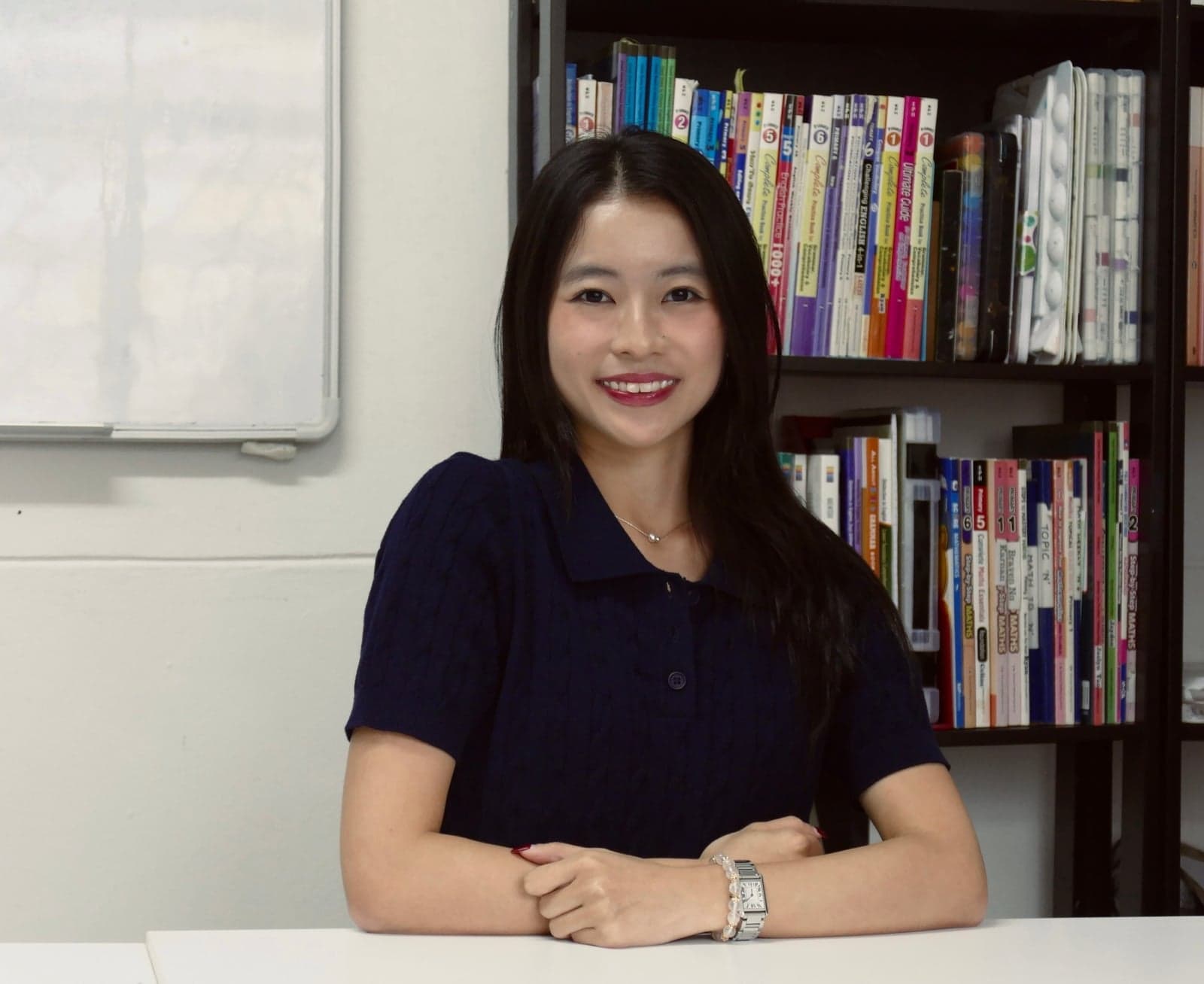
Founder & Academic Director
Related Courses
Explore other courses that complement your learning journey
JC1 H2 Physics
H2 Physics applies mathematical concepts to physical phenomena
JC1 H2 Chemistry
H2 Chemistry requires strong mathematical foundations for calculations
JC2 H2 Maths
Continue to A-Level preparation with intensive exam strategies
JC 1 H1 Maths
Same subject family: JC1 · H1 track.
JC 2 H1 Maths
Same subject family: JC2 · H1 track.
JC 1 H2 Economics
Recommends this course as a related programme.
Frequently Asked Questions
Yes, H2 Maths is substantially more demanding. It covers more topics at greater depth, including vectors in 3D, advanced integration techniques, and complex probability distributions. Strong A-Maths foundations are essential, but JC1 requires building new skills and mathematical maturity. Our JC Math tuition provides the structured support students need for this transition, whether at the H1 or H2 level. Read our H2 Mathematics guide.
Most STEM degrees (engineering, computer science, physics, chemistry) and quantitative social sciences (economics, data science) require or strongly prefer H2 Maths. Medical schools accept H1 Maths, but H2 demonstrates stronger analytical capability.
We build algebraic fluency through systematic practice and teach students to approach proofs and derivations methodically. Small group settings allow us to identify conceptual gaps early and address them before they compound.
JC1 H2 Maths lessons run in small groups of 3-6 students, with 2-hour weekly sessions. Trial lessons are currently free (usually $18). Contact us for the full schedule and current fee structure for our Bishan and Woodlands centres.
Yes. H2 Maths is substantially more demanding, covering vectors in 3D, complex numbers, advanced integration techniques, Maclaurin series, and differential equations — none of which appear in H1. Our H2 Maths tuition develops the mathematical maturity and rigour needed for STEM and economics pathways at university, while H1 focuses on applied statistics and basic calculus. Read our H2 Mathematics guide.
Absolutely — our Woodlands centre at Vista Point is well-connected by the Thomson-East Coast Line (Woodlands South MRT, 5-minute walk). JC1 H2 Maths students from Yishun Innova Junior College and estates across Woodlands, Yishun, Admiralty, and Sembawang attend our classes to develop problem-solving skills through the CPA (Concrete-Pictorial-Abstract) approach. Start with a trial class.
Our small-group classes are capped at 6 students and typically run 3 to 6, so every learner receives close guidance, timely feedback, and ample practice.
Each lesson is 2 hours, providing ample time for thorough coverage of topics and interactive learning.
Yes. All lesson materials and worksheets are provided and included in the fees. Students should bring regular stationery and, where applicable, school textbooks/workbooks for reference.
Yes. Our materials and pacing align with the MOE syllabus. External syllabuses (e.g. IGCSE, IB) are available upon request.
Helpful Resources for Parents
In-depth guides on preparation strategies and learning tips
H2 Mathematics JC Guide: Mastering A-Level Maths
H2 Mathematics — one of the most challenging A-Level subjects. Syllabus overview, Paper 1 and 2 structure, and proven strategies to score well.
Read more →Secondary to JC Transition: What Students Must Know
The jump from Secondary to JC is one of the toughest academic transitions. Learn what changes, how to prepare, and strategies to thrive in Junior College.
Read more →JC Tuition in Bishan: A-Level Preparation Guide
JCs near Bishan include Eunoia JC, Raffles Institution, and Catholic JC. A-Level preparation strategies across key H1 and H2 subjects.
Read more →JC Subject Combination Guide: H1 vs H2, Science & Arts
JC subject combinations determine university options. Here is how H1 and H2 levels work, what each stream offers, and which combinations align with specific degree programmes.
Read more →Deepen Your Learning
Comprehensive topic guides covering everything in this subject area.
Mathematics
Your complete guide to Mathematics education in Singapore — from Primary school foundations through Secondary E-Maths and A-Maths to JC H2 Mathematics and beyond.
Browse guide →Junior College (JC)
Navigate Junior College life in Singapore — from choosing H1/H2 subject combinations to mastering A-Level content, managing the JC workload, and preparing for university admissions.
Browse guide →Study Tips & Exam Prep
Practical study tips and exam preparation strategies that work — from effective revision techniques and time management to past year paper strategies and exam day tips for Singapore students.
Browse guide →
Ready to Get Started?
Enquire now and experience our proven teaching methodology
💬 Have questions? WhatsApp us anytime — we typically respond within 2 hours
Also from Ancourage: Art classes for kids, teens & adults →