
PSLE Mathematics success in Woodlands comes from mastering the problem-solving heuristics — the model method, guess and check, working backwards, listing systematically, and simplifying the problem — and knowing which one to apply for each question type. At Ancourage Academy Vista Point, we help District 25 students build the problem-solving confidence that converts understanding into top AL scores.
As a mathematics educator who has prepared hundreds of Woodlands students for PSLE, I share school-specific insights and strategies that work for this community's children.
PSLE Mathematics Format and Scoring
PSLE Standard Mathematics is 100 marks over two papers: Paper 1 (1 h 10 min, no calculator) carries 50 marks across Booklet A multiple-choice and Booklet B short answers, and Paper 2 (1 h 20 min, calculator allowed) carries 50 marks of short and long answers testing application and reasoning, not just computation.
Ancourage Academy's PSLE Maths programme at our Woodlands centre targets the specific problem-solving gaps Woodlands students face — book a trial class (usually $18) for a diagnostic assessment.
The paper structure (total 100 marks, 2 hours 30 minutes):
| Component | Format | Marks | Key Challenge |
|---|---|---|---|
| Paper 1 (Booklet A) | MCQs (no calculator) | ~26 | Speed and accuracy under time pressure |
| Paper 1 (Booklet B) | Short answer (no calculator) | ~24 | Working must be shown clearly |
| Paper 2 | Short + long answer (calculator allowed) | 50 | Strategy selection and multi-step reasoning |
Under the AL scoring system, every mark matters. The difference between AL2 and AL3 can be a single mark (84 versus 85). Students who master exam technique alongside content consistently outperform those who only do practice papers. Under the 2026 syllabus changes, 40 of Paper 2's 50 marks are structured and long-answer questions that test reasoning.
School-Specific Math Patterns in Woodlands
Each Woodlands primary school develops different mathematical strengths through its programmes, and effective PSLE preparation should build on — not ignore — these foundations.
- Woodlands Primary School: Play-based learning in lower primary builds strong number sense. By P5, students need structured heuristic training to bridge the gap between conceptual understanding and exam performance
- Woodlands Ring Primary School: Strong STEM focus develops logical thinking and data handling. Students often excel at pattern recognition but may need support with model drawing for word problems
- Si Ling Primary School: ALP in Environmental Science (STEM-Sustainability) develops inquiry and data-handling skills. Students sometimes need help with English-medium maths vocabulary in problem sums. Well-maintained academic discipline supports consistent practice habits
- Riverside Primary School: PlayWorks ALP nurtures critical and inventive thinking through design challenges. Students may need targeted support with abstract algebraic thinking when it appears in P5-P6
- Greenwood Primary School: The BLISS bilingual literature ALP builds close reading and reasoning aloud, encourages students to reason aloud. Students may need structured frameworks for multi-step problem sums to convert that reasoning into marks
- Fuchun Primary School: Future-ready Communicators Programme (FCP) ALP develops communication and critical thinking. Students benefit from learning systematic heuristic selection rather than relying on trial and error
- Admiralty Primary School: Character-driven approach builds resilience. Students who have strong work habits but weak strategy selection improve rapidly with targeted heuristic coaching
High-Impact Topics for PSLE Mathematics
Focus revision time on high-weightage, high-difficulty topics that appear repeatedly in Paper 2 problem sums.
| Topic | Difficulty | Common Mistake | Fix |
|---|---|---|---|
| Fractions & Ratios | High | Confusing "fraction of" vs "fraction more than" | Identify the unchanged quantity first |
| Percentage | High | Using wrong base for percentage change | Always identify "percentage of what" |
| Algebra | High | Setting up the wrong expression for the unknown | Define the unknown clearly, then translate each clause into an equation |
| Area & Perimeter | Medium | Not identifying composite shapes | Break complex shapes into rectangles and triangles |
| Whole Numbers | Medium | Careless calculation in long division | Estimation to check reasonableness |
These topics appear in SEAB PSLE papers year after year. (Note: Speed — distance-time — has moved to Secondary 1 under the 2026 syllabus and no longer appears in the PSLE paper.) Our experience shows that systematic work on these five areas produces the fastest score improvement for most Woodlands students.
The Five Heuristics Every P6 Must Master
Problem sums are not about knowing more maths — they are about choosing the right strategy for each question type. Students who recognise which heuristic to use before they start solving save time and reduce errors. These align with MOE Mathematics syllabus requirements.
- Model Drawing: Best for "before and after" problems, comparison, and fraction-of-remainder questions. Draw the models before reading the question a second time
- Guess and Check: Use when there are two unknowns with a fixed total. Organise guesses in a table to find patterns quickly
- Work Backwards: Ideal for questions that give the final result and ask for the starting value. Reverse each operation step by step
- Make a List / Table: For questions involving combinations, arrangements, or systematic counting. Prevents missed cases
- Simplification: When problems involve large numbers, try with small numbers first to find the pattern, then apply to the actual values
One Woodlands Ring Primary student came to us scoring 55 for maths. Her content knowledge was adequate — she could do the calculations. The problem was strategy selection: she applied model drawing to every question, even when guess-and-check would have been faster. After two months of targeted heuristic training, she scored 82. The maths had not changed. Her approach had.
Time Management for PSLE Mathematics
PSLE Mathematics gives 2 hours and 30 minutes across Paper 1 (1 hour 10 minutes) and Paper 2 (1 hour 20 minutes) — students who do not manage their time strategically lose marks on questions they could have solved.
Recommended time allocation:
- Paper 1 Booklet A (MCQs): Aim for roughly 1 minute per mark. Do not spend more than 3 minutes on any single question — mark it and return later
- Paper 1 Booklet B (Short answer): Show working clearly — partial marks may be awarded even when the final answer is wrong
- Paper 2 (Problem sums): Start with questions you are confident about. Attempt every question — blank answers guarantee zero marks
- Checking: Reserve 5-10 minutes per paper. Re-read questions (not just your answers) to catch misread problems
When to Start PSLE Math Preparation
Most Woodlands students benefit from starting structured PSLE Mathematics preparation in mid-Primary 5, which gives about 15 months before the PSLE Mathematics papers in late September of P6 — enough to build foundations without last-minute cramming.
A suggested timeline:
- P5 Term 1-2: Strengthen P4-P5 foundations, especially fractions and percentages
- P5 Term 3-4: Introduce heuristic strategies and practise Paper 2 problem sums
- P6 Term 1: Complete new P6 content (algebra, data analysis) while revising P5 topics
- P6 Term 2-3: Full paper practice with timed conditions and exam technique refinement
- P6 Term 4: Final revision focusing on weak areas identified through practice papers
Students who start in P6 often run out of time to fill foundational gaps while simultaneously learning new content. Starting in P5 avoids this pressure. Consider a trial class (usually $18) at Ancourage Academy Woodlands to see if our approach suits your child, or WhatsApp us with any questions.
How Ancourage Academy Prepares Woodlands Students
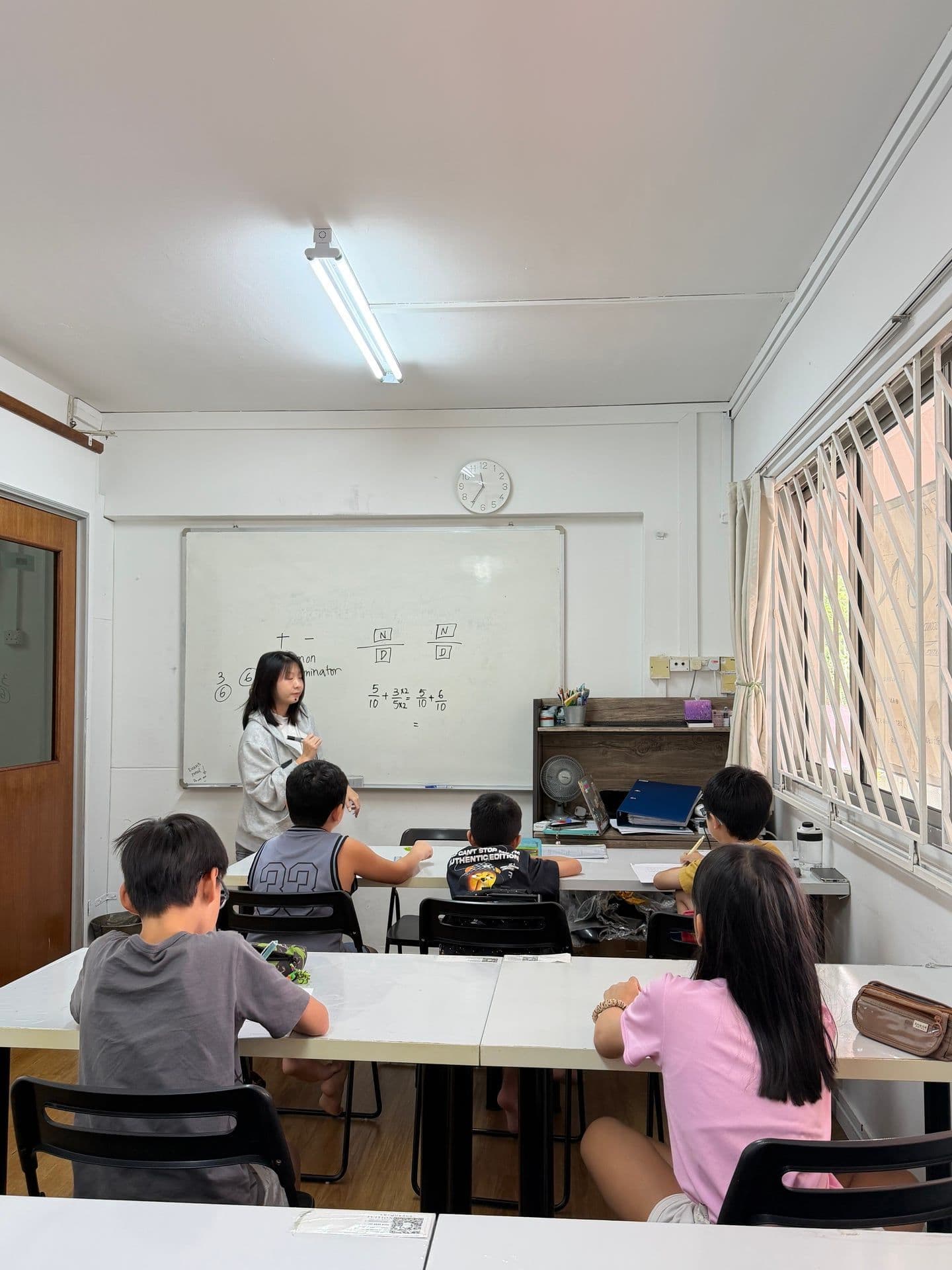
At Ancourage Academy Vista Point, our small classes of 3-6 students allow us to watch each child's working step by step — we catch the moment understanding breaks down and correct it immediately.
Our approach for PSLE Mathematics includes:
- Diagnostic assessment: Identify specific gaps before teaching begins
- School-aware teaching: We know the exam formats for Woodlands primary schools
- Heuristic mastery programme: Systematic training in strategy selection, not just calculation
- Regular parent updates: You will know exactly what your child is working on and where they stand
- Timed practice papers: Exam simulation with detailed marking and feedback
The Importance of Starting Early
PSLE Mathematics builds cumulatively — concepts from P3 and P4 directly underpin the heuristics and problem-solving methods tested at P5-P6 level. Students who struggle with fractions in P3 will find ratio and proportion in P6 significantly harder. Our P1-P6 Mathematics tuition is designed around this cumulative progression. Students weak in multiplication facts will lose time on P6 multi-step problems that require quick arithmetic within larger heuristic frameworks. Starting structured preparation in P4 or early P5 gives students time to close foundational gaps before the PSLE syllabus accelerates. By P6 Term 3, the focus should be on exam practice and timing strategy, not learning new concepts — but this is only possible if foundations were built earlier.
Common Questions About PSLE Math in Woodlands
What AL score should my child aim for in Mathematics?
AL1 (90+ marks) places your child in the top band. AL2 (85-89) and AL3 (80-84) are strong scores that open doors to good secondary schools. For most Woodlands students, improving by one AL band (for example from AL4 to AL3) is a realistic goal with structured preparation over 6-12 months.
My child scores well in school tests but struggles with PSLE-style papers. Why?
School tests often test recently taught topics. PSLE tests everything together, requiring students to identify which topic applies and which heuristic to use. This "strategy selection" skill needs specific training beyond content knowledge.
Is tuition necessary for PSLE Mathematics?
Not always. If your child consistently scores above 80 and can solve unfamiliar problems independently, self-study with assessment books may suffice. If they struggle with problem sums, make repeated common mistakes, or cannot explain their working, guided tuition from an experienced educator makes a significant difference. Read our analysis: Is Tuition Worth It?
How quickly will my child's math grades improve?
Most students see measurable improvement within 2-3 months with consistent weekly lessons. The speed depends on the nature of the gaps — conceptual issues take longer to resolve than technique issues. We set realistic expectations in our first parent consultation.
Is a small group of 3-6 better than one-to-one tuition for PSLE Maths?
For most Woodlands students, a small group of 3-6 is the more practical choice — it costs far less, and the EEF rates small-group tuition at four months' additional progress a year. At Ancourage Academy Vista Point, class sizes of three to six keep enough teacher attention to catch the moment a child's working breaks down, while peers model different heuristic choices on the same problem sum — a benefit one-to-one cannot offer. Children also build exam stamina by working alongside others under timed conditions. One-to-one suits only a narrow set of cases, such as deep conceptual gaps needing slower pacing. For more on why this format works, read our explainer on small classes of 3-6 students, then book a trial class (usually $18) so we can recommend the right fit after a diagnostic assessment.
Related: P5-P6 Maths Tuition Woodlands · P2-P4 Maths Foundations Woodlands · Math Tuition in Woodlands · Woodlands Primary Schools PSLE Guide · PSLE English for Woodlands · The model (bar) method explained · H2 Math Differential Equations guide · PSLE Maths Heuristics Guide